The prime of Ana Abad Santos
By Walter Ang
November 29, 2010
Philippine Daily Inquirer
By all accounts, Ana Abad Santos had a fulfilling 2009. "It was a good year, I got to play very strong women characters in several productions with different directors. I learned a lot," she says. She got to direct theater productions and even acted in a film or two.
As soon as 2010 came around, things got even better.
Earlier this year, she was nominated twice in a single category for the 2009 Philstage Gawad Buhay, the awards given out to productions and performers of Philstage member companies. Santos was nominated for the Best Actress in a Straight Play category for her turns as Candida Marasigan in Repertory Philippines's "A Portrait of the Artist as Filipino" and as Blanche Dubois in Tanghalang Pilipino's "A Streetcar named Desire."
The short film she acted in, "Out of Love," directed by Flora Lau, won best film at the Hong Kong International Film Festival.
And, oh yes, she just won this year's Aliw Award for Best Actress in a Non-Musical Production for her portrayal of the title role in Dulaang UP's "Mary Stuart."
"It was pretty great!" she says of the recognition. "I loved being chosen by a respected group of people and being nominated with actresses that I respect."
Growing up
Abad Santos seemed destined for a life in theater. She grew up "sleeping in hotel ballrooms" as her mother, former supermodel and fashion show director Wanda Louwallien, would tag her along to rehearsals.
"I remember having fun at my mom's shows. I loved watching everything, paying attention to what was going on," Santos says. "I even modeled once for one of my mom's shows. I loved modeling but, unfortunately, I never grew any taller," she adds with a laugh.
A trip to New York City solidified her love affair with theater. "My mom took me to see a Broadway show and I loved it. It just hit me, theater was what I wanted to do," she says.
Upon her return, Abad Santos sought out theater but "I didn't really know where to go, there weren't a lot opportunities back then to learn the craft."
Abad Santos started taking summer acting workshops at Repertory Philippines and soon debuted professionally in one of the company's productions. "I was a tree or something like that in `King and I,'" she says with a laugh.
She's been at it ever since, becoming part of Rep's stable of actors with ensemble or lead roles from Shakespeare tragedies to contemporary comedies.
At a time when theater companies were not as open in allowing cross-over appearances of actors, Abad Santos bucked convention and proceeded to appear in productions with Actors Actors and Dramatis Personae. Eventually, she also performed with World Theater Project ("King Lear"), Atlantis Productions ("Dogeaters") and UP Playwrights Theater ("Fluid") and Dulaang UP (most recently in "Shock Value").
Learning
"I wanted to see what was out there," she says. "It's important to always keep learning. You need to learn, you need to go out there. I have such a hunger to learn. You have to work with other directors, with other actors, with people you respect, to hone your craft."
She credits her former teachers at Rep for being long-lasting influences in her career as a theater artist. "Bart Guingona and Jaime Del Mundo were two of my teachers at the Rep workshops," she says. "Bart taught me the importance of doing radical works and Jaime taught me the value of the foundation work of doing the classics."
Abad Santos has also taken a post graduate course in Classical Theater at the London Academy of Music & Dramatic Art and got a chance to apply what she'd learned, this time as a director, when she was tapped to helm Rep's critically-acclaimed "Hamlet" a few years ago.
She's also directed rock opera "Bare" for Ateneo Blue Repertory, the musical "Duets" for Rep and, most recently, Rodgers and Hammerstein's musical revue "A Grand Night for Singing," for Power Plant Mall.
Doing
From student to practitioner, Abad Santos also has "teacher" as part of her list of roles. She teaches at Rep's summer workshops and at Beacon Academy for its International Baccalaureate academic program's drama subjects.
Her "hunger to learn" is insatiable it seems. And her capacity to work knows no bounds.
Abad Santos is currently taking up an online course on "professional development on teaching theater." She's also already working on her first two productions for 2011. She's rehearsing as an actress for Repertory Philippines' February staging of Amy Tan's "Joy Luck Club," where she plays one of the daughters in the story of Chinese women who've immigrated to America, and she's rehearsing as the director for Rep's March staging of "The 39 Steps," a comedy based on the Alfred Hitchcock movie.
All this learning, teaching and doing is inspired by her ten year old son, Tommy, and is driven by her desire to take an active role in developing theater for the country.
"Theater is alive here in the Philippines. It doesn't always have to be `serious.' Even if it's just to entertain or amuse, it's there," she says. "I attended a talk by playwright David Henry Hwang where he said people can find their culture and their identity in theater. I believe that. Being Filipino is tied to theater. I want people to be able to see themselves in theater. I want to bridge that gap."
Also published online:
http://lifestyle.inquirer.net/artsandbooks/artsandbooks/view/20101129-305841/The-prime-of-Ana-Abad-Santos
Aside from sports, Spain has fashion and shopping
Aside from sports, Spain has fashion and shopping
By Walter Ang
November 28, 2010
Philippine Daily Inquirer
 "If you've been to Spain," said Angela Castaño, Director of National Tourist Office of Spain, "you'll understand why our new tagline is 'I need Spain.'"
"When you experience what Spain has to offer, you'll need its food and wine, need its arts and culture, need its passion and lifestyle, need your visit to last forever."
Castaño visited Manila to invite Filipinos to include Spain in their travel plans. She noted the historical relationship between the two countries and said, "Perhaps some Filipinos see Spain as a 'historical' place and therefore 'old' place. I'm here to let everyone know that, yes, we have historical sites for you to visit, but we are also very cosmopolitan and always exciting!"
Fashion and sports
Just this past year, Spain has been in the sports spotlight with Rafael Nadal winning at Wimbledon, La Roja winning the World Cup, Alberto Contador winning the Tour de France and Barcelona hosting the 2010 European Athletics Championships.
"But we also have fashion and shopping," she said smiling. "There are so many fashion brands that are from Spain such as Mango, Zara, Springfield, Trucco, Manolo Blahnik and many others. From apparel to accessories, from footwear to jewellery and perfumes."
She recommended spring (March to May) and autumn (September to November) as the best times to visit because "the weather is nice and you can get better rates for accommodations. But those who want to catch our biggest sales of the year should go in January."
Madrid has a "golden mile" that is "home to the most prestigious Spanish brands alongside world names in luxury fashion" and the "Rastro," a street market in the city center. Barcelona has five kilometers' worth of fashion stores in its Ensanche and El Borne areas.
Castaño announced the Spain tourism office's partnership with Mango. "In the Glorietta and Rockwell branches, a P3,000 purchase will entitle you to a a raffle coupon to win a trip to Spain," she said. The promo runs until Nov 30 for a Dec 7 draw.
Culture and lifestyle
The two largest cities are the thriving capital, Madrid, and the vibrant coastal city of Barcelona.
"Madrid is exciting simply because it is Madrid. There is always something going on," she said. Madrid has the Royal Palace, the Prado Musuem, and Las Ventas, the largest Plaza de Toros (bullring) in Spain, among other tourist spots. The city is also known for its art galleries, shopping and nightlife.
Barcelona features the architecture of Antoni Gaudi, including the Sagrada Familia, recently consecrated by Pope Benedict XVI and still undergoing construction since the 1882. This city also has the Picasso Museum and Joan Miro Foundation Gallery. Miro's surrealist work is recognizable as Spain's tourism logo for 25 years now.
But, of course, there are other cities to explore. And in these different cities there are all sorts of festivals year-round that celebrate everything "from wine to wild horses." Performing arts festivals and events cover the gamut: music, opera, jazz, dance, ballet, film, books and theater.
Commerce and industry
Emerging Filipino energy industrialists might want to visit and learn from the world's largest solar thermal energy plant, La Florida, in the northern state of Navarra.
Another interesting city is Bilbao, one of Spain's main industrial centers (shipbuilding and iron and steel production) featuring a 100-year-old transporter bridge. It's a fairly "new" popular tourist destination by virtue of it being the home of the Guggenheim Musuem.
Gastronomy
Spain has its origins in the Iberian, Celtiberian, Latin, Visigothic, Roman Catholic, and Islamic cultures and this is reflected in its arts, languages, and, of course, food. The country's different regions have respective signature cuisines.
Ferran Adria, head chef of the El Bulli restaurant in Roses, Costa Brava, is one of Spain's tourism ambassadors for 2011, together with six-time kitesurfing world champion Gisela Pulido, among others.
Gourmet Magazine has dubbed Adria as "the Salvador Dali of the kitchen" and El Bulli has been named best restaurant in the world by Restaurant Magazine. Adria has built a reputation as the father of modern Spanish cuisine and as an experimentalist who crafts unexpected flavors with unconventional ingredients.
Nature and spirituality
"The Philippines has Boracay beach, so I won't mention Spain's beaches anymore," Castaño said laughing. (Though it's worth mentioning that Spain is home to Ibiza, famous for its summer club parties and Café del Mar.)
Spain has more than 300 hectares worth of national parks featuring flora, fauna and vistas not usually seen in places with tropical climates (like the Philippines) such as high-altitude deserts and sub-alpine steppes.
She noted that the Spain tourism office can recommend itineraries that allow visitors to experience a combination of whatever it is that they are looking for, whether it be shopping, nightlife, culture, food or arts, in either urban or rural settings.
Spain boasts one of the greatest collections of historical and architectural monuments in the world. The country has the second highest number of Unesco World Heritage designations in the world.
For those who seek a more spiritual itinerary, there's the pilgrimage "Way of St. James" from the east of Spain to Santiago de Compostela in the west, where the tomb of St. James the Apostle is located. This destination is considered as the world's third biggest Christian pilgrimage site, next to Rome and Jerusalem.
In 2011, Madrid will host World Youth Day, a Catholic event done every two to three years featuring a public appearance by the Pope.
Visit www.spain.info. Thai Airways flies from Manila to Spain (Madrid) via Bangkok. For bookings, call 817-5442 or 812-4812.
Also published online:
http://lifestyle.inquirer.net/sundaylifestyle/sundaylifestyle/view/20101128-305693/Aside-from-sports-Spain-has-fashion-and-shopping
By Walter Ang
November 28, 2010
Philippine Daily Inquirer

"When you experience what Spain has to offer, you'll need its food and wine, need its arts and culture, need its passion and lifestyle, need your visit to last forever."
Castaño visited Manila to invite Filipinos to include Spain in their travel plans. She noted the historical relationship between the two countries and said, "Perhaps some Filipinos see Spain as a 'historical' place and therefore 'old' place. I'm here to let everyone know that, yes, we have historical sites for you to visit, but we are also very cosmopolitan and always exciting!"
Fashion and sports
Just this past year, Spain has been in the sports spotlight with Rafael Nadal winning at Wimbledon, La Roja winning the World Cup, Alberto Contador winning the Tour de France and Barcelona hosting the 2010 European Athletics Championships.
"But we also have fashion and shopping," she said smiling. "There are so many fashion brands that are from Spain such as Mango, Zara, Springfield, Trucco, Manolo Blahnik and many others. From apparel to accessories, from footwear to jewellery and perfumes."
She recommended spring (March to May) and autumn (September to November) as the best times to visit because "the weather is nice and you can get better rates for accommodations. But those who want to catch our biggest sales of the year should go in January."
Madrid has a "golden mile" that is "home to the most prestigious Spanish brands alongside world names in luxury fashion" and the "Rastro," a street market in the city center. Barcelona has five kilometers' worth of fashion stores in its Ensanche and El Borne areas.
Castaño announced the Spain tourism office's partnership with Mango. "In the Glorietta and Rockwell branches, a P3,000 purchase will entitle you to a a raffle coupon to win a trip to Spain," she said. The promo runs until Nov 30 for a Dec 7 draw.
Culture and lifestyle
The two largest cities are the thriving capital, Madrid, and the vibrant coastal city of Barcelona.
"Madrid is exciting simply because it is Madrid. There is always something going on," she said. Madrid has the Royal Palace, the Prado Musuem, and Las Ventas, the largest Plaza de Toros (bullring) in Spain, among other tourist spots. The city is also known for its art galleries, shopping and nightlife.
Barcelona features the architecture of Antoni Gaudi, including the Sagrada Familia, recently consecrated by Pope Benedict XVI and still undergoing construction since the 1882. This city also has the Picasso Museum and Joan Miro Foundation Gallery. Miro's surrealist work is recognizable as Spain's tourism logo for 25 years now.
But, of course, there are other cities to explore. And in these different cities there are all sorts of festivals year-round that celebrate everything "from wine to wild horses." Performing arts festivals and events cover the gamut: music, opera, jazz, dance, ballet, film, books and theater.
Commerce and industry
Emerging Filipino energy industrialists might want to visit and learn from the world's largest solar thermal energy plant, La Florida, in the northern state of Navarra.
Another interesting city is Bilbao, one of Spain's main industrial centers (shipbuilding and iron and steel production) featuring a 100-year-old transporter bridge. It's a fairly "new" popular tourist destination by virtue of it being the home of the Guggenheim Musuem.
Gastronomy
Spain has its origins in the Iberian, Celtiberian, Latin, Visigothic, Roman Catholic, and Islamic cultures and this is reflected in its arts, languages, and, of course, food. The country's different regions have respective signature cuisines.
Ferran Adria, head chef of the El Bulli restaurant in Roses, Costa Brava, is one of Spain's tourism ambassadors for 2011, together with six-time kitesurfing world champion Gisela Pulido, among others.
Gourmet Magazine has dubbed Adria as "the Salvador Dali of the kitchen" and El Bulli has been named best restaurant in the world by Restaurant Magazine. Adria has built a reputation as the father of modern Spanish cuisine and as an experimentalist who crafts unexpected flavors with unconventional ingredients.
Nature and spirituality
"The Philippines has Boracay beach, so I won't mention Spain's beaches anymore," Castaño said laughing. (Though it's worth mentioning that Spain is home to Ibiza, famous for its summer club parties and Café del Mar.)
Spain has more than 300 hectares worth of national parks featuring flora, fauna and vistas not usually seen in places with tropical climates (like the Philippines) such as high-altitude deserts and sub-alpine steppes.
She noted that the Spain tourism office can recommend itineraries that allow visitors to experience a combination of whatever it is that they are looking for, whether it be shopping, nightlife, culture, food or arts, in either urban or rural settings.
Spain boasts one of the greatest collections of historical and architectural monuments in the world. The country has the second highest number of Unesco World Heritage designations in the world.
For those who seek a more spiritual itinerary, there's the pilgrimage "Way of St. James" from the east of Spain to Santiago de Compostela in the west, where the tomb of St. James the Apostle is located. This destination is considered as the world's third biggest Christian pilgrimage site, next to Rome and Jerusalem.
In 2011, Madrid will host World Youth Day, a Catholic event done every two to three years featuring a public appearance by the Pope.
Visit www.spain.info. Thai Airways flies from Manila to Spain (Madrid) via Bangkok. For bookings, call 817-5442 or 812-4812.
Also published online:
http://lifestyle.inquirer.net/sundaylifestyle/sundaylifestyle/view/20101128-305693/Aside-from-sports-Spain-has-fashion-and-shopping
Aquino Museum in Tarlac up for redesign
Aquino Museum in Tarlac up for redesign
By Walter Ang
November 22, 2010
Philippine Daily Inquirer
 Architects, interior designers, conservators, and curators are invited to join "Reawakening Democracy: Aquino Museum Redesign Competition," a contest that aims to find the best design solution for the museum that will capture the impact of Benigno "Ninoy" and Corazon "Cory" Aquino on Philippine history.
The Aquino Musuem is housed in the Aquino Center located in Tarlac. It features the Aquino family's memorabilia and a chronological depiction of how the couple "re-awakened and regained the democracy that the Philippines lost during the martial law regime:" the assassination of Senator Ninoy Aquino in 1983 that led to the emergence of the People Power revolution in 1986 and the presidency of Cory Aquino.
Opportunity
Architect and University of Santo Tomas College of Architecture professor Dan Lichauco, nephew of Mrs. Aquino, developed the design concepts for the center in 2001. The Aquino Center was originally intended to be predominantly a museum but eventually included convention facilities that are rented out to generate income for the center's maintenance and upkeep.
"The center is nine years old, although ageing gracefully since it is well maintained, it's beginning to show its age," he said. "It's also become evident that spaces originally intended to be used as offices are under-utilized. The exhibit is no longer current in chronicling the lives of both Ninoy and Cory and how they continue to influence us as a nation and race."
"The Design Completion is intended to change this," he said. "In addition to the competition, we are also hoping to establish a curatorial team that will guide the museum in the future."
The competition will be an opportunity to develop a more comprehensive coverage of the life and legacy of the late President Aquino beyond her six-year term; and to re-package the entire museum exhibition to appeal to and resonate among visitors.
The competition requires participants to submit a "creative and cost-efficient design scheme that should deliver a coherent and compelling museum-going experience, including all aspects of exhibition design, content selection, installation scheme, atmospherics and path narrative."
Support
The competition is organized by Lafarge Cement Services Philippines with the endorsement of and for the benefit of the Ninoy and Cory Aquino Foundation (NCAF), which runs the Aquino Center.
The foundation was formerly known as Benigno S. Aquino, Jr. Foundation. Mrs. Aquino worked through the foundation to engage non-governmental organizations and supported programs to strengthen cooperatives, human rights education among law enforcers, and microfinance institutions.
In 2008, the foundation launched the "iamninoy" campaign to make the former senator's values resonant among the youth. The foundation's name was changed last year after former President Aquino passed away.
"For the past many years, Republic Cement Corporation and Iligan Cement Corporation, both Lafarge companies, have made it a commitment to support landmarks of our Filipino identity," said Lafarge vice president of communications Cirilo M. Pestaño II.
"As we launch the redevelopment of the Aquino Museum, we continue our support for the preservation of the memories of two Filipino icons of democracy that have shaped Philippine history. We are extremely proud and deeply honored to take the lead in this project and keep their legacy alive for future generations."
Shared exhibit
Three finalists will be given funding to further develop their designs. The winning team will be awarded a design contract to implement its proposal.
The competition's board of judges is composed of NCAF chair Maria Elena Aquino-Cruz, NCAF trustee Dan Lichauco, Lafarge Cement Services Philippines chair Rene Sunico, Ateneo professor Ricky Abad, film director Marilou Diaz-Abaya, Cultural Center of the Philippines chair Emily Abrera, former Metropolitan Musuem director Ino Manalo, Presidential Communications Development and Strategic Planning Office undersecretary Manuel Quezon III, and Ayala Foundation executive vice president and chief operating officer Guillermo Luz.
As the Aquino Center redesigns its galleries, the Ayala Musuem will host a year-round series of exhibits of selected items from the Aquino Musuem.
"We are pleased to make these exhibits more accessible to the public," said Ayala Foundation chair Jaime Zobel de Ayala. "It is our hope that by viewing these exhibits, we will all learn to be proud to be Filipinos and to continue to collectively work hard to bring more benefits to more people."
Thanks
Ma. Elena "Ballsy" Aquino-Cruz, eldest daughter of the Aquinos, thanked the organizers of the redesign competition and said, "Dad, the glib master politician, realized his true mission in the loneliness of a prison cell and emerged a far better and stronger human being. Mom, the self-effacing housewife, was thrust into a position of leadership that she could not spurn and emerged a source of inspiration for millions. Together, as destiny would have it, they changed the face of our nation.
"The museum's narrative comprehensively covers the colorful life of Ninoy Aquino. When Mom passed on last year, the tremendous outpouring of affection and respect for her made it clear that she had accomplished far more than just continuing Dad's unfinished work. She had earned her place in the hearts and minds of our countrymen.
"It is only fitting, therefore, that the Aquino Center be re-designed and updated to reflect, as well, what it is about the person, life and legacy of Cory Aquino that inspires and animates so many. It is the interweaving of these two narratives that I hope the redesigned Museum would capture in a manner that would resonate even among those who never got to know Ninoy or Cory Aquino. We in the family continue to be overwhelmed and grateful for our fellow Filipinos' love for her to this day."
Also published online:
http://lifestyle.inquirer.net/artsandbooks/artsandbooks/view/20101122-304525/Aquino-Museum-in-Tarlac-up-for-redesign
By Walter Ang
November 22, 2010
Philippine Daily Inquirer

The Aquino Musuem is housed in the Aquino Center located in Tarlac. It features the Aquino family's memorabilia and a chronological depiction of how the couple "re-awakened and regained the democracy that the Philippines lost during the martial law regime:" the assassination of Senator Ninoy Aquino in 1983 that led to the emergence of the People Power revolution in 1986 and the presidency of Cory Aquino.
Opportunity
Architect and University of Santo Tomas College of Architecture professor Dan Lichauco, nephew of Mrs. Aquino, developed the design concepts for the center in 2001. The Aquino Center was originally intended to be predominantly a museum but eventually included convention facilities that are rented out to generate income for the center's maintenance and upkeep.
"The center is nine years old, although ageing gracefully since it is well maintained, it's beginning to show its age," he said. "It's also become evident that spaces originally intended to be used as offices are under-utilized. The exhibit is no longer current in chronicling the lives of both Ninoy and Cory and how they continue to influence us as a nation and race."
"The Design Completion is intended to change this," he said. "In addition to the competition, we are also hoping to establish a curatorial team that will guide the museum in the future."
The competition will be an opportunity to develop a more comprehensive coverage of the life and legacy of the late President Aquino beyond her six-year term; and to re-package the entire museum exhibition to appeal to and resonate among visitors.
The competition requires participants to submit a "creative and cost-efficient design scheme that should deliver a coherent and compelling museum-going experience, including all aspects of exhibition design, content selection, installation scheme, atmospherics and path narrative."
Support
The competition is organized by Lafarge Cement Services Philippines with the endorsement of and for the benefit of the Ninoy and Cory Aquino Foundation (NCAF), which runs the Aquino Center.
The foundation was formerly known as Benigno S. Aquino, Jr. Foundation. Mrs. Aquino worked through the foundation to engage non-governmental organizations and supported programs to strengthen cooperatives, human rights education among law enforcers, and microfinance institutions.
In 2008, the foundation launched the "iamninoy" campaign to make the former senator's values resonant among the youth. The foundation's name was changed last year after former President Aquino passed away.
"For the past many years, Republic Cement Corporation and Iligan Cement Corporation, both Lafarge companies, have made it a commitment to support landmarks of our Filipino identity," said Lafarge vice president of communications Cirilo M. Pestaño II.
"As we launch the redevelopment of the Aquino Museum, we continue our support for the preservation of the memories of two Filipino icons of democracy that have shaped Philippine history. We are extremely proud and deeply honored to take the lead in this project and keep their legacy alive for future generations."
Shared exhibit
Three finalists will be given funding to further develop their designs. The winning team will be awarded a design contract to implement its proposal.
The competition's board of judges is composed of NCAF chair Maria Elena Aquino-Cruz, NCAF trustee Dan Lichauco, Lafarge Cement Services Philippines chair Rene Sunico, Ateneo professor Ricky Abad, film director Marilou Diaz-Abaya, Cultural Center of the Philippines chair Emily Abrera, former Metropolitan Musuem director Ino Manalo, Presidential Communications Development and Strategic Planning Office undersecretary Manuel Quezon III, and Ayala Foundation executive vice president and chief operating officer Guillermo Luz.
As the Aquino Center redesigns its galleries, the Ayala Musuem will host a year-round series of exhibits of selected items from the Aquino Musuem.
"We are pleased to make these exhibits more accessible to the public," said Ayala Foundation chair Jaime Zobel de Ayala. "It is our hope that by viewing these exhibits, we will all learn to be proud to be Filipinos and to continue to collectively work hard to bring more benefits to more people."
Thanks
Ma. Elena "Ballsy" Aquino-Cruz, eldest daughter of the Aquinos, thanked the organizers of the redesign competition and said, "Dad, the glib master politician, realized his true mission in the loneliness of a prison cell and emerged a far better and stronger human being. Mom, the self-effacing housewife, was thrust into a position of leadership that she could not spurn and emerged a source of inspiration for millions. Together, as destiny would have it, they changed the face of our nation.
"The museum's narrative comprehensively covers the colorful life of Ninoy Aquino. When Mom passed on last year, the tremendous outpouring of affection and respect for her made it clear that she had accomplished far more than just continuing Dad's unfinished work. She had earned her place in the hearts and minds of our countrymen.
"It is only fitting, therefore, that the Aquino Center be re-designed and updated to reflect, as well, what it is about the person, life and legacy of Cory Aquino that inspires and animates so many. It is the interweaving of these two narratives that I hope the redesigned Museum would capture in a manner that would resonate even among those who never got to know Ninoy or Cory Aquino. We in the family continue to be overwhelmed and grateful for our fellow Filipinos' love for her to this day."
Also published online:
http://lifestyle.inquirer.net/artsandbooks/artsandbooks/view/20101122-304525/Aquino-Museum-in-Tarlac-up-for-redesign
Theater-in-a-backpack brings Orwell to the streets
Theater-in-a-backpack brings Orwell to the streets
By Walter Ang
November 22, 2010
Philippine Daily Inquirer
 "Imperio Animalia," despite sounding somewhat scary, is actually meant to be "an engaging and highly interactive children's play and installation art piece." It's the title of Sipat Lawin Ensemble's adaptation of George Orwell's "Animal Farm."
Orwell's allegory tells of barn animals that revolt against their human master to establish a utopia where "all animals are equal." The plot turns when the pigs start changing the rules and stealthily espouse, "but some animals are more equal than others."
SLE plans to stage its production in "nerve centers of the metro." So far, their line-up includes Market!Market! Mall (in collaboration with the "Arts in the City" program), Intramuros, UP Diliman and UP Los Banos.
In order for the group to achieve its goal of performing on the streets "for free and open to the public," SLE is seeking support, financial or otherwise, for its "theater-in-a-backpack" brand of artistry.
Backpack
The troupe was formed in 2007, though its members had been performing together in various productions since 1999 under the tutelage of Herbert Go, former artistic director of Tanghalang Pilipino and former faculty at the Philippine High School for the Arts (PHSA).
"He left the country in 2006 and we were left with nothing but ourselves and our desire to continue creating for the theatre," says SLE artistic director JK Anicoche. The group then staged a twinbill using their own resources. "Bring your own props. Bring your own costume. We mainly did it all for the love of theatre."
Thus was born the idea of making theatre readily available. "We want to put up shows where all we need to do so should fit in a backpack. This includes costumes, props, sounds and lights," he says.
All over the place
These PHSA alumni (Theater Arts majors) took the name of their school's more than 30 year old resident theatre company, Dulaang Sipat Lawin, and evolved it into Sipat Lawin Ensemble.
"We became a non-stock, non-profit organization geared towards promoting culture and the arts by involving the audience through site-specific, open space, public theatre performances," he says.
The group's works have been staged in bars, galleries, gift shops, living rooms, and, yes, public comfort rooms. "These are our playgrounds, our battlefields, in line with our vision and mission of developing an urban theatre community experience," he says. "We want to engage larger audiences in different places and make theatre relevant to the lives of more Filipinos."
Works
Recent works include a collaboration with Australian playwright David Finnigan in "To Heat You Up and Cool You Down," a national tour under Tanghalang Pilipino of National Artist for Literature F. Sionil Jose's "Progress," and a work that mixed elements of theater, opera, film, contemporary dance and music titled "Strange Pilgrims."
There are plans to stage their version of the cult Japanese movie "Battle Royale" (where a classroom of students are stranded in an island and forced to exterminate each other) next year involving 12 university theater groups. SLE has also been holding "Theater-in-a-Backpack" workshops, teaching theater throughout the country.
Meanwhile, as a progression of "Haring Tubu-l," its adaptation of Alfred Jarry's absurdist play "Ubu Roi," staged earlier this year as a commentary on the mid-year elections, SLE chose to adapt "Animal Farm" to "investigate the promises and foundation of democracy amidst post-elections Philippines."
Disguising Orwell's story as a fairy tale is deliberate. "People can relate to fairy tales," he says. "When, at first look, they see magic and spectacle, they'd be engaged to watch. Then they'd want to find out what the performance is about and what it wants to say."
Assistance needed
The group has much to say and they're saying it in a unique way. Unlike most Tagalog translations/adaptations, "Imperio Animalia" has no single translator. The troupe employs a collaborative process where all actors have inputs in the development of the text and staging devices?a method they used with success for "Haring Tubu-l."
"It's a challenge to bring theatre to middle-class and grassroots audiences who don't usually step into theaters," he says. "We create works that aren't usually supported by corporate sponsors. We want to bring our work to more people, for free if possible, but still addressing the financial needs of the production and our actors.
"We're asking if you could pledge to spare some cab fare and take the jeepney or bus instead, just for a day, or maybe miss one venti-size coffee and drink a 3-in-1 sachet for breakfast, or save on extra rice. Perhaps you can share your little extras for us to be able to bring this work into the streets. Simple gestures, little risks, and small contributions can amount to a big impact in changing people's consciousness."
"We really feel that we have an important story to tell, ideas to share, images to show. As artists, we play an important role in today's society, in creating our new history," he says. "Now we have to change the way how we create theatre."
To donate in cash or kind to Sipat Lawin Ensemble, contact 0917-500-8753. Imperio Animalia aims to run from November 2010 to January 2011.
Also published online:
http://lifestyle.inquirer.net/artsandbooks/artsandbooks/view/20101122-304528/Theater-in-a-backpack-brings-Orwell-to-the-streets
By Walter Ang
November 22, 2010
Philippine Daily Inquirer

Orwell's allegory tells of barn animals that revolt against their human master to establish a utopia where "all animals are equal." The plot turns when the pigs start changing the rules and stealthily espouse, "but some animals are more equal than others."
SLE plans to stage its production in "nerve centers of the metro." So far, their line-up includes Market!Market! Mall (in collaboration with the "Arts in the City" program), Intramuros, UP Diliman and UP Los Banos.
In order for the group to achieve its goal of performing on the streets "for free and open to the public," SLE is seeking support, financial or otherwise, for its "theater-in-a-backpack" brand of artistry.
Backpack
The troupe was formed in 2007, though its members had been performing together in various productions since 1999 under the tutelage of Herbert Go, former artistic director of Tanghalang Pilipino and former faculty at the Philippine High School for the Arts (PHSA).
"He left the country in 2006 and we were left with nothing but ourselves and our desire to continue creating for the theatre," says SLE artistic director JK Anicoche. The group then staged a twinbill using their own resources. "Bring your own props. Bring your own costume. We mainly did it all for the love of theatre."
Thus was born the idea of making theatre readily available. "We want to put up shows where all we need to do so should fit in a backpack. This includes costumes, props, sounds and lights," he says.
All over the place
These PHSA alumni (Theater Arts majors) took the name of their school's more than 30 year old resident theatre company, Dulaang Sipat Lawin, and evolved it into Sipat Lawin Ensemble.
"We became a non-stock, non-profit organization geared towards promoting culture and the arts by involving the audience through site-specific, open space, public theatre performances," he says.
The group's works have been staged in bars, galleries, gift shops, living rooms, and, yes, public comfort rooms. "These are our playgrounds, our battlefields, in line with our vision and mission of developing an urban theatre community experience," he says. "We want to engage larger audiences in different places and make theatre relevant to the lives of more Filipinos."
Works
Recent works include a collaboration with Australian playwright David Finnigan in "To Heat You Up and Cool You Down," a national tour under Tanghalang Pilipino of National Artist for Literature F. Sionil Jose's "Progress," and a work that mixed elements of theater, opera, film, contemporary dance and music titled "Strange Pilgrims."
There are plans to stage their version of the cult Japanese movie "Battle Royale" (where a classroom of students are stranded in an island and forced to exterminate each other) next year involving 12 university theater groups. SLE has also been holding "Theater-in-a-Backpack" workshops, teaching theater throughout the country.
Meanwhile, as a progression of "Haring Tubu-l," its adaptation of Alfred Jarry's absurdist play "Ubu Roi," staged earlier this year as a commentary on the mid-year elections, SLE chose to adapt "Animal Farm" to "investigate the promises and foundation of democracy amidst post-elections Philippines."
Disguising Orwell's story as a fairy tale is deliberate. "People can relate to fairy tales," he says. "When, at first look, they see magic and spectacle, they'd be engaged to watch. Then they'd want to find out what the performance is about and what it wants to say."
Assistance needed
The group has much to say and they're saying it in a unique way. Unlike most Tagalog translations/adaptations, "Imperio Animalia" has no single translator. The troupe employs a collaborative process where all actors have inputs in the development of the text and staging devices?a method they used with success for "Haring Tubu-l."
"It's a challenge to bring theatre to middle-class and grassroots audiences who don't usually step into theaters," he says. "We create works that aren't usually supported by corporate sponsors. We want to bring our work to more people, for free if possible, but still addressing the financial needs of the production and our actors.
"We're asking if you could pledge to spare some cab fare and take the jeepney or bus instead, just for a day, or maybe miss one venti-size coffee and drink a 3-in-1 sachet for breakfast, or save on extra rice. Perhaps you can share your little extras for us to be able to bring this work into the streets. Simple gestures, little risks, and small contributions can amount to a big impact in changing people's consciousness."
"We really feel that we have an important story to tell, ideas to share, images to show. As artists, we play an important role in today's society, in creating our new history," he says. "Now we have to change the way how we create theatre."
To donate in cash or kind to Sipat Lawin Ensemble, contact 0917-500-8753. Imperio Animalia aims to run from November 2010 to January 2011.
Also published online:
http://lifestyle.inquirer.net/artsandbooks/artsandbooks/view/20101122-304528/Theater-in-a-backpack-brings-Orwell-to-the-streets
'Little Women' is Rep's 2010 holiday musical
'Little Women' is Rep's holiday musical
By Walter Ang
November 18, 2010
Philippine Daily Inquirer
 A hundred eighty degree turn from the material it staged last year for its annual big musical, Repertory Philippines has gone from a suspense-thriller about people eating pies made from people (a sold-out run of "Sweeny Todd") to a decidedly more genteel, light comedy romance about the lives and loves of four sisters: Little Women.
This family musical, with music by Jason Howard, lyrics by Mindi Dickstein and book by Allan Knee, is based on the novel by American author Louisa May Alcott.
"This is a wonderful story that's appropriate for the holiday season," says director Menchu Lauchengco-Yulo. Yulo won the 2009 Philstage Gawad Buhay for Female Lead Perfomance in a Musical for her turn as Mrs. Lovett in Rep's "Sweeny Todd." Her most recent directing credit was for the musical "West Side Story."
"Audiences will see how the March sisters depend on each other as a family and how they cope as their father is away serving the American Civil War," she says. "They're a fun bunch: brash aspiring writer Jo, romantic Meg, pretentious Amy, and kind-hearted Beth. Audiences will surely be able to relate to these four little women."
Design
To further help audiences relate to the material, Yulo is collaborating with New York-based set designer Joey Mendoza to craft an acting space that "visually bridges the material's setting with the sensibilities of today's audiences."
Mendoza was a teenage Rep workshop attendee in the 1980s. He graduated into backstage work and acting roles for Rep. "My first bit in design was for a staging of the musical `You're A Good Man, Charlie Brown' in Dumaguete. I was terrible," he says with a laugh.
Mendoza moved to New York City in the early 90s and "immediately got involved with former Rep member Jorge Ortoll's spanking new theater group, Ma-Yi Theatre Company." It was here that Mendoza was able to learn from and work closely with multi-awarded set designer Loy Arcenas.
While he did other theatrical endeavors like producing the "Stage" series of albums (compilations of musical theater love songs sung by men) and the premiere cast recordings of "Heading East" (featuring Paolo Montalban) and "Bed, Boys & Beyond," designing for the theater has never left his heart.
"I belong to a family of architects/designers/artists so it's no surprise I have reverted back to my first love, the theater," he says. "Little Women's setting and period fascinates me."
Modern aesthetic
The story is set in Boston, Massachusetts in the 1860s. "While it is a period piece, we wanted something very modern about the design. I think it's essential to have a contemporary interpretation to suit the times," he says.
No one can accuse Yulo and Mendoza of being copycats. "The first thing we wanted to do was stay clear of the look of the original Broadway staging," he says.
"We wanted to magnify the story, making it as intimate as possible. I discarded anything that wasn't absolutely necessary that might clutter or distract. The set is a study in minimalism, which is ideal for the era's austere architecture and a stark contrast to the warm, cozy yet strong March family.
"When the March sisters are playing make-believe, we have a center platform to anchor the scenes but all conventional rules of space and movement are thrown out. The audience is encouraged to participate in an imaginative way. There are just enough pieces of very well appointed furniture and props that will allow them to make that leap.
Mendoza will also use silhouettes ("A very Victorian effect," he says.) to create shapes such as trees and dunes, and to imbue the necessary atmosphere.
"The script is very episodic and the best way to achieve fluid transitions is to have only essential pieces that will define the space, so that shifting to the next scenes won't be tedious or cumbersome (our theaters are not equipped with multi-million dollar hydraulics of yet). I prefer this more organic method. While spectacle is entertaining, there's something more magical about simple stage techniques.
"Ironically, this back-to-basics concept seems very modern to me. There is an elegance in this minimalism that is very modern to me."
Movement
The actors who'll be using Mendoza's set are Caisa Borromeo (Jo), Lora Nicolas (Meg), Kelly Lati (Amy) and Cara Barredo (Beth).
Multi-awarded performer Pinky Marquez will play the sisters' mother (Marmee). Marquez was last seen onstage for Rep in the musical "Fiddler on the Roof" and the children's musical "Sleeping Beauty." She has played major roles in productions such as "Magnificat," "The Vagina Monologues," "Flower Drum Song," "The Sound of Music," "Rama at Sita," and "Beauty and the Beast," among many others.
Gerard Salonga conducts the FILharmoniKA orchestra. Tuxqs Rutaquio does costume design and John Batalla does lighting design. Rem Zamora is assistant director.
The musical will be staged at Onstage Theater at the second floor of Greenbelt 1 Mall, Makati City. "We're at a convenient location for families or friends. There are many things they can do before or after watching our shows, like shopping, dining out, visiting the nearby Ayala Musuem or even simply enjoying the outdoor garden spaces as we embrace the holiday season," Yulo says.
"Little Women" runs from Nov. 20 to Dec. 12, 2010, Fridays and Saturdays at 8:00PM with matinees at 3:30PM on Saturdays and Sundays at Onstage Theater, Greenbelt 1 Mall, Makati City.
Call Repertory Philippines at 571-6926, 571-4941 or email info@repertory-philippines.com. Tickets also available at Ticketworld at 891-9999 or www.ticketworld.com.ph.
Also published online:
http://lifestyle.inquirer.net/artsandbooks/artsandbooks/view/20101108-302023/Little-Women-is-Reps-holiday-musical
By Walter Ang
November 18, 2010
Philippine Daily Inquirer

This family musical, with music by Jason Howard, lyrics by Mindi Dickstein and book by Allan Knee, is based on the novel by American author Louisa May Alcott.
"This is a wonderful story that's appropriate for the holiday season," says director Menchu Lauchengco-Yulo. Yulo won the 2009 Philstage Gawad Buhay for Female Lead Perfomance in a Musical for her turn as Mrs. Lovett in Rep's "Sweeny Todd." Her most recent directing credit was for the musical "West Side Story."
"Audiences will see how the March sisters depend on each other as a family and how they cope as their father is away serving the American Civil War," she says. "They're a fun bunch: brash aspiring writer Jo, romantic Meg, pretentious Amy, and kind-hearted Beth. Audiences will surely be able to relate to these four little women."
Design
To further help audiences relate to the material, Yulo is collaborating with New York-based set designer Joey Mendoza to craft an acting space that "visually bridges the material's setting with the sensibilities of today's audiences."
Mendoza was a teenage Rep workshop attendee in the 1980s. He graduated into backstage work and acting roles for Rep. "My first bit in design was for a staging of the musical `You're A Good Man, Charlie Brown' in Dumaguete. I was terrible," he says with a laugh.
Mendoza moved to New York City in the early 90s and "immediately got involved with former Rep member Jorge Ortoll's spanking new theater group, Ma-Yi Theatre Company." It was here that Mendoza was able to learn from and work closely with multi-awarded set designer Loy Arcenas.
While he did other theatrical endeavors like producing the "Stage" series of albums (compilations of musical theater love songs sung by men) and the premiere cast recordings of "Heading East" (featuring Paolo Montalban) and "Bed, Boys & Beyond," designing for the theater has never left his heart.
"I belong to a family of architects/designers/artists so it's no surprise I have reverted back to my first love, the theater," he says. "Little Women's setting and period fascinates me."
Modern aesthetic
The story is set in Boston, Massachusetts in the 1860s. "While it is a period piece, we wanted something very modern about the design. I think it's essential to have a contemporary interpretation to suit the times," he says.
No one can accuse Yulo and Mendoza of being copycats. "The first thing we wanted to do was stay clear of the look of the original Broadway staging," he says.
"We wanted to magnify the story, making it as intimate as possible. I discarded anything that wasn't absolutely necessary that might clutter or distract. The set is a study in minimalism, which is ideal for the era's austere architecture and a stark contrast to the warm, cozy yet strong March family.
"When the March sisters are playing make-believe, we have a center platform to anchor the scenes but all conventional rules of space and movement are thrown out. The audience is encouraged to participate in an imaginative way. There are just enough pieces of very well appointed furniture and props that will allow them to make that leap.
Mendoza will also use silhouettes ("A very Victorian effect," he says.) to create shapes such as trees and dunes, and to imbue the necessary atmosphere.
"The script is very episodic and the best way to achieve fluid transitions is to have only essential pieces that will define the space, so that shifting to the next scenes won't be tedious or cumbersome (our theaters are not equipped with multi-million dollar hydraulics of yet). I prefer this more organic method. While spectacle is entertaining, there's something more magical about simple stage techniques.
"Ironically, this back-to-basics concept seems very modern to me. There is an elegance in this minimalism that is very modern to me."
Movement
The actors who'll be using Mendoza's set are Caisa Borromeo (Jo), Lora Nicolas (Meg), Kelly Lati (Amy) and Cara Barredo (Beth).
Multi-awarded performer Pinky Marquez will play the sisters' mother (Marmee). Marquez was last seen onstage for Rep in the musical "Fiddler on the Roof" and the children's musical "Sleeping Beauty." She has played major roles in productions such as "Magnificat," "The Vagina Monologues," "Flower Drum Song," "The Sound of Music," "Rama at Sita," and "Beauty and the Beast," among many others.
Gerard Salonga conducts the FILharmoniKA orchestra. Tuxqs Rutaquio does costume design and John Batalla does lighting design. Rem Zamora is assistant director.
The musical will be staged at Onstage Theater at the second floor of Greenbelt 1 Mall, Makati City. "We're at a convenient location for families or friends. There are many things they can do before or after watching our shows, like shopping, dining out, visiting the nearby Ayala Musuem or even simply enjoying the outdoor garden spaces as we embrace the holiday season," Yulo says.
"Little Women" runs from Nov. 20 to Dec. 12, 2010, Fridays and Saturdays at 8:00PM with matinees at 3:30PM on Saturdays and Sundays at Onstage Theater, Greenbelt 1 Mall, Makati City.
Call Repertory Philippines at 571-6926, 571-4941 or email info@repertory-philippines.com. Tickets also available at Ticketworld at 891-9999 or www.ticketworld.com.ph.
Also published online:
http://lifestyle.inquirer.net/artsandbooks/artsandbooks/view/20101108-302023/Little-Women-is-Reps-holiday-musical
Dance Forum marks 15th year with "Re-performing"
Dance Forum marks 15th year with "Re-performing"
By Walter Ang
November 15, 2010
Philippine Daily Inquirer
 In celebration of the fifteenth anniversary of Dance Forum, a collaborative group of contemporary dance artists headed by Myra Beltran, a dance concert titled "Re-performing" will feature excerpts of selected choreography from her earlier works.
The concert marks Beltran's 21 years of independent contemporary dance practice. "It's also my birthday celebration," she says with a laugh.
Since Beltran's choreographic career started in 1989, she has been a moving force in shaping current contemporary dance practice in the Philippines. Notable is her push for the solo form.
She founded Dance Forum in 1995 and proceeded to pursue collaborations with artists of different disciplines such as musician Alfonso "Coke" Bolipata, Ramon Bolipata and Dr. Ramon Santos, filmmaker Carlitos Siguion-Reyna, theater director Anton Juan, visual artists Benedicto "Bencab" Cabrera, Roberto Feleo and Karen Flores, among others.
"We had to break away from the regular conceptions and conventions of `formal' dance, that is, classical ballet, not that this is not valid but it was necessary to re-consider what its assumptions were. In the process, one could evolve what could be `contemporary,'" she says.
"Independent dance practice in the Philippines necessarily had to be contemporary in approach and aesthetic and it bravely challenged some previously `untouched' premises such as where dance should be produced, the process it should take, the hierarchy inherent in how it was being produced?these things were under examination."
To further advocate contemporary dance, she converted her backyard into a studio-theater, Dance Forum Space, as an alternative venue. It has hosted works by Paul Morales, Dwight Rodrigazo, Denisa Reyes, Christine Maranan, Jojo Lucila, Enrico Labayen, and many other choreographers who are now making their mark in Philippine contemporary dance.
Enjoining others
Dance writer Joelle Jacinto has said of Beltran, "Myra is not the first to attempt a career as a dance artist putting on regular performances without the benefit of a dance company or a regular institutional sponsor, but she is definitely the only one who really persevered and has ? active years of performances to show for it."
Last year, Beltran staged "Itim Asu 1719-2009," her deconstruction of Virginia Moreno's play "The Onyx Wolf."
Beltran is also founding director and current vice chair of Contemporary Dance Network Philippines (CNDP), a group that promotes contemporary dance in the Philippines composed of
dance companies, artists, school-based organizations, critics and institutions.
CDNP hosts the annual Wifi Body Independent Contemporary Dance Festival and Contemporary Dance Map series. Earlier this year, the Contemporary Dance Map series staged "Moving Dance @ The LRT Dance Express," where over 20 dancers danced inside LRT2 trains and stations.
Body of work
The concert "Re-performing" serves as a meditation on these past accomplishments filtered by and through new choreographers and dancers.
"In a world of constant updates such as in Facebook, how would it feel to go back to an earlier work?" she says. "Works that were the first pitch in the shaping of independent contemporary dance in the Philippines. Works that were `alone' in the dance landscape. Can we understand their breakthroughs? Was it due to something that can be re-created or is it more intangible and specific to the time?"
"The works I've done over the years seem to be mostly characterized by silence. I wanted to hear myself, and I think the audience wanted the same as well. So today, we want to find out if silence is still the most radical thing in a world of constant `status updates.'"
Participating choreographers who will work with Beltran for the concert include Ava Maureen Villanueva, Herbert Alvarez, Rhosam Prudenciado Jr. Dancers will come from Airdance and U.P. Dance Company.
"Re-performing" runs on Nov. 17 8pm and Nov. 20 8pm at Dance Forum Studio, 36E West Ave., Quezon City (near Mister Kabab restaurant). Call 0917-526-9724 or 373-2947.
Also published online:
http://lifestyle.inquirer.net/artsandbooks/artsandbooks/view/20101115-303254/Dance-Forum-marks-15th-year-with-Re-performing
By Walter Ang
November 15, 2010
Philippine Daily Inquirer

The concert marks Beltran's 21 years of independent contemporary dance practice. "It's also my birthday celebration," she says with a laugh.
Since Beltran's choreographic career started in 1989, she has been a moving force in shaping current contemporary dance practice in the Philippines. Notable is her push for the solo form.
She founded Dance Forum in 1995 and proceeded to pursue collaborations with artists of different disciplines such as musician Alfonso "Coke" Bolipata, Ramon Bolipata and Dr. Ramon Santos, filmmaker Carlitos Siguion-Reyna, theater director Anton Juan, visual artists Benedicto "Bencab" Cabrera, Roberto Feleo and Karen Flores, among others.
"We had to break away from the regular conceptions and conventions of `formal' dance, that is, classical ballet, not that this is not valid but it was necessary to re-consider what its assumptions were. In the process, one could evolve what could be `contemporary,'" she says.
"Independent dance practice in the Philippines necessarily had to be contemporary in approach and aesthetic and it bravely challenged some previously `untouched' premises such as where dance should be produced, the process it should take, the hierarchy inherent in how it was being produced?these things were under examination."
To further advocate contemporary dance, she converted her backyard into a studio-theater, Dance Forum Space, as an alternative venue. It has hosted works by Paul Morales, Dwight Rodrigazo, Denisa Reyes, Christine Maranan, Jojo Lucila, Enrico Labayen, and many other choreographers who are now making their mark in Philippine contemporary dance.
Enjoining others
Dance writer Joelle Jacinto has said of Beltran, "Myra is not the first to attempt a career as a dance artist putting on regular performances without the benefit of a dance company or a regular institutional sponsor, but she is definitely the only one who really persevered and has ? active years of performances to show for it."
Last year, Beltran staged "Itim Asu 1719-2009," her deconstruction of Virginia Moreno's play "The Onyx Wolf."
Beltran is also founding director and current vice chair of Contemporary Dance Network Philippines (CNDP), a group that promotes contemporary dance in the Philippines composed of
dance companies, artists, school-based organizations, critics and institutions.
CDNP hosts the annual Wifi Body Independent Contemporary Dance Festival and Contemporary Dance Map series. Earlier this year, the Contemporary Dance Map series staged "Moving Dance @ The LRT Dance Express," where over 20 dancers danced inside LRT2 trains and stations.
Body of work
The concert "Re-performing" serves as a meditation on these past accomplishments filtered by and through new choreographers and dancers.
"In a world of constant updates such as in Facebook, how would it feel to go back to an earlier work?" she says. "Works that were the first pitch in the shaping of independent contemporary dance in the Philippines. Works that were `alone' in the dance landscape. Can we understand their breakthroughs? Was it due to something that can be re-created or is it more intangible and specific to the time?"
"The works I've done over the years seem to be mostly characterized by silence. I wanted to hear myself, and I think the audience wanted the same as well. So today, we want to find out if silence is still the most radical thing in a world of constant `status updates.'"
Participating choreographers who will work with Beltran for the concert include Ava Maureen Villanueva, Herbert Alvarez, Rhosam Prudenciado Jr. Dancers will come from Airdance and U.P. Dance Company.
"Re-performing" runs on Nov. 17 8pm and Nov. 20 8pm at Dance Forum Studio, 36E West Ave., Quezon City (near Mister Kabab restaurant). Call 0917-526-9724 or 373-2947.
Also published online:
http://lifestyle.inquirer.net/artsandbooks/artsandbooks/view/20101115-303254/Dance-Forum-marks-15th-year-with-Re-performing
The thrill of the (cheap) hunt: Marc Ablaza collects watches
The Thrill of the (cheap) hunt
By Walter Ang
November-December 2010 issue
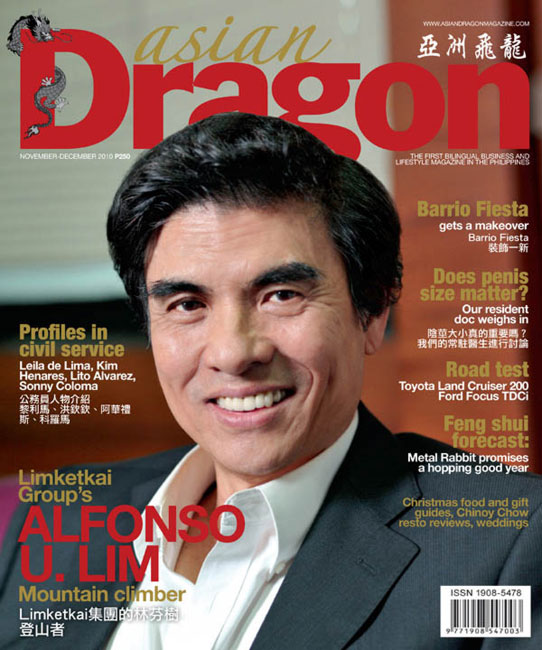
Asian Dragon Magazine
Pawnshop scion Marc Ablaza collects watches but doesn't have to dig deep into his wallet. He tells Walter Ang it's all about
The thrill of the (cheap) hunt
 When people find out that Marc Ablaza has a collection of Seiko, Citizen and Casio G-Shock wristwatches, the first question they always ask is "Why not Swiss watches?"
While he doesn't dismiss the pleasure most collectors derive from owning classic Swiss timepieces, he also points out that these are the pieces that most collectors deal with, and most of them are just in it for the resale value. "I want to be different," he says. "I'm in it for the fun of it!"
Like a kid with his stacks of gaming cards, Ablaza has an earnest gleam in his eye when he talks about his collection. Scion to the Ablaza chain of pawnshops, Marc grew up surrounded by plastic bags filled with Rolexes and an assortment of other well-known brands. He had, however, no particular attachment or fascination for them.
His first watch was given to him when he was four so he could learn to tell time. He'd occasionally be given a new watch or two while he was growing up, but the only appeal was perhaps some playground bragging rights since "it wasn't too often that you'd see a grade school student wearing a wristwatch." In high school, Ablaza discovered diving and had to acquire a chronograph wristwatch.
Of course, these days, he sings a different tune. His collection is young by most measures. In the mid-90s, he went to Hong Kong and scored a Seiko chronograph at "a fantastic value." That was the beginning of a new relationship with the brand he'd grown up with.
First off, he realized that he enjoyed Seiko's mechanical precision. He also notes the brand's "underdog" quality. "The Japanese took technology from the Swiss then made it even better," he says.
Also, he finds the historical perspective fascinating. "We were the second largest market for Japanese wristwatches for quite a while, so there are pieces out there that aren't commonly found anywhere else in the world," he says.
Unfortunately, there were quite a number of shrewd buyers who would purchase Seiko pieces in the country at cheaper prices and sell them off abroad for profit. So part of the adventure in collecting this brand is chasing down the pieces.
However, Ablaza doesn't have suspenseful stories of going down dingy side streets, or meeting suspicious men in overcoats in dark alleys to acquire new pieces. "I get all of my stuff from eBay!" he announces.
He usually starts off by shortlisting dial designs that he likes, and bids on them. If the bid goes beyond what he's willing to pay for it, he has no problem letting a piece go. "I'm attracted to parts of a wristwatch that have interesting elements," he says, listing features such as dials with unusual colors, multiple hands, and crowns and pushbuttons that are positioned in places other than the usual right side of the bezel.
Sometimes, in the course of his search, he will end up with just the dial or just the bracelet of a piece. Hunting down the corresponding part adds to the thrill. Otherwise, he'll simply match two parts that weren't originally meant for each other, or he takes a trip to his favorite craftsman to have a bracelet fashioned.
Purists needn't bother trying to get acquainted with Ablaza, since his tinkering has evolved into occasionally customizing his pieces. He'll have a dial in a non Seiko-issued color made from scratch or come up with a bracelet design just because.
Beyond surface aesthetics, Ablaza also usually has the watches' casebacks opened so he can determine the condition and type of the machine or "watch caliber," as it's called amongst watch enthusiasts. "The machine is the heart and soul of the watch," he says. "For example, chronograph seikos are complications because of the many functions the machine can do. The machines or modules on the quartz watches are a different matter altogether. The more functions a quartz watch has, the more complicated the modules."
Ablaza's collection is always anchored on two things. "I get designs that I like, since I wear all the pieces I acquire," he says, noting that some collectors never wear any of their pieces. "What's the point of that?" he wonders out loud, shaking his head.
"Importantly, they have to be cheap," he says. The low price of his watches helps keep the process fun. "I don't want to have to think or worry about where I have to source the funds to acquire a piece I like."
The choice of collecting Seiko watches isn't really about being different, but about being true to himself. "I'm not one to get a fancy expensive Omega watch that looks nice, because it's simply not me," he says.
For someone who collects watches, Ablaza confesses to not being too conscious of where he swings or places his arms. "And you know how it is, the more fancy or expensive your watch is, the faster it gets scratched as soon as you start wearing it," he says with a laugh. "So I get cheap ones. If I bang them up, it's all right."
By Walter Ang
November-December 2010 issue
Asian Dragon Magazine
Pawnshop scion Marc Ablaza collects watches but doesn't have to dig deep into his wallet. He tells Walter Ang it's all about
The thrill of the (cheap) hunt
While he doesn't dismiss the pleasure most collectors derive from owning classic Swiss timepieces, he also points out that these are the pieces that most collectors deal with, and most of them are just in it for the resale value. "I want to be different," he says. "I'm in it for the fun of it!"
Like a kid with his stacks of gaming cards, Ablaza has an earnest gleam in his eye when he talks about his collection. Scion to the Ablaza chain of pawnshops, Marc grew up surrounded by plastic bags filled with Rolexes and an assortment of other well-known brands. He had, however, no particular attachment or fascination for them.
His first watch was given to him when he was four so he could learn to tell time. He'd occasionally be given a new watch or two while he was growing up, but the only appeal was perhaps some playground bragging rights since "it wasn't too often that you'd see a grade school student wearing a wristwatch." In high school, Ablaza discovered diving and had to acquire a chronograph wristwatch.
Of course, these days, he sings a different tune. His collection is young by most measures. In the mid-90s, he went to Hong Kong and scored a Seiko chronograph at "a fantastic value." That was the beginning of a new relationship with the brand he'd grown up with.
First off, he realized that he enjoyed Seiko's mechanical precision. He also notes the brand's "underdog" quality. "The Japanese took technology from the Swiss then made it even better," he says.
Also, he finds the historical perspective fascinating. "We were the second largest market for Japanese wristwatches for quite a while, so there are pieces out there that aren't commonly found anywhere else in the world," he says.
Unfortunately, there were quite a number of shrewd buyers who would purchase Seiko pieces in the country at cheaper prices and sell them off abroad for profit. So part of the adventure in collecting this brand is chasing down the pieces.
However, Ablaza doesn't have suspenseful stories of going down dingy side streets, or meeting suspicious men in overcoats in dark alleys to acquire new pieces. "I get all of my stuff from eBay!" he announces.
He usually starts off by shortlisting dial designs that he likes, and bids on them. If the bid goes beyond what he's willing to pay for it, he has no problem letting a piece go. "I'm attracted to parts of a wristwatch that have interesting elements," he says, listing features such as dials with unusual colors, multiple hands, and crowns and pushbuttons that are positioned in places other than the usual right side of the bezel.
Sometimes, in the course of his search, he will end up with just the dial or just the bracelet of a piece. Hunting down the corresponding part adds to the thrill. Otherwise, he'll simply match two parts that weren't originally meant for each other, or he takes a trip to his favorite craftsman to have a bracelet fashioned.
Purists needn't bother trying to get acquainted with Ablaza, since his tinkering has evolved into occasionally customizing his pieces. He'll have a dial in a non Seiko-issued color made from scratch or come up with a bracelet design just because.
Beyond surface aesthetics, Ablaza also usually has the watches' casebacks opened so he can determine the condition and type of the machine or "watch caliber," as it's called amongst watch enthusiasts. "The machine is the heart and soul of the watch," he says. "For example, chronograph seikos are complications because of the many functions the machine can do. The machines or modules on the quartz watches are a different matter altogether. The more functions a quartz watch has, the more complicated the modules."
Ablaza's collection is always anchored on two things. "I get designs that I like, since I wear all the pieces I acquire," he says, noting that some collectors never wear any of their pieces. "What's the point of that?" he wonders out loud, shaking his head.
"Importantly, they have to be cheap," he says. The low price of his watches helps keep the process fun. "I don't want to have to think or worry about where I have to source the funds to acquire a piece I like."
The choice of collecting Seiko watches isn't really about being different, but about being true to himself. "I'm not one to get a fancy expensive Omega watch that looks nice, because it's simply not me," he says.
For someone who collects watches, Ablaza confesses to not being too conscious of where he swings or places his arms. "And you know how it is, the more fancy or expensive your watch is, the faster it gets scratched as soon as you start wearing it," he says with a laugh. "So I get cheap ones. If I bang them up, it's all right."
REVIEW: Campus productions tackle cruel nature of life, memory, death
Campus productions tackle cruel nature of life, memory, death
By Walter Ang
October 25, 2010
Philippine Daily Inquirer
 In our world of sensory overload through various mediums, desensitization to real life is a constant threat, if not result. Last month, the University of the Philippines' College of Arts and Letters put up three productions whose different materials and staging methods provided meditations on this implication while commemorating International Day of the Disappeared.
The college's Departamento ng Filipino at Panitikan ng Pilipinas staged a twinbill of Palanca Hall of Fame awardee Reuel Aguila's works: "Alimuom / Walang Maliw," directed by Chris Millado and its Dept. of English and Comparative Literature staged Argentine playwright Griselda Gambaro's "Information for Foreigners," directed by Anton Juan. Its Dept. of Speech Communications and Theater Arts, through Dulaang UP, staged Floy Quintos' "Shock Value," directed by Alex Cortez.
Ephemeral
Aguila's works take us into the internal and ephemeral. Staged in the intimate Tanghalang Hermogenes Ylagan, "Alimuom" (roughly: mugginess) is a monologue featuring a former military torturer inventorying the various methods he has applied in his career.
He talks of becoming used to the sights and sounds of the fallout of torture. He justifies that he'd only been following orders. A solitary length of bright orange plastic pipe coiled on the ground, a torture implement creating waves of creepy atmosphere.
Jonathan Tadiaoan deftly brought the torturer to life, though the monologue was staged in an unrelenting one-note of guilty anger, making it easy to space out at his ranting. Yes, we too became used the sights and sounds on stage, no matter the horrors being revealed.
"Walang Maliw" (roughly: unwaning) features a couple talking about their daughter who has disappeared five years hence. Names of Filipino desaparecidos (victims of forced disappearance) were written in chalk across the stage floor, setting a sharp, poignant and poetic statement: these names of real people who have disappeared that can all be easily erased with the swipe of a hand.
Millado employed a light touch with this piece, allowing Teroy Guzman (Daddy), Sherry Lara (Mommy) and Julia Enriquez (alternating with Kat Castillo) playing the daughter, Leny, to highlight Aguila's text with impactful subtlety.
The twinbill highlighted the burden of memory, the oppression of longing, and the struggle of letting go. The stark staging provided the immediacy and space to contemplate these themes.
Overload
If Aguila's work showed the inner workings of the mind and heart, Juan and assistant director/dramaturg Pat Valera's "Information for Foreigners" was all guts and gore.
Through a bacchanalia of exaggerated props, costumes (Lhenvil Paneda), lighting (Meliton Roxas) and sound (Jethro Joaquin) under Ohm David's technical direction, the show overwhelmed by using three entire floors of the College of Arts and Letters Building and bombarded audiences with scenes of torture and other acts of inhuman insanity in different classrooms and hallways.
To create the sense of loss of control, audiences were broken into groups led by tour guides through the different locations and were whisked away at turning points in scenes, some of which required audience participation. Kudos to the cast for powering through repeated performances for every group that arrives in succession and to the tour guides who had to navigate Juan's labyrinthine production while controlling large groups of people.
At one point, the novelty of going from room to room wearing off, the heat and humidity, the unyielding cacophony, the going up and down the stairs in herds had gotten to me and I thought, "How different is this from riding the MRT during rush hour and seeing, hearing and smelling Manila's brand of poverty-ridden craziness when I exit the station? What am I seeing here that I haven't already seen on TV or on the internet? This is supposed to be scary?"
Yet another instance of the numbing effect, which is very telling of the desensitizing powers of media and everyday life, despite the theatrically-configured presentation. Reality is blurred into fantasy when the production features the story of desaparecido Jonas Burgos. The enforced manner of experiencing this production leaves no time for thinking but is definitely thought-provoking through and through.
Manipulative
At the other end of the spectrum, "Shock Value" is a fluffy comedy about TV producer Matt Desaparecidos and how he orchestrates his own disappearance after becoming involved in a sex scandal that was, in turn, orchestrated by a rival. Subplots involve TV personalities as products of formulation and exploitation.
Andoy Ranay (alternating with Jojit Lorenzo) made Matt easy to hate: a self-absorbed, selfish, deceitful man-child. Mylene Dizon (alternating with Ana Abad Sanots) gives moments of earnestness to Rina Corpuz, the high-strung producer attempting to be Matt's voice of reason. Stella Canete (alternating with Frances Makil Ignacio) is a hilarious news anchor forced to compromise standards for ratings gimmicks while John Lapus (alternating with Jomari Jose) is a hilarious TV show host with no standards at all.
Cortez shows us the carnival that the broadcast industry is and Quintos makes us laugh at its ridiculousness. That this is a light comedy doesn't mean it doesn't have anything serious to say.
Quintos uses the broadcast industry as a metaphor to show us how power can be systematically abused on such a scale and to such a degree that we don't even notice it anymore or accept it as par (again, the notion of numbing).
Victims all
While the three departments didn't plan to showcase three distinct ways of presenting connected subject matter, audiences are better for it because they've been treated to a wealth of ideas to ponder on.
Social issues and history are touched on by the first two productions, but as the last production prods us to ask, despite the illusion that information is more accessible than ever, if all you watched on cable television were showbiz talk shows or all your current events news came only from your Facebook friends' shoutouts, and if all published and broadcasted information is actually edited by unseen powers anyway, who's to know what's real or not?
Needless to say, comparing enforced disappearances to anything else will be construed as insensitive. This tangential connection is merely to indulge a very small idea: if desaparecidos become disappeared without their consent because of their character, beliefs and will, it doesn't seem any better to have your own character, beliefs and will disappear, with your consent and participation, while you're still alive. Human cruelty spans from the horrible to the haunting, and also, the habitual.
Dulaang UP will stage "Isang Panaginip na Fili" written and directed by Floy Quintos from Nov. 24 to Dec. 12, 2010. This will be the third production for its 35th season "Return Engagement: Plays that deserve a second look," a series of restagings of DUP's past popular works. Call 981-8500 local 2449, 926-1349, 433-7840 or 0917-6206224.
Also published online:
http://lifestyle.inquirer.net/artsandbooks/artsandbooks/view/20101025-299538/Campus-productions-tackle-cruel-nature-of-life-memory-death
By Walter Ang
October 25, 2010
Philippine Daily Inquirer

The college's Departamento ng Filipino at Panitikan ng Pilipinas staged a twinbill of Palanca Hall of Fame awardee Reuel Aguila's works: "Alimuom / Walang Maliw," directed by Chris Millado and its Dept. of English and Comparative Literature staged Argentine playwright Griselda Gambaro's "Information for Foreigners," directed by Anton Juan. Its Dept. of Speech Communications and Theater Arts, through Dulaang UP, staged Floy Quintos' "Shock Value," directed by Alex Cortez.
Ephemeral
Aguila's works take us into the internal and ephemeral. Staged in the intimate Tanghalang Hermogenes Ylagan, "Alimuom" (roughly: mugginess) is a monologue featuring a former military torturer inventorying the various methods he has applied in his career.
He talks of becoming used to the sights and sounds of the fallout of torture. He justifies that he'd only been following orders. A solitary length of bright orange plastic pipe coiled on the ground, a torture implement creating waves of creepy atmosphere.
Jonathan Tadiaoan deftly brought the torturer to life, though the monologue was staged in an unrelenting one-note of guilty anger, making it easy to space out at his ranting. Yes, we too became used the sights and sounds on stage, no matter the horrors being revealed.
"Walang Maliw" (roughly: unwaning) features a couple talking about their daughter who has disappeared five years hence. Names of Filipino desaparecidos (victims of forced disappearance) were written in chalk across the stage floor, setting a sharp, poignant and poetic statement: these names of real people who have disappeared that can all be easily erased with the swipe of a hand.
Millado employed a light touch with this piece, allowing Teroy Guzman (Daddy), Sherry Lara (Mommy) and Julia Enriquez (alternating with Kat Castillo) playing the daughter, Leny, to highlight Aguila's text with impactful subtlety.
The twinbill highlighted the burden of memory, the oppression of longing, and the struggle of letting go. The stark staging provided the immediacy and space to contemplate these themes.
Overload
If Aguila's work showed the inner workings of the mind and heart, Juan and assistant director/dramaturg Pat Valera's "Information for Foreigners" was all guts and gore.
Through a bacchanalia of exaggerated props, costumes (Lhenvil Paneda), lighting (Meliton Roxas) and sound (Jethro Joaquin) under Ohm David's technical direction, the show overwhelmed by using three entire floors of the College of Arts and Letters Building and bombarded audiences with scenes of torture and other acts of inhuman insanity in different classrooms and hallways.
To create the sense of loss of control, audiences were broken into groups led by tour guides through the different locations and were whisked away at turning points in scenes, some of which required audience participation. Kudos to the cast for powering through repeated performances for every group that arrives in succession and to the tour guides who had to navigate Juan's labyrinthine production while controlling large groups of people.
At one point, the novelty of going from room to room wearing off, the heat and humidity, the unyielding cacophony, the going up and down the stairs in herds had gotten to me and I thought, "How different is this from riding the MRT during rush hour and seeing, hearing and smelling Manila's brand of poverty-ridden craziness when I exit the station? What am I seeing here that I haven't already seen on TV or on the internet? This is supposed to be scary?"
Yet another instance of the numbing effect, which is very telling of the desensitizing powers of media and everyday life, despite the theatrically-configured presentation. Reality is blurred into fantasy when the production features the story of desaparecido Jonas Burgos. The enforced manner of experiencing this production leaves no time for thinking but is definitely thought-provoking through and through.
Manipulative
At the other end of the spectrum, "Shock Value" is a fluffy comedy about TV producer Matt Desaparecidos and how he orchestrates his own disappearance after becoming involved in a sex scandal that was, in turn, orchestrated by a rival. Subplots involve TV personalities as products of formulation and exploitation.
Andoy Ranay (alternating with Jojit Lorenzo) made Matt easy to hate: a self-absorbed, selfish, deceitful man-child. Mylene Dizon (alternating with Ana Abad Sanots) gives moments of earnestness to Rina Corpuz, the high-strung producer attempting to be Matt's voice of reason. Stella Canete (alternating with Frances Makil Ignacio) is a hilarious news anchor forced to compromise standards for ratings gimmicks while John Lapus (alternating with Jomari Jose) is a hilarious TV show host with no standards at all.
Cortez shows us the carnival that the broadcast industry is and Quintos makes us laugh at its ridiculousness. That this is a light comedy doesn't mean it doesn't have anything serious to say.
Quintos uses the broadcast industry as a metaphor to show us how power can be systematically abused on such a scale and to such a degree that we don't even notice it anymore or accept it as par (again, the notion of numbing).
Victims all
While the three departments didn't plan to showcase three distinct ways of presenting connected subject matter, audiences are better for it because they've been treated to a wealth of ideas to ponder on.
Social issues and history are touched on by the first two productions, but as the last production prods us to ask, despite the illusion that information is more accessible than ever, if all you watched on cable television were showbiz talk shows or all your current events news came only from your Facebook friends' shoutouts, and if all published and broadcasted information is actually edited by unseen powers anyway, who's to know what's real or not?
Needless to say, comparing enforced disappearances to anything else will be construed as insensitive. This tangential connection is merely to indulge a very small idea: if desaparecidos become disappeared without their consent because of their character, beliefs and will, it doesn't seem any better to have your own character, beliefs and will disappear, with your consent and participation, while you're still alive. Human cruelty spans from the horrible to the haunting, and also, the habitual.
Dulaang UP will stage "Isang Panaginip na Fili" written and directed by Floy Quintos from Nov. 24 to Dec. 12, 2010. This will be the third production for its 35th season "Return Engagement: Plays that deserve a second look," a series of restagings of DUP's past popular works. Call 981-8500 local 2449, 926-1349, 433-7840 or 0917-6206224.
Also published online:
http://lifestyle.inquirer.net/artsandbooks/artsandbooks/view/20101025-299538/Campus-productions-tackle-cruel-nature-of-life-memory-death
Asian American playwrights lend support to their Filipino counterparts
Asian American playwrights lend support to their Filipino counterparts
By Walter Ang
October 18, 2010
Philippine Daily Inquirer
 Tony Award winning playwright David Henry Hwang noted the importance of supporting local playwrights as part of efforts to establish Philippine theater in the global arena.
"[The Philippines] has a unique, beautiful and complicated identity that needs to be shared with the world," he said at a reception at the Ayala Museum hosted by the Asia Society Philippine Foundation in cooperation with the Lark Play Development Center.
Hwang's most famous work is the play "M. Butterfly," which has been staged in the Philippines several times by theater groups such as Dulaang UP and Repertory Philippines. His "Golden Child" has also been staged by Tanghalang Pilipino.
Hwang co-wrote the libretto for the Disney musical "Aida" and wrote the libretti for the Disney musical "Tarzan" and an updated version of the Rodgers and Hammerstein musical "Flower Drum Song," which was initially slated to be staged at the Cultural Center of the Philippines this year but has been postponed.
Hwang admitted to having more than just a unique perspective of the Philippines: his mother's family is from Cebu. "The works of playwrights," he said, "need to be honored by being produced for the stage. Theater can help shape identities of communities, of nations, of peoples. There are many local writers who deserve to be heard."
The reception featured short excerpts of plays written by members of the Writers Bloc, a support group for Filipino playwrights headed by multi-awarded playwright Rody Vera.
A scene was performed from Layeta Bucoy's play, "Anatomiya ni Hermano Puli," to open the program. Stage readings were done for the works of Vincent De Jesus' work-in-progress musical "Dragon Tales;" Mariane Villalon's play "Streetlight Manifesto;" and Floy Quintos' play "Fake."
Exchange
Korean American playwright Lloyd Suh's play "American Hwangup" was also featured. His play is currently being staged by Tanghalang Pilipino. Performances in English and in a Filipino translation by Joi Barrios-Leblanc, in mixed-schedules, run until October 3.
The local staging of "American Hwangup" is done in cooperation with the Lark Play Development Center. The center in New York City provides resources for writers in developing plays and has international programs to "seek out and embrace unheard voices and diverse perspectives, celebrating differences in language and worldviews."
Hwang is a playwright advisor for the center and Suh is a former fellow.
Both Hwang and Suh demonstrated, through the readings of their plays, the revision process that they've had to go through to polish their works for successful runs.
Hwang reminded playwrights to ensure that they hear their works being spoken out loud as part of their revision process and to finally "have them produced however way you can." He recounted how he himself directed his first play in his college dormitory, which served to open doors for him in establishing a career as a playwright.
"David articulated everything that we've envisioned for Writers Bloc and the Virgin Labfest," said Rody Vera. The Virgin Labfest is the annual staging of output from the Writers Bloc's pool of playwrights. "It's wonderful that we have the same mission regarding playwrights' development in the country."
Barriers
Prior to the reception, the Asia Society hosted a panel discussion titled "Breaking through Barriers" that focused on diversity and theater's role in cultural exchange.
Asia Society executive director Arnel Casanova said, "Theater serves as a platform and a bridge for different voices to be heard."
Founded by John D. Rockefeller III, the Asia Society promotes understanding of Asia through education. To this end, it conducts lectures, exhibitions, films, seminars, conferences and travel tours to encourage intercultural communications between Asia and the United States across the fields of policy, business, education, arts and culture.
Held at the Filipinas Heritage Library, speakers included John Eisner, Lark artistic director; Kate Leowald, Play Company artistic director; and Jorge Ortoll, Ma-Yi Theater executive director.
Headed by Ortoll and artistic director Ralph Pena, Ma-Yi Theater is known as one of the leading incubators of new Asian-American plays. It received a Special Drama Desk Award for Excellence this year.
Hsu's play was premiered Off-Broadway by Ma-Yi Theater. He is also co-director of Ma-Yi Writers Lab, the largest resident company of professional Asian American playwrights.
Joining the discussion were Asia Society's fellows for arts and culture Martin Lopez, Far Eastern University President's Committee on Culture head; and Cagayan De Oro-based Mozart Pastrano, Pasundayag Community Theater artistic director.
Also published online:
http://lifestyle.inquirer.net/artsandbooks/artsandbooks/view/20101018-298276/Asian-American-playwrights-lend-support--to-their-Filipino-counterparts
By Walter Ang
October 18, 2010
Philippine Daily Inquirer

"[The Philippines] has a unique, beautiful and complicated identity that needs to be shared with the world," he said at a reception at the Ayala Museum hosted by the Asia Society Philippine Foundation in cooperation with the Lark Play Development Center.
Hwang's most famous work is the play "M. Butterfly," which has been staged in the Philippines several times by theater groups such as Dulaang UP and Repertory Philippines. His "Golden Child" has also been staged by Tanghalang Pilipino.
Hwang co-wrote the libretto for the Disney musical "Aida" and wrote the libretti for the Disney musical "Tarzan" and an updated version of the Rodgers and Hammerstein musical "Flower Drum Song," which was initially slated to be staged at the Cultural Center of the Philippines this year but has been postponed.
Hwang admitted to having more than just a unique perspective of the Philippines: his mother's family is from Cebu. "The works of playwrights," he said, "need to be honored by being produced for the stage. Theater can help shape identities of communities, of nations, of peoples. There are many local writers who deserve to be heard."
The reception featured short excerpts of plays written by members of the Writers Bloc, a support group for Filipino playwrights headed by multi-awarded playwright Rody Vera.
A scene was performed from Layeta Bucoy's play, "Anatomiya ni Hermano Puli," to open the program. Stage readings were done for the works of Vincent De Jesus' work-in-progress musical "Dragon Tales;" Mariane Villalon's play "Streetlight Manifesto;" and Floy Quintos' play "Fake."
Exchange
Korean American playwright Lloyd Suh's play "American Hwangup" was also featured. His play is currently being staged by Tanghalang Pilipino. Performances in English and in a Filipino translation by Joi Barrios-Leblanc, in mixed-schedules, run until October 3.
The local staging of "American Hwangup" is done in cooperation with the Lark Play Development Center. The center in New York City provides resources for writers in developing plays and has international programs to "seek out and embrace unheard voices and diverse perspectives, celebrating differences in language and worldviews."
Hwang is a playwright advisor for the center and Suh is a former fellow.
Both Hwang and Suh demonstrated, through the readings of their plays, the revision process that they've had to go through to polish their works for successful runs.
Hwang reminded playwrights to ensure that they hear their works being spoken out loud as part of their revision process and to finally "have them produced however way you can." He recounted how he himself directed his first play in his college dormitory, which served to open doors for him in establishing a career as a playwright.
"David articulated everything that we've envisioned for Writers Bloc and the Virgin Labfest," said Rody Vera. The Virgin Labfest is the annual staging of output from the Writers Bloc's pool of playwrights. "It's wonderful that we have the same mission regarding playwrights' development in the country."
Barriers
Prior to the reception, the Asia Society hosted a panel discussion titled "Breaking through Barriers" that focused on diversity and theater's role in cultural exchange.
Asia Society executive director Arnel Casanova said, "Theater serves as a platform and a bridge for different voices to be heard."
Founded by John D. Rockefeller III, the Asia Society promotes understanding of Asia through education. To this end, it conducts lectures, exhibitions, films, seminars, conferences and travel tours to encourage intercultural communications between Asia and the United States across the fields of policy, business, education, arts and culture.
Held at the Filipinas Heritage Library, speakers included John Eisner, Lark artistic director; Kate Leowald, Play Company artistic director; and Jorge Ortoll, Ma-Yi Theater executive director.
Headed by Ortoll and artistic director Ralph Pena, Ma-Yi Theater is known as one of the leading incubators of new Asian-American plays. It received a Special Drama Desk Award for Excellence this year.
Hsu's play was premiered Off-Broadway by Ma-Yi Theater. He is also co-director of Ma-Yi Writers Lab, the largest resident company of professional Asian American playwrights.
Joining the discussion were Asia Society's fellows for arts and culture Martin Lopez, Far Eastern University President's Committee on Culture head; and Cagayan De Oro-based Mozart Pastrano, Pasundayag Community Theater artistic director.
Also published online:
http://lifestyle.inquirer.net/artsandbooks/artsandbooks/view/20101018-298276/Asian-American-playwrights-lend-support--to-their-Filipino-counterparts
'Dolce Italia!' launched
'Dolce Italia!' launched
Text and photos by Walter Ang
October 18, 2010
Philippine Daily Inquirer
Italian ambassador Luca Fornari and his wife Silvana opened this year's Italian Festival 2010 at a reception held at Italian furniture retailer Furnitalia's showroom in Bonifacio Global City.
Fornari gave a few inspiring words, highlighting that the festival is indeed the perfect time to celebrate the continuing partnership between Italy and the Philippines.
Organized annually by the Italian Trade Commission, this year's theme is "Dolce Italia," aiming "to promote fine Italian living through a series of interesting events that mix art with technology, design with function, and tradition with development."
Hosting the launch were Furnitalia managing director Florence Ko and Italian Trade Commission senior trade officer Lyndon Villanueva. Noted personalities from the social, business and diplomatic circles were treated to a red, white and green celebration.
Multi-awarded tenor and pop opera singer Jonathan Badon serenaded the guests with Italian arias. Canapés and desserts were prepared by Florabel retauarant. Furnitalia raffled off luxurious furniture pieces.
This year's festival runs until November 24 and includes various events. An Italian Village was created at The Podium to benefit the Animal Welfare Coalition. Italian companies in the Philippines and those that carry Italian brands exhibited their products and held lectures and product demos.
Film festival
From Oct. 20 to 26, the Italian Film Festival will be held at Shangri-la Plaza. Line-up of movies includes comedies such as Ovosodo (Hard boiled egg), L'abbufatta (The feast), Riprendimi (Good morning heartache) and Chiedimi se sono felice (Ask me if I'm happy), among others. There will also be thrillers like La Sindrome Di Stendhal (The Stendhal Syndrome) and La Ragazza del lago (The Girl by the lake).
Fashion and home
Stores like Furnitalia, B&B, Megamax Concepts and Alessi will highlight Italian furniture and houseware in their particular showrooms, focusing on the newest products available.
In November, Newtrends will hold an invitational fashion accessories show featuring Italian brand watches. The Segnatempo Time and Jewels store in Greenbelt will also be launched.
Food
Hotels and restaurants that offer Italian cuisine have discounts or special offers: Caffe Puccini, Cantinetta, Sunday Brunch at Escolta of Peninsula Manila, Giuseppe, L'Ambasciata d'Abruzzo, L'Opera Group of Restaurants, Paparazzi of EDSA Shangri-la, and White Hat Frozen Yogurt.
A raffle promo for tickets to Italy is up for grabs at the following establishments: Bellini's, Cantinetta, Cravings, Skylounge of Diamond Hotel, Harry's Bar, L'Incontro, Latitude of Traders Hotel, Oakroom of Oakwood Premier, Riviera Café of Hertiage Hotel, and Tosca of Dusit Thani Hotel.
Until the end of October, the Italian Food and Wine Festival is being held at the Araneta Center, Cubao, where promos and discounts are offered by restaurants and wine shops like Vapensiero, Cibo, Titania, and Premier Wine.
Wine collectors or people stocking up on Christmas gifts should take advantage of the discounts that distributors are offering on Italian labels.
In November, the Center for Culinary Arts will conduct demonstrations featuring prominent Italian chefs as lecturers such as Chef Salvatore de Vincentis of EDSA Shangri-la's Italian restaurant, Paparazzi.
For details, call the Italian Trade Commission at 817-5929.
Also published online:
http://lifestyle.inquirer.net/artsandbooks/artsandbooks/view/20101018-298264/Dolce-Italia-launched
Text and photos by Walter Ang
October 18, 2010
Philippine Daily Inquirer
Fornari gave a few inspiring words, highlighting that the festival is indeed the perfect time to celebrate the continuing partnership between Italy and the Philippines.
Organized annually by the Italian Trade Commission, this year's theme is "Dolce Italia," aiming "to promote fine Italian living through a series of interesting events that mix art with technology, design with function, and tradition with development."
Hosting the launch were Furnitalia managing director Florence Ko and Italian Trade Commission senior trade officer Lyndon Villanueva. Noted personalities from the social, business and diplomatic circles were treated to a red, white and green celebration.
Multi-awarded tenor and pop opera singer Jonathan Badon serenaded the guests with Italian arias. Canapés and desserts were prepared by Florabel retauarant. Furnitalia raffled off luxurious furniture pieces.
This year's festival runs until November 24 and includes various events. An Italian Village was created at The Podium to benefit the Animal Welfare Coalition. Italian companies in the Philippines and those that carry Italian brands exhibited their products and held lectures and product demos.
Film festival
From Oct. 20 to 26, the Italian Film Festival will be held at Shangri-la Plaza. Line-up of movies includes comedies such as Ovosodo (Hard boiled egg), L'abbufatta (The feast), Riprendimi (Good morning heartache) and Chiedimi se sono felice (Ask me if I'm happy), among others. There will also be thrillers like La Sindrome Di Stendhal (The Stendhal Syndrome) and La Ragazza del lago (The Girl by the lake).
Fashion and home
Stores like Furnitalia, B&B, Megamax Concepts and Alessi will highlight Italian furniture and houseware in their particular showrooms, focusing on the newest products available.
In November, Newtrends will hold an invitational fashion accessories show featuring Italian brand watches. The Segnatempo Time and Jewels store in Greenbelt will also be launched.
Food
Hotels and restaurants that offer Italian cuisine have discounts or special offers: Caffe Puccini, Cantinetta, Sunday Brunch at Escolta of Peninsula Manila, Giuseppe, L'Ambasciata d'Abruzzo, L'Opera Group of Restaurants, Paparazzi of EDSA Shangri-la, and White Hat Frozen Yogurt.
A raffle promo for tickets to Italy is up for grabs at the following establishments: Bellini's, Cantinetta, Cravings, Skylounge of Diamond Hotel, Harry's Bar, L'Incontro, Latitude of Traders Hotel, Oakroom of Oakwood Premier, Riviera Café of Hertiage Hotel, and Tosca of Dusit Thani Hotel.
Until the end of October, the Italian Food and Wine Festival is being held at the Araneta Center, Cubao, where promos and discounts are offered by restaurants and wine shops like Vapensiero, Cibo, Titania, and Premier Wine.
Wine collectors or people stocking up on Christmas gifts should take advantage of the discounts that distributors are offering on Italian labels.
In November, the Center for Culinary Arts will conduct demonstrations featuring prominent Italian chefs as lecturers such as Chef Salvatore de Vincentis of EDSA Shangri-la's Italian restaurant, Paparazzi.
For details, call the Italian Trade Commission at 817-5929.
Also published online:
http://lifestyle.inquirer.net/artsandbooks/artsandbooks/view/20101018-298264/Dolce-Italia-launched
REVIEW: American Hwangap -- charming, funny and fuzzy
American Hwangap -- charming, funny and fuzzy
By Walter Ang
October 14, 2010
Philippine Daily Inquirer
 Distance is a recurring theme in Korean American Lloyd Suh's "American Hwangap," recently staged by Tanghalang Pilipino.
Min Suk left his family in Texas for Korea fifteen years ago and has returned for his 60th birthday. David, his eldest son, is in New York City, closer to Texas than Korea, but refuses to join the reunion. Esther, his daughter, is in the same house as he is but can't wait to leave. Ralph, the youngest son, lives in the basement but now Min Suk wants him out. Mary, the mother, is in a new place in her life, even if she's still physically in the same location.
Suh's play is charming and funny enough: the characters are endearingly quirky, the punchlines are good for laughs. But it plods along at a slow pace and fizzles at the end due to both scripting and staging.
Hwangap commemorates the completion of one full astrological cycle and is a symbolic "rebirth" upon turning 60. Min Suk takes this as a carte blanche free pass to suddenly start fixing his children's lives as if he'd never left.
The premise of the prodigal father sounds ripe for confrontations, but Suh has crafted a family that's not into explosions, instead, they suppress bitterness, feign self-control, and intersperse their points with circuitous recollections of the past. Not the best way to sustain tension on stage.
Suh's lines for the characters tell us where they've been, but don't seem to tell us where they're coming from. And before we get to know the children enough to empathize with the angst they feel for their father, Suh has already cut them off with closing statements. One underexplained motivation is how Mary, without a trace of resentment, is so welcoming of Min Suk's return.
Dissipate
This results in the distances, emotional or otherwise, either feeling like they aren't leading anywhere or terminating too cleanly. After you leave the theater, you realize that the characters actually articulated where they want to go, but because of the roundabout sequencing of these declarations and director Chris Millado's drawn out pacing, it was easy to miss.
It does not help that set designer Mio Infante parlays the distances being navigated by the characters with a cavernous house that spans the entire length of the Tanghalang Aurelio Tolentino stage.
Yes, it can be construed as a metaphor for how the characters rattle around an external world as far reaching as their internal problems, but the scale dissipates the intimate material (of mostly scenes between two characters at a time) and eats up the otherwise competent turns of the cast.
Sound designer Jethro Joaquin's melancholy music bridge for the black-outs between scenes, which are awkwardly long because audiences have to wait for the actors have to cross back and forth the huge set, and Katsch Catoy's dim lighting design further add to the sluggish pacing.
There are questions about the adaptation choices as well. The birthdays of celebrities is used as a conversation point, but why does the production use names that are familiar to Filipinos only in the Tagalog translation? If it weren't for being the voice behind Mermaid Man in Spongebob Squarepants, would anyone younger than 35 even know who Ernest Borgnine is? (He shares Esther's birthday). The blank look of the college students watching tells us the name doesn't ring any bells.
Language gap
Nonetheless, Jeremy Domingo (David), Leisel Batucan (Esther) and Nico Manalo (Ralph) are each given scenes where they are able to show off their acting chops. Domingo and Batucan express variations of frustration and hurt. Manalo, although too young looking for his 30 year old character, has great comic timing.
The English staging works with Bembol Roco (Min Suk) since Suh assigns the character lines with broken grammar and Roco speaks without an American twang.
As Mary, Celeste Legaspi's ease with twang fits her character's context of having rebuilt herself into a more "American" version of herself (therefore, being able to speak "better" English?though a Texan drawl might have been more fun and funnier).
The Tagalog translation runs into several problems. Joi Barrios-Lebanc's translation is clumsy and hard on the ears. Her choices for Tagalog vocabulary lean towards the poetic, which doesn't match the conversational tone of the original English. She has the characters slip in and out of English (a lot of this) and Tagalog (doesn't seem enough, considering it's a translation) but not in the usual Taglish syntax that we use.
In the Tagalog version, Mario O' Hara (Min Suk) speaks with equal ease in Tagalog and English while Gina Pareno (Mary), is comfortable in Tagalog but her English wavers. Twang colors Batucan's and Domingo's Tagalog.
If, in this world that Leblanc has created, Taglish replaces American English as the parents' second language (assuming Korean is there first language), then shouldn't O'Hara be speaking broken Taglish for that matter, instead of slipping into entire sentences of broken English? Never mind the disparate accents.
Language barriers aside, both Roco and O'Hara were able to balance out Min Suk with equal parts arrogance, humor and sensitivity. Legaspi is an assured and sassy Mary, at ease with her co-actors. Pareno, while occasionally falling prey to split second gaps as she anticipates her cues, holds her own against the veteran cast and is hilarious with her effortless turns at physical comedy in her stage debut.
External to internal
It's as if Suh wants to say Asian American theater craft is done with asking questions about identity hinged on culture or ethnicity, instead, it's now hinged on other things like, oh say, family dynamics.
It's as if Millado's casting choices and Leblanc's translation choices want to point out that accents and grammar (and, okay, let's put facial features and skin color in the mix, too) don't matter in this production that is, at this point, a mix of Korean, American and Filipino filters.
But in this world seemingly stripped of cultural identifiers?the set design is a generic "American" suburban interior devoid of Korean decor; Korean phrases seem inserted as an afterthought, etc.?the risk of stereotyping notwithstanding, it becomes difficult to situate this attempt at an everyfamily.
Perhaps the production's whole point is that, save for the concept of hwangap, this family is not at all encumbered by their Korean cultural baggage, and are, in fact, depending on how you look at it, all American? Or is that Filipino? Who exactly are they again?
Tanghalang Pilipino will stage the children's musical "Ang Hukuman Ni Sinukuan" by National Artist for Literature Virgilio Almario from Nov. 19 to Dec. 12, 2010. Call 832-3661.
Also published online:
http://lifestyle.inquirer.net/artsandbooks/artsandbooks/view/20101004-295818/American-Hwangap-charming-funny-and-fuzzy
By Walter Ang
October 14, 2010
Philippine Daily Inquirer

Min Suk left his family in Texas for Korea fifteen years ago and has returned for his 60th birthday. David, his eldest son, is in New York City, closer to Texas than Korea, but refuses to join the reunion. Esther, his daughter, is in the same house as he is but can't wait to leave. Ralph, the youngest son, lives in the basement but now Min Suk wants him out. Mary, the mother, is in a new place in her life, even if she's still physically in the same location.
Suh's play is charming and funny enough: the characters are endearingly quirky, the punchlines are good for laughs. But it plods along at a slow pace and fizzles at the end due to both scripting and staging.
Hwangap commemorates the completion of one full astrological cycle and is a symbolic "rebirth" upon turning 60. Min Suk takes this as a carte blanche free pass to suddenly start fixing his children's lives as if he'd never left.
The premise of the prodigal father sounds ripe for confrontations, but Suh has crafted a family that's not into explosions, instead, they suppress bitterness, feign self-control, and intersperse their points with circuitous recollections of the past. Not the best way to sustain tension on stage.
Suh's lines for the characters tell us where they've been, but don't seem to tell us where they're coming from. And before we get to know the children enough to empathize with the angst they feel for their father, Suh has already cut them off with closing statements. One underexplained motivation is how Mary, without a trace of resentment, is so welcoming of Min Suk's return.
Dissipate
This results in the distances, emotional or otherwise, either feeling like they aren't leading anywhere or terminating too cleanly. After you leave the theater, you realize that the characters actually articulated where they want to go, but because of the roundabout sequencing of these declarations and director Chris Millado's drawn out pacing, it was easy to miss.
It does not help that set designer Mio Infante parlays the distances being navigated by the characters with a cavernous house that spans the entire length of the Tanghalang Aurelio Tolentino stage.
Yes, it can be construed as a metaphor for how the characters rattle around an external world as far reaching as their internal problems, but the scale dissipates the intimate material (of mostly scenes between two characters at a time) and eats up the otherwise competent turns of the cast.
Sound designer Jethro Joaquin's melancholy music bridge for the black-outs between scenes, which are awkwardly long because audiences have to wait for the actors have to cross back and forth the huge set, and Katsch Catoy's dim lighting design further add to the sluggish pacing.
There are questions about the adaptation choices as well. The birthdays of celebrities is used as a conversation point, but why does the production use names that are familiar to Filipinos only in the Tagalog translation? If it weren't for being the voice behind Mermaid Man in Spongebob Squarepants, would anyone younger than 35 even know who Ernest Borgnine is? (He shares Esther's birthday). The blank look of the college students watching tells us the name doesn't ring any bells.
Language gap
Nonetheless, Jeremy Domingo (David), Leisel Batucan (Esther) and Nico Manalo (Ralph) are each given scenes where they are able to show off their acting chops. Domingo and Batucan express variations of frustration and hurt. Manalo, although too young looking for his 30 year old character, has great comic timing.
The English staging works with Bembol Roco (Min Suk) since Suh assigns the character lines with broken grammar and Roco speaks without an American twang.
As Mary, Celeste Legaspi's ease with twang fits her character's context of having rebuilt herself into a more "American" version of herself (therefore, being able to speak "better" English?though a Texan drawl might have been more fun and funnier).
The Tagalog translation runs into several problems. Joi Barrios-Lebanc's translation is clumsy and hard on the ears. Her choices for Tagalog vocabulary lean towards the poetic, which doesn't match the conversational tone of the original English. She has the characters slip in and out of English (a lot of this) and Tagalog (doesn't seem enough, considering it's a translation) but not in the usual Taglish syntax that we use.
In the Tagalog version, Mario O' Hara (Min Suk) speaks with equal ease in Tagalog and English while Gina Pareno (Mary), is comfortable in Tagalog but her English wavers. Twang colors Batucan's and Domingo's Tagalog.
If, in this world that Leblanc has created, Taglish replaces American English as the parents' second language (assuming Korean is there first language), then shouldn't O'Hara be speaking broken Taglish for that matter, instead of slipping into entire sentences of broken English? Never mind the disparate accents.
Language barriers aside, both Roco and O'Hara were able to balance out Min Suk with equal parts arrogance, humor and sensitivity. Legaspi is an assured and sassy Mary, at ease with her co-actors. Pareno, while occasionally falling prey to split second gaps as she anticipates her cues, holds her own against the veteran cast and is hilarious with her effortless turns at physical comedy in her stage debut.
External to internal
It's as if Suh wants to say Asian American theater craft is done with asking questions about identity hinged on culture or ethnicity, instead, it's now hinged on other things like, oh say, family dynamics.
It's as if Millado's casting choices and Leblanc's translation choices want to point out that accents and grammar (and, okay, let's put facial features and skin color in the mix, too) don't matter in this production that is, at this point, a mix of Korean, American and Filipino filters.
But in this world seemingly stripped of cultural identifiers?the set design is a generic "American" suburban interior devoid of Korean decor; Korean phrases seem inserted as an afterthought, etc.?the risk of stereotyping notwithstanding, it becomes difficult to situate this attempt at an everyfamily.
Perhaps the production's whole point is that, save for the concept of hwangap, this family is not at all encumbered by their Korean cultural baggage, and are, in fact, depending on how you look at it, all American? Or is that Filipino? Who exactly are they again?
Tanghalang Pilipino will stage the children's musical "Ang Hukuman Ni Sinukuan" by National Artist for Literature Virgilio Almario from Nov. 19 to Dec. 12, 2010. Call 832-3661.
Also published online:
http://lifestyle.inquirer.net/artsandbooks/artsandbooks/view/20101004-295818/American-Hwangap-charming-funny-and-fuzzy
New internet experience from Sky Broadband
New internet experience
By Walter Ang
October 11, 2010
Philippine Daily Inquirer
 Cable internet provider SkyBroadband has launched its 112mbps service, the fastest ultra high speed plan available for residential customers. Speeds of 48mbps and 24mbps are also now offered, all surpassing its high speed connections of 6mbps and 12mbps.
SkyBroadband provides internet connection using the same infrastructure used for the SkyCable cable television service. Cable lines carry more data and allow for higher bandwidths compared to DSL internet connections which use phone lines.
"With this service, we bring the Philippines to the next level, moving closer to first-world countries such as Japan," said Ray Montinola, marketing head of Sky. Japan ranked the highest in a study of 30 countries on the fastest advertised broadband speeds offered commercially and technologically. The study was conducted by the Organization for Economic Co-operation and Development.
"We are committed to elevate the Filipino internet experience and contribute to the country's upward path to economic progress," he added, citing a statement made by the International Telecommunications Union's secretary general that broadband is "the next truly transformational technology. It can generate jobs, drive growth and productivity, and underpin long-term economic competitiveness."
Home use
Montinola notes that SkyBroadband is "at the forefront of pushing greater broadband speeds to allow more Filipinos improved access to productivity, entertainment and information sources and applications on the internet."
He said that having this kind of access to high speed will allow users to use multiple online applications without lag, for example, watching uninterrupted streaming high-definition video while downloading large files.
The service also allows subscribers to access exclusive content from SkyCable and sister broadcasting company ABS-CBN at the www.iwantv.com.ph website.
"Subscribers can watch shows they want, on-demand anytime, for free," he said. "They can catch up the latest telenovela shows in ABS-CBN, the business programs in ANC, the news-breaking developments in foreign cable news shows, and, for the young, the latest music videos on MYX." Live streaming is also available from certain stations.
Bundled packages can include SkyCable service as well as the company's SkyVoice overseas phone call service that uses voice over internet protocol for cheaper rates compared to calls made on phone lines. "This allows our subscribers the convenience of paying for all three services with just one bill," he said.
While lower speed plans are also available, subscribers who avail of the 6mpbs plan and upward are given a personal concierge for service concerns.
The roll-out is in its initial stages and is now available in Rockwell, Makati City in the following buildings: Rizal Tower, Hidalgo Place, Luna Gardens, Amorsolo Square, Joya Lofts and Towers, and The Manansala.
Call 636-9292 loc. 4952 or visit www.mysky.com.ph.
Also published online:
http://lifestyle.inquirer.net/artsandbooks/artsandbooks/view/20101011-297043/New-Internet-experience
By Walter Ang
October 11, 2010
Philippine Daily Inquirer

SkyBroadband provides internet connection using the same infrastructure used for the SkyCable cable television service. Cable lines carry more data and allow for higher bandwidths compared to DSL internet connections which use phone lines.
"With this service, we bring the Philippines to the next level, moving closer to first-world countries such as Japan," said Ray Montinola, marketing head of Sky. Japan ranked the highest in a study of 30 countries on the fastest advertised broadband speeds offered commercially and technologically. The study was conducted by the Organization for Economic Co-operation and Development.
"We are committed to elevate the Filipino internet experience and contribute to the country's upward path to economic progress," he added, citing a statement made by the International Telecommunications Union's secretary general that broadband is "the next truly transformational technology. It can generate jobs, drive growth and productivity, and underpin long-term economic competitiveness."
Home use
Montinola notes that SkyBroadband is "at the forefront of pushing greater broadband speeds to allow more Filipinos improved access to productivity, entertainment and information sources and applications on the internet."
He said that having this kind of access to high speed will allow users to use multiple online applications without lag, for example, watching uninterrupted streaming high-definition video while downloading large files.
The service also allows subscribers to access exclusive content from SkyCable and sister broadcasting company ABS-CBN at the www.iwantv.com.ph website.
"Subscribers can watch shows they want, on-demand anytime, for free," he said. "They can catch up the latest telenovela shows in ABS-CBN, the business programs in ANC, the news-breaking developments in foreign cable news shows, and, for the young, the latest music videos on MYX." Live streaming is also available from certain stations.
Bundled packages can include SkyCable service as well as the company's SkyVoice overseas phone call service that uses voice over internet protocol for cheaper rates compared to calls made on phone lines. "This allows our subscribers the convenience of paying for all three services with just one bill," he said.
While lower speed plans are also available, subscribers who avail of the 6mpbs plan and upward are given a personal concierge for service concerns.
The roll-out is in its initial stages and is now available in Rockwell, Makati City in the following buildings: Rizal Tower, Hidalgo Place, Luna Gardens, Amorsolo Square, Joya Lofts and Towers, and The Manansala.
Call 636-9292 loc. 4952 or visit www.mysky.com.ph.
Also published online:
http://lifestyle.inquirer.net/artsandbooks/artsandbooks/view/20101011-297043/New-Internet-experience
Metrobank art and design winners named
Metrobank art and design winners named
By Walter Ang
October 11,2010
Philippine Daily Inquirer
Winners of this year's Metrobank Art and Design Excellence (Made) National Competition in painting, sculpture, architecture and interior design were awarded by the Metrobank Foundation.
Reynaldo Samson, Jr. won grand prize in the oil/acrylic-on-canvas category with his 36 by 48 inches "Ang Hindi Matapus-tapos na Ebolusyon, at ang Walang Katapusang Paghahanap sa 'Di Matagpu-tagpuang Langit."
Lester Rodriguez won grand prize in the watermedia-on-paper category with his 24 x 36 inches "The Hidden Agenda."
Both Samson and Rodriguez are first time competitors, do not have any formal training in painting, and hail from Rizal (Antipolo and Binangonan, respectively).
For the sculpture category, which allows entries in glass, metal, wood, stone, and fired clay, Marc Vincent Cosico took top honors for his polymer "Superhero Complex."
The painting and sculpture categories are open to artists 18 to 35 years old. This year, one of the youngest competitors, 18 year old Dennis Ticao, received the special prize in the sculpture category for his terracotta "Riders of the Storm."
Other winners in the oil/acrylic-on-canvas category include Mary Grace Tenorio, second prize, for "Tanikalang Bakal;" and Rolf Domini Campos, third prize, for "Unfinished Bout." For the watermedia-on-paper category, Kathleen Yeo won the special prize for "Patungo."
Maureen Grace De Jesus won grand prize for the interior design category for her work "Rise of the Fallen," which features repurposed fallen tree parts. Heidrun Milan won the special prize for his "Eco-lecticReflection."
Miguel Angelo Mañosa, known for advocating "tropical organic" houses specifically designed for tropical climates, won grand prize in the architecture category for his work "Private Residence."
The interior design and architecture categories are open to licensed professionals 25 to 45 years old. These two categories are done in partnership with Philippine Institute of Interior Designers, United Architects of the Philippines, the Chamber of Furniture Industries of the Philippines, Metrobank Card Corporation, real estate company Federal Land, and architecture magazine BluPrint.
Each winner received a glass trophy designed by sculptor Noell El Farol.
Culture of excellence
Guests of honor at the awarding ceremony held at Le Pavillion events hall included Ambassador Luca Fornari of the Republic of Italy, Ambassador Liu Jianchao of the People's Republic of China, and Secretary Julia Andrea Abad, Presidential Management Staff Head.
Ballet Philippines performed at the beginning of the ceremony to a mixed group of artists, art patrons, business and government leaders, diplomats, and cultural advocates.
Metrobank Foundation president Aniceto Sobrepeña gave the welcome remarks. "We are delighted to have been able to discover such promising talents among today's youth," he said. "We hope that our winners this year will continue to pursue their craft and motivate aspiring artists and designers to do the same, contributing to the development of Philippine art and design."
Metrobank founder and group chairperson George Ty created the foundation in 1979 to "share the fruits of [the bank's] success with society." Ty serves as the foundation's chairperson. Aside from the Made competition, the foundation has awards that honor teachers, policemen and soldiers.
The visual arts competition was created in 1984, then known as the Metrobank Annual Painting Competition. "The Competition was foreseen as an instrument that would engage the youth in a positive endeavor amidst the economic and political chaos that the Philippines was in at that time," said Made program officer Dolores Macayan.
In the mid 90s, the competition was renamed to Young Painters' Annual to "reflect the expanding interventions of the foundation in the arts." Beyond hosting competitions, it evolved into developing and funding art and design programs to "promote a culture of excellence towards holistic human social development."
The competition's current name was created in the mid 2000s when sculpture, architecture and interior design were included in its roster of categories.
Promote and educate
"To date, the arts intervention programs of Metrobank Foundation has given recognition to almost 500 young artists," said Macayan.
Previous winners of the competition include Elmer Borlongan, Anton Del Castillo, Mark Justiniani, Jan Leeroy New and Ronald Ventura.
Former winners of the competition are usually tapped to conduct art demonstrations or teaching sessions annually.
Aside from this year's awarding ceremony, an exhibit showcasing this year's entries was unveiled. A number of the artworks were put on sale, with proceeds going directly to the artists.
The foundation also hosted its own Art Exploration Series, lectures on art that included topics on printmaking; trends in Philippine architecture and interior design; as well as legal issues on copyright, forgeries and obscenity.
"The foundation has supported close to 300 arts-related activities such as exhibits of competition winners, art workshops, art festivals, facilities improvement of museums and schools, among others," said Macayan.
"Close to P15M has been disbursed in support of the programs over the foundation's existence."
For details, call the Metrobank Foundation at 898-8856 and 857-5918 or email foundation@metrobank.com.ph.
Also published online:
http://lifestyle.inquirer.net/artsandbooks/artsandbooks/view/20101011-297050/Metrobank-art-and-design-winners-named
By Walter Ang
October 11,2010
Philippine Daily Inquirer
Reynaldo Samson, Jr. won grand prize in the oil/acrylic-on-canvas category with his 36 by 48 inches "Ang Hindi Matapus-tapos na Ebolusyon, at ang Walang Katapusang Paghahanap sa 'Di Matagpu-tagpuang Langit."
Lester Rodriguez won grand prize in the watermedia-on-paper category with his 24 x 36 inches "The Hidden Agenda."
Both Samson and Rodriguez are first time competitors, do not have any formal training in painting, and hail from Rizal (Antipolo and Binangonan, respectively).
For the sculpture category, which allows entries in glass, metal, wood, stone, and fired clay, Marc Vincent Cosico took top honors for his polymer "Superhero Complex."
The painting and sculpture categories are open to artists 18 to 35 years old. This year, one of the youngest competitors, 18 year old Dennis Ticao, received the special prize in the sculpture category for his terracotta "Riders of the Storm."
Other winners in the oil/acrylic-on-canvas category include Mary Grace Tenorio, second prize, for "Tanikalang Bakal;" and Rolf Domini Campos, third prize, for "Unfinished Bout." For the watermedia-on-paper category, Kathleen Yeo won the special prize for "Patungo."
Maureen Grace De Jesus won grand prize for the interior design category for her work "Rise of the Fallen," which features repurposed fallen tree parts. Heidrun Milan won the special prize for his "Eco-lecticReflection."
Miguel Angelo Mañosa, known for advocating "tropical organic" houses specifically designed for tropical climates, won grand prize in the architecture category for his work "Private Residence."
The interior design and architecture categories are open to licensed professionals 25 to 45 years old. These two categories are done in partnership with Philippine Institute of Interior Designers, United Architects of the Philippines, the Chamber of Furniture Industries of the Philippines, Metrobank Card Corporation, real estate company Federal Land, and architecture magazine BluPrint.
Each winner received a glass trophy designed by sculptor Noell El Farol.
Culture of excellence
Guests of honor at the awarding ceremony held at Le Pavillion events hall included Ambassador Luca Fornari of the Republic of Italy, Ambassador Liu Jianchao of the People's Republic of China, and Secretary Julia Andrea Abad, Presidential Management Staff Head.
Ballet Philippines performed at the beginning of the ceremony to a mixed group of artists, art patrons, business and government leaders, diplomats, and cultural advocates.
Metrobank Foundation president Aniceto Sobrepeña gave the welcome remarks. "We are delighted to have been able to discover such promising talents among today's youth," he said. "We hope that our winners this year will continue to pursue their craft and motivate aspiring artists and designers to do the same, contributing to the development of Philippine art and design."
Metrobank founder and group chairperson George Ty created the foundation in 1979 to "share the fruits of [the bank's] success with society." Ty serves as the foundation's chairperson. Aside from the Made competition, the foundation has awards that honor teachers, policemen and soldiers.
The visual arts competition was created in 1984, then known as the Metrobank Annual Painting Competition. "The Competition was foreseen as an instrument that would engage the youth in a positive endeavor amidst the economic and political chaos that the Philippines was in at that time," said Made program officer Dolores Macayan.
In the mid 90s, the competition was renamed to Young Painters' Annual to "reflect the expanding interventions of the foundation in the arts." Beyond hosting competitions, it evolved into developing and funding art and design programs to "promote a culture of excellence towards holistic human social development."
The competition's current name was created in the mid 2000s when sculpture, architecture and interior design were included in its roster of categories.
Promote and educate
"To date, the arts intervention programs of Metrobank Foundation has given recognition to almost 500 young artists," said Macayan.
Previous winners of the competition include Elmer Borlongan, Anton Del Castillo, Mark Justiniani, Jan Leeroy New and Ronald Ventura.
Former winners of the competition are usually tapped to conduct art demonstrations or teaching sessions annually.
Aside from this year's awarding ceremony, an exhibit showcasing this year's entries was unveiled. A number of the artworks were put on sale, with proceeds going directly to the artists.
The foundation also hosted its own Art Exploration Series, lectures on art that included topics on printmaking; trends in Philippine architecture and interior design; as well as legal issues on copyright, forgeries and obscenity.
"The foundation has supported close to 300 arts-related activities such as exhibits of competition winners, art workshops, art festivals, facilities improvement of museums and schools, among others," said Macayan.
"Close to P15M has been disbursed in support of the programs over the foundation's existence."
For details, call the Metrobank Foundation at 898-8856 and 857-5918 or email foundation@metrobank.com.ph.
Also published online:
http://lifestyle.inquirer.net/artsandbooks/artsandbooks/view/20101011-297050/Metrobank-art-and-design-winners-named
How Jackielou Blanco detoxifies her colon
How Jackielou Blanco detoxifies her colon
By Walter Ang
September 21, 2010
Philippine Daily Inquirer
 Jackielou Blanco keeps fit and trim by making conscious efforts at exercising, eating healthy, getting enough rest and having a positive attitude. She also cleanses and detoxifies her colon on a regular basis.
At a forum that discussed ways to maintain colon health organized by wheatgrass-based powdered drinks manufacturer Easy Pha-max, Blanco said, ""I take So Easy Colon Cleanse, a three day meal replacement program, as a safe and effective way to 'let it all out.'"
Oncologist Dr. Anthony Abad said that the colon is the catch basin of all the toxins and waste products from the food we eat. Beyond fatty and oily foods, there are also processed foods, artificial ingredients, and preservatives?all harmful substances that can cause not only colon diseases but other problems such as migraines, weakened immunity, high blood pressure, liver and kidney problems. These can increase the chances of colon cancer as well.
"Toxins can stagnate in the colon and get reabsorbed into the blood stream, leading to self-intoxication," he said. "The colon is like `the garbage can' of the body. It should be emptied regularly. If left unattended, waste products will rot and become a breeding ground for bacteria and viruses. The solution is cleansing."
Losing toxins and weight
"You will lose a bit of weight and a few centimeters off your waist as one of the `good' side effects," said Blanco of taking the So Easy Colon Cleanse liquid diet program.
The product comes in a set of three boxes. Each box contains ten sachets of different powdered drinks that replaces the day's meals. The fasting process is meant to allow the digestive system to naturally eliminate hard-to-remove and built-up waste as well as rebuild damaged cells and tissues.
The drinks contain oil palm fiber and other types of fiber from different fruits and vegetables. "Oil palm fiber is highly effective in lubricating the inner lining of the colon wall, which makes elimination of chronic waste easier," said Blanco.
Research has also shown that oil palm fiber is a powerful anti-oxidant that promotes glucose metabolism and helps manage cholesterol levels. It contains lignin, which binds with cholesterol, bile salts, fats and toxins that allows for better elimination by the body.
"Once chronic waste and other toxic substances are removed, nutrients are absorbed more easily," said Abad. He noted that users needn't be afraid of feeling hungry since the regimen also comes with wheatgrass, which is high in fiber, therefore providing a sense of fullness.
Complete food
Wheatgrass is considered as a type of "complete food" because of its high levels of nutrients which include vitamins, minerals, antioxidants, amino acids, bioflavonoids, phytochemicals and more than 100 types of enzymes. "It provides the body with the necessary nutrition it needs to sustain itself during the three days," said Blanco.
Wheatgrass also works to neutralize acidity and help restore the normal pH of the gastrointestinal tract. It has chlorophyll that eliminates toxins in the blood. Its enzymes break down the bond of chronic waste to colon walls while its amino acids assist in cellular and tissue repair, allowing the gastrointestinal tract to regain its natural efficiency.
Nonetheless, Blanco reassured the audience that nibbling on bits of fruits or vegetables is allowed during the cleansing period. She confessed to liking apples and carrots herself. "I like the way they crunch, crunch, crunch in my mouth," she said.
All together now
The forum is part of Easy Pha-max's "Green Ribbon" campaign to generate awareness for the importance and benefits of preventive health. The campaign includes a series of health and nutrition lectures, leisure and sports rallies, and outreach programs.
Abad shared that there have been documented medical studies where patients were successfully treated for ailments such as fatigue, insomnia, allergies and even leukemia through colon cleansing. He advocates the regimen since it also removes mucoid plaque, considered the leading cause of colon cancer.
"It can be a bit of a challenge," Blanco admitted. "I've done the program at home while the rest of my family went about their regular meals, so there was a lot of temptation. But I really made a conscious decision to do this for myself so I can stay healthy for my loved ones."
Fortunately for everyone else who would like to do the regimen, they can join upcoming installments of the "So Easy Life Camp," where participants go through the process taking So Easy Colon Cleanse while engaging in lectures and social activities.
"There will be games, karaoke singing, dancing?a chance to unwind. You can go with your family and friends or meet new friends. It's easier to detoxify if you're with a group instead of doing it alone," said Blanco.
The camps are usually held in five-star hotels like Taal Vista Hotel in Tagaytay. "You'll also learn colonic massages plus breathing and stretching techniques?all of which can aid in successful waste removal from the colon," she said. "I really encourage everyone to take So Easy Colon Cleanse. I've tried it and it's one of the best gifts I've given myself."
Visit www.wheatgrasscan.com. For details on So Easy Life Camp, call 890-1111 or toll free 1-800-10-890-111.
Also published online:
http://lifestyle.inquirer.net/wellness/wellness/view/20100921-293359/gtHow-Jackielou-Blanco-detoxifies-her-colon
By Walter Ang
September 21, 2010
Philippine Daily Inquirer

At a forum that discussed ways to maintain colon health organized by wheatgrass-based powdered drinks manufacturer Easy Pha-max, Blanco said, ""I take So Easy Colon Cleanse, a three day meal replacement program, as a safe and effective way to 'let it all out.'"
Oncologist Dr. Anthony Abad said that the colon is the catch basin of all the toxins and waste products from the food we eat. Beyond fatty and oily foods, there are also processed foods, artificial ingredients, and preservatives?all harmful substances that can cause not only colon diseases but other problems such as migraines, weakened immunity, high blood pressure, liver and kidney problems. These can increase the chances of colon cancer as well.
"Toxins can stagnate in the colon and get reabsorbed into the blood stream, leading to self-intoxication," he said. "The colon is like `the garbage can' of the body. It should be emptied regularly. If left unattended, waste products will rot and become a breeding ground for bacteria and viruses. The solution is cleansing."
Losing toxins and weight
"You will lose a bit of weight and a few centimeters off your waist as one of the `good' side effects," said Blanco of taking the So Easy Colon Cleanse liquid diet program.
The product comes in a set of three boxes. Each box contains ten sachets of different powdered drinks that replaces the day's meals. The fasting process is meant to allow the digestive system to naturally eliminate hard-to-remove and built-up waste as well as rebuild damaged cells and tissues.
The drinks contain oil palm fiber and other types of fiber from different fruits and vegetables. "Oil palm fiber is highly effective in lubricating the inner lining of the colon wall, which makes elimination of chronic waste easier," said Blanco.
Research has also shown that oil palm fiber is a powerful anti-oxidant that promotes glucose metabolism and helps manage cholesterol levels. It contains lignin, which binds with cholesterol, bile salts, fats and toxins that allows for better elimination by the body.
"Once chronic waste and other toxic substances are removed, nutrients are absorbed more easily," said Abad. He noted that users needn't be afraid of feeling hungry since the regimen also comes with wheatgrass, which is high in fiber, therefore providing a sense of fullness.
Complete food
Wheatgrass is considered as a type of "complete food" because of its high levels of nutrients which include vitamins, minerals, antioxidants, amino acids, bioflavonoids, phytochemicals and more than 100 types of enzymes. "It provides the body with the necessary nutrition it needs to sustain itself during the three days," said Blanco.
Wheatgrass also works to neutralize acidity and help restore the normal pH of the gastrointestinal tract. It has chlorophyll that eliminates toxins in the blood. Its enzymes break down the bond of chronic waste to colon walls while its amino acids assist in cellular and tissue repair, allowing the gastrointestinal tract to regain its natural efficiency.
Nonetheless, Blanco reassured the audience that nibbling on bits of fruits or vegetables is allowed during the cleansing period. She confessed to liking apples and carrots herself. "I like the way they crunch, crunch, crunch in my mouth," she said.
All together now
The forum is part of Easy Pha-max's "Green Ribbon" campaign to generate awareness for the importance and benefits of preventive health. The campaign includes a series of health and nutrition lectures, leisure and sports rallies, and outreach programs.
Abad shared that there have been documented medical studies where patients were successfully treated for ailments such as fatigue, insomnia, allergies and even leukemia through colon cleansing. He advocates the regimen since it also removes mucoid plaque, considered the leading cause of colon cancer.
"It can be a bit of a challenge," Blanco admitted. "I've done the program at home while the rest of my family went about their regular meals, so there was a lot of temptation. But I really made a conscious decision to do this for myself so I can stay healthy for my loved ones."
Fortunately for everyone else who would like to do the regimen, they can join upcoming installments of the "So Easy Life Camp," where participants go through the process taking So Easy Colon Cleanse while engaging in lectures and social activities.
"There will be games, karaoke singing, dancing?a chance to unwind. You can go with your family and friends or meet new friends. It's easier to detoxify if you're with a group instead of doing it alone," said Blanco.
The camps are usually held in five-star hotels like Taal Vista Hotel in Tagaytay. "You'll also learn colonic massages plus breathing and stretching techniques?all of which can aid in successful waste removal from the colon," she said. "I really encourage everyone to take So Easy Colon Cleanse. I've tried it and it's one of the best gifts I've given myself."
Visit www.wheatgrasscan.com. For details on So Easy Life Camp, call 890-1111 or toll free 1-800-10-890-111.
Also published online:
http://lifestyle.inquirer.net/wellness/wellness/view/20100921-293359/gtHow-Jackielou-Blanco-detoxifies-her-colon
Marco Polo Plaza whips up treats
Marco Polo Plaza whips up treats
By Walter Ang
September 16, 2010
Philippine Daily Inquirer
 Cebu City's Marco Polo Plaza hosted a week-long Swiss Alpine Food Festival at its Café Marco buffet restaurant. Frankfurters, bratwursts, schubligs and, of course, cheeses like emmenthal, gouda, gruyere, and tilsit were added to the restaurant's usual array of Asian and Western sections.
The Swiss festival is part of Café Marco's "Culinary Journeys" program that highlights particular cuisines at certain times of the year. The festivities culminated in a celebration of Swiss National Day via an al fresco buffet party at the hotel's Garden Terrace hosted by hotel general manager Johannes "Hans" Hauri.
Hauri, who is Swiss himself, started the annual party with the traditional ringing of a Swiss cow bell and jokingly introduced the audience to a cow replica that was standing guard onstage. He welcomed the Swiss nationals in attendance, which made up almost half of the 200-strong headcount.
Hotel executive chef Luke Gagnon (formerly affiliated with Excelsior Hong Kong and Shangri-La Shenzhen China) and his staff prepared iconic Swiss offerings like roesti (potato cakes), Oswald-style cheese quiche, spaetzle (noodles) and the very popular raclette (cheese and potatoes).
Veal, pork, beef tongue, and, yes, fleischkaese (meatloaf), prepared in Swiss methods, were also featured. Swiss chocolate cakes, apple streudels, chocolate fondue, engadine nut cake and zuger kirsch torte (cherry brandy cake) were just some of the treats at the dessert station.
Restaurants
The food festival is just one of the many culinary-centric undertakings that the hotel comes up with throughout the year to keep itself top-of-mind with its patrons. The hotel boasts of different dining venues for different inclinations.
Aside from its Café Marco buffet restaurant, the hotel has El Viento Restaurant and Bar beside its mango-shaped pool. El Viento specializes in Mediterranean cuisine and serves pizzas from an outdoor wood-fired brick oven.
Guests who prefer to relax indoors can stay at the Lobby Lounge and order wines and tapas while enjoying nightly live entertainment that range from acoustic, classical, Latin jazz, to rhythm and blues.
The hotel is located in the Nivel Hills district and many guests take advantage of the panoramic views of the Mactan Channel and the neighboring islands. Hauri noted that the hotel's penthouse dining venues are popular with both locals and tourists for the commanding vistas it provides.
The Continental Club Lounge at the hotel's penthouse offers complimentary refreshments and cocktails throughout the day for the exclusive use of guests staying on the hotel's upper floors. For everyone else, the penthouse also houses the hotel's Blu Bar and Grill, which offers Continenal cuisine and cocktails al fresco.
Heritage
To entice guests to come and enjoy these different venues, "We make sure that something is always happening at Marco Polo so that the town always comes up here," Hauri said. "Our lights are always on. We have the biggest fireworks in the city on New Year's Eve and on Valentine's Day."
The hotel has also made sure that guests are greeted by staff in smart-looking attire. Food attendants wear uniforms designed by Philip Rodriquez while front desk staff wear Junjun Escario.
The man behind all the action is Hauri, a seasoned hotelier who has worked in the hospitality industry in Asia for the past 25 years. He was general manager of The Hilton, The Peninsula and Shangri-la and has been with Marco Polo Plaza since the chain resurrected the former Cebu Plaza Hotel in 2006.
In the renovation process, Hauri was cognizant of Cebuanos' shared history with the hotel. "This is where people had debuts, wedding receptions and different celebrations," he said. "You can't just take all those memories from them."
Hospitality
To keep long-time guests and to attract new ones, the staff freshened up the hotel's 329 guest rooms (which includes 20 suites), upgraded the inner workings of the 24-storey structure and established new venues within the hotel for Cebuanos and visitors to gather. Their efforts have earned them a Deluxe Class Hotel accreditation by the Philippine Department of Tourism.
The surface improvements go hand-in-hand with a conscious effort to deliver "authentic Asian hospitality experience and a warm welcome" to its all its visitors, noted Hauri.
This specialized hospitality extends to new tour packages that the hotel has created to introduce Cebu to visitors. The hotel can take guests on private tours to a guitar factory, dried mango factory and a rattan furniture showroom and workshop. Long-standing landmarks can also be visited, like Colon Street (the oldest street in the Philippines), Yap Santiago's Spanish-inspired ancestral home in Parian and the Cathedral Museum (home of a 1521 wood-carved Sto. Niño).
"A sidetrip to Casa Gorordo, Magellan's Cross, Fort San Pedro and Gullas Museum completes the experience," Hauri says. The hotel also offers a southern trail tour which leads to culturally-rich towns like Carcar, known for its shoe factory, Balay na Tisa (an ancestral home), St. Catherine's Monastery and Argao Cathedral.
"What we have sums up as an elegant urban resort hotel," he said. "We are all very excited to serve guests and extend hospitality that is distinctly Filipino."
Call (032) 253-1111.
Also published online:
http://lifestyle.inquirer.net/food/food/view/20100916-292472/Marco-Polo-Plaza-whips-up-treats
By Walter Ang
September 16, 2010
Philippine Daily Inquirer

The Swiss festival is part of Café Marco's "Culinary Journeys" program that highlights particular cuisines at certain times of the year. The festivities culminated in a celebration of Swiss National Day via an al fresco buffet party at the hotel's Garden Terrace hosted by hotel general manager Johannes "Hans" Hauri.
Hauri, who is Swiss himself, started the annual party with the traditional ringing of a Swiss cow bell and jokingly introduced the audience to a cow replica that was standing guard onstage. He welcomed the Swiss nationals in attendance, which made up almost half of the 200-strong headcount.
Hotel executive chef Luke Gagnon (formerly affiliated with Excelsior Hong Kong and Shangri-La Shenzhen China) and his staff prepared iconic Swiss offerings like roesti (potato cakes), Oswald-style cheese quiche, spaetzle (noodles) and the very popular raclette (cheese and potatoes).
Veal, pork, beef tongue, and, yes, fleischkaese (meatloaf), prepared in Swiss methods, were also featured. Swiss chocolate cakes, apple streudels, chocolate fondue, engadine nut cake and zuger kirsch torte (cherry brandy cake) were just some of the treats at the dessert station.
Restaurants
The food festival is just one of the many culinary-centric undertakings that the hotel comes up with throughout the year to keep itself top-of-mind with its patrons. The hotel boasts of different dining venues for different inclinations.
Aside from its Café Marco buffet restaurant, the hotel has El Viento Restaurant and Bar beside its mango-shaped pool. El Viento specializes in Mediterranean cuisine and serves pizzas from an outdoor wood-fired brick oven.
Guests who prefer to relax indoors can stay at the Lobby Lounge and order wines and tapas while enjoying nightly live entertainment that range from acoustic, classical, Latin jazz, to rhythm and blues.
The hotel is located in the Nivel Hills district and many guests take advantage of the panoramic views of the Mactan Channel and the neighboring islands. Hauri noted that the hotel's penthouse dining venues are popular with both locals and tourists for the commanding vistas it provides.
The Continental Club Lounge at the hotel's penthouse offers complimentary refreshments and cocktails throughout the day for the exclusive use of guests staying on the hotel's upper floors. For everyone else, the penthouse also houses the hotel's Blu Bar and Grill, which offers Continenal cuisine and cocktails al fresco.
Heritage
To entice guests to come and enjoy these different venues, "We make sure that something is always happening at Marco Polo so that the town always comes up here," Hauri said. "Our lights are always on. We have the biggest fireworks in the city on New Year's Eve and on Valentine's Day."
The hotel has also made sure that guests are greeted by staff in smart-looking attire. Food attendants wear uniforms designed by Philip Rodriquez while front desk staff wear Junjun Escario.
The man behind all the action is Hauri, a seasoned hotelier who has worked in the hospitality industry in Asia for the past 25 years. He was general manager of The Hilton, The Peninsula and Shangri-la and has been with Marco Polo Plaza since the chain resurrected the former Cebu Plaza Hotel in 2006.
In the renovation process, Hauri was cognizant of Cebuanos' shared history with the hotel. "This is where people had debuts, wedding receptions and different celebrations," he said. "You can't just take all those memories from them."
Hospitality
The surface improvements go hand-in-hand with a conscious effort to deliver "authentic Asian hospitality experience and a warm welcome" to its all its visitors, noted Hauri.
This specialized hospitality extends to new tour packages that the hotel has created to introduce Cebu to visitors. The hotel can take guests on private tours to a guitar factory, dried mango factory and a rattan furniture showroom and workshop. Long-standing landmarks can also be visited, like Colon Street (the oldest street in the Philippines), Yap Santiago's Spanish-inspired ancestral home in Parian and the Cathedral Museum (home of a 1521 wood-carved Sto. Niño).
"A sidetrip to Casa Gorordo, Magellan's Cross, Fort San Pedro and Gullas Museum completes the experience," Hauri says. The hotel also offers a southern trail tour which leads to culturally-rich towns like Carcar, known for its shoe factory, Balay na Tisa (an ancestral home), St. Catherine's Monastery and Argao Cathedral.
"What we have sums up as an elegant urban resort hotel," he said. "We are all very excited to serve guests and extend hospitality that is distinctly Filipino."
Call (032) 253-1111.
Also published online:
http://lifestyle.inquirer.net/food/food/view/20100916-292472/Marco-Polo-Plaza-whips-up-treats
REVIEW: Orosman at Zafira is rousing and (who knew?) fun
Orosman at Zafira is rousing and (who knew?) fun
By Walter Ang
September 13, 2010
Philippine Daily Inquirer
 Brilliantly directed and choreographed by Dexter Santos, Dulaang UP's Orosman at Zafira (which closed yesterday) is an exhilarating show that makes the Francisco Baltazar's komedya not just accessible to contemporary audiences, but also engaging, not to mention, fun.
This particular theater form, not to be mistaken as comedy (the Tagalog term komedya is derived from comedia, a Spanish generic term for drama), was brought over by colonizers as an evangelizing tool, usually has plots about saints or warring kindgoms, and uses staging conventions like structured choreographed entrances and exits.
This production is definitely not your great-grandparents' komedya.
Sound and movement
Santos clearly directed the piece with an audience in mind, selecting staging devices that successfully render both the theatre form and Baltazar's work for today's sensibilities. With his artistic collaborators, Santos executes this epic story with stylized movement, evocative choreography and a distinctly Filipino score.
His dramaturgs have edited the original text, changed Baltazar's original Turkish kingdoms to Filipino tribes and created a narrator to help audiences along.
Carol Bello, former member of world music group Pinikpikan, has composed original music that is earthy, textured, haunting and immensely rousing. While the music of a traditional komedya is performed by a brass band, Bello's neo-ethnic music is performed by a live orchestra using indigenous instruments like djembe drums, kulintang (gong chime) and kubing (jaw harp) together with electric guitars and keyboards.
Santos replaces the traditional marches with movement vocabularies inspired by the country's regional dances. He marks the narrative with three impressive battle scenes that showcase a heady amalgamation of fight stances and dance. The cast charge, pounce and attack as they twist, glide and leap.
He delivers a coup de grace in the last battle scene by making his cast use musical instruments as weapons, an all-out sound and action machine.
It's complicated
Beyond the spectacle of the battle scenes, more importantly, the show reintroduces Baltazar's canonical work to audiences. And the work can seem like a handful, with characters who covet, scheme, kill, avenge, pine and love?stuff that teleserye producers would love and audiences will have no problem relating to.
Love in a time of war is daunting, Santos and Bello seem to say. Music for battle sequences are loud and fast while the love duets are all furtive, angry or grief-ridden. No joyful, danceable Broadway-esque love anthems here.
To help audiences remember who's who, production designer Tuxqs Rutaquio assigns color motifs to the tribes. He opens the show with a single file of reeds that break into labyrinthine components, mirroring the fleeting delicate nature of calm and the many convoluted plot turns that the characters must negotiate. He then punctuates major narrative segments via a moon (that turns an ominous blood red at one point) that crosses the length of the stage.
In the show's world premiere in 2008, the preternatural voice of Tao Aves (inherited from her mother Grace Nono) as narrator added a mystical quality to the proceedings. In this year's restaging, we caught her alternate, Natasha Cabrera, who nonetheless provides a more human, more relatable sound, especially when her character's father is slain in the second act.
Boys and girls
In Florante at Laura, Baltazar's more known work (since it's required reading in high school), the male protagonist (Florante), gets tied to a tree and waits quite a while to get saved while the female characters (Laura and Flerida) have to do a bit of work.
These are plot points that Baltazar repeats here. Orosman ends up shackled and Zafira has to (among other things, avenge her father's assassination and finds out her beloved is the son of the enemy) come save him (as she fights to maintain control of her tribe).
The alternating actors who play Orosman don't have much to do, really, but pop onstage occasionally, show off some pecs and abs, declare love for Zafira, and then wait for her to save him.
It is more fun watching Zafira, played with wonderful aplomb by Delphine Buencamino. Her expressive face infuses the character with depth and spunk. She does her parents, theatre stalwarts Nonie and Shamaine Buencamino, proud.
Jacinta Remulla provides steady support for Buencamino's performance as Gulnara, the concubine of Zafira's father who battles side by side with her. Roeder Camanag is a strong Boulasem (Orosman's father).
All eyes, however, were on Reuben Uy in his intense and menacing turn as Orosman's villainous brother Abdalap. Uy's scenes with Buencamino register the most impact, tension, and strangely enough, chemistry.
Scope and scale
At the end of the day, its music and choreography are the defining characteristics of this show. It carries you through the narrative, sweeps over you and is a convenient storytelling device that allows audiences who don't have a steady grasp of Tagalog to stay immersed in the goings on.
Therefore, the Wilfrido Ma. Guerrero Theatre underserves the material's epic scope with its small scale. Extensions are clipped and jetes are truncated. You half expect the cast to ram into each other whenever they dance onstage.
No doubt the proximity of the dancers to each other in such a small space adds heft to their pieces, still, one can imagine Santos's choreography and blocking truly blossoming if only he were given an appropriately bigger platform.
The restaging is proof that the show can sell, so the next step for Dulaang UP is to find a producer or apply for grants to push the production to its next logical and higher level. Can't the Cultural Center of the Philippines, the university's sister government institution, lend a helping hand? The Tanghalang Nicanor Abelardo (where Andrew Lloyd Webber's Cats just wrapped) would be perfect.
Dulaang UP will stage Floy Quintos' "Shock Value, Take 2" directed by Alexander Cortez from Sept. 15 to Oct. 3, 2010. This will be the second production for its 35th season "Return Engagement: Plays that deserve a second look," a series of restagings of DUP's past popular works. Call 981-8500 local 2449, 926-1349, 433-7840 or 0917-6206224.
Also published online:
http://lifestyle.inquirer.net/artsandbooks/artsandbooks/view/20100913-291912/Orosman-at-Zafira-is-rousing-and--who-knew--fun
By Walter Ang
September 13, 2010
Philippine Daily Inquirer

This particular theater form, not to be mistaken as comedy (the Tagalog term komedya is derived from comedia, a Spanish generic term for drama), was brought over by colonizers as an evangelizing tool, usually has plots about saints or warring kindgoms, and uses staging conventions like structured choreographed entrances and exits.
This production is definitely not your great-grandparents' komedya.
Sound and movement
Santos clearly directed the piece with an audience in mind, selecting staging devices that successfully render both the theatre form and Baltazar's work for today's sensibilities. With his artistic collaborators, Santos executes this epic story with stylized movement, evocative choreography and a distinctly Filipino score.
His dramaturgs have edited the original text, changed Baltazar's original Turkish kingdoms to Filipino tribes and created a narrator to help audiences along.
Carol Bello, former member of world music group Pinikpikan, has composed original music that is earthy, textured, haunting and immensely rousing. While the music of a traditional komedya is performed by a brass band, Bello's neo-ethnic music is performed by a live orchestra using indigenous instruments like djembe drums, kulintang (gong chime) and kubing (jaw harp) together with electric guitars and keyboards.
Santos replaces the traditional marches with movement vocabularies inspired by the country's regional dances. He marks the narrative with three impressive battle scenes that showcase a heady amalgamation of fight stances and dance. The cast charge, pounce and attack as they twist, glide and leap.
He delivers a coup de grace in the last battle scene by making his cast use musical instruments as weapons, an all-out sound and action machine.
It's complicated
Beyond the spectacle of the battle scenes, more importantly, the show reintroduces Baltazar's canonical work to audiences. And the work can seem like a handful, with characters who covet, scheme, kill, avenge, pine and love?stuff that teleserye producers would love and audiences will have no problem relating to.
Love in a time of war is daunting, Santos and Bello seem to say. Music for battle sequences are loud and fast while the love duets are all furtive, angry or grief-ridden. No joyful, danceable Broadway-esque love anthems here.
To help audiences remember who's who, production designer Tuxqs Rutaquio assigns color motifs to the tribes. He opens the show with a single file of reeds that break into labyrinthine components, mirroring the fleeting delicate nature of calm and the many convoluted plot turns that the characters must negotiate. He then punctuates major narrative segments via a moon (that turns an ominous blood red at one point) that crosses the length of the stage.
In the show's world premiere in 2008, the preternatural voice of Tao Aves (inherited from her mother Grace Nono) as narrator added a mystical quality to the proceedings. In this year's restaging, we caught her alternate, Natasha Cabrera, who nonetheless provides a more human, more relatable sound, especially when her character's father is slain in the second act.
Boys and girls
In Florante at Laura, Baltazar's more known work (since it's required reading in high school), the male protagonist (Florante), gets tied to a tree and waits quite a while to get saved while the female characters (Laura and Flerida) have to do a bit of work.
These are plot points that Baltazar repeats here. Orosman ends up shackled and Zafira has to (among other things, avenge her father's assassination and finds out her beloved is the son of the enemy) come save him (as she fights to maintain control of her tribe).
The alternating actors who play Orosman don't have much to do, really, but pop onstage occasionally, show off some pecs and abs, declare love for Zafira, and then wait for her to save him.
It is more fun watching Zafira, played with wonderful aplomb by Delphine Buencamino. Her expressive face infuses the character with depth and spunk. She does her parents, theatre stalwarts Nonie and Shamaine Buencamino, proud.
Jacinta Remulla provides steady support for Buencamino's performance as Gulnara, the concubine of Zafira's father who battles side by side with her. Roeder Camanag is a strong Boulasem (Orosman's father).
All eyes, however, were on Reuben Uy in his intense and menacing turn as Orosman's villainous brother Abdalap. Uy's scenes with Buencamino register the most impact, tension, and strangely enough, chemistry.
Scope and scale
At the end of the day, its music and choreography are the defining characteristics of this show. It carries you through the narrative, sweeps over you and is a convenient storytelling device that allows audiences who don't have a steady grasp of Tagalog to stay immersed in the goings on.
Therefore, the Wilfrido Ma. Guerrero Theatre underserves the material's epic scope with its small scale. Extensions are clipped and jetes are truncated. You half expect the cast to ram into each other whenever they dance onstage.
No doubt the proximity of the dancers to each other in such a small space adds heft to their pieces, still, one can imagine Santos's choreography and blocking truly blossoming if only he were given an appropriately bigger platform.
The restaging is proof that the show can sell, so the next step for Dulaang UP is to find a producer or apply for grants to push the production to its next logical and higher level. Can't the Cultural Center of the Philippines, the university's sister government institution, lend a helping hand? The Tanghalang Nicanor Abelardo (where Andrew Lloyd Webber's Cats just wrapped) would be perfect.
Dulaang UP will stage Floy Quintos' "Shock Value, Take 2" directed by Alexander Cortez from Sept. 15 to Oct. 3, 2010. This will be the second production for its 35th season "Return Engagement: Plays that deserve a second look," a series of restagings of DUP's past popular works. Call 981-8500 local 2449, 926-1349, 433-7840 or 0917-6206224.
Also published online:
http://lifestyle.inquirer.net/artsandbooks/artsandbooks/view/20100913-291912/Orosman-at-Zafira-is-rousing-and--who-knew--fun
Subscribe to:
Posts (Atom)