Art conservation arrives in Manila via the Lopez Musuem, and art collectors should check out what it has to offer.
Return to top form
By Walter Ang
June-August 2008 issue
Metro Home and Entertaining
Furry mice are suspended in mid-crawl across three wooden contraptions with pulleys. No need to worry, the mice are actually just stuffed toys. This humorous installation piece speaks volumes about the vulnerability of art, or anything made by man, for that matter, against the elements. And it is an apt introduction to the Lopez Memorial Musuem's exhibit tackling the very serious matter of art conservation.
"The Sum of Its Parts" features pieces from the museum's collection which have undergone or are slated to undergo conservation. To underscore how fragile art can be, the exhibit shows how Juan Luna's "A group of men pushing the wall" (pencil on papel de marquilla) has been reduced to what looks like pencil striations on a yellowed piece of paper. Fortunately, it has gone through the musuem's conservation laboratory and has been declared "stable."
Husband-and-wife curating team of Claro and Eileen Ramirez aims to share the role of and the processes involved in conservation. "Preserving and promoting cultural heritage is mostly behind the scenes, few museum audiences understand the work involved," Claro says.
Through the works of Felix Resurrecion Hidalgo, Pacita Abad, Nena Saguil and Juvenal Sanso among others, the exhibit creates awareness of the thought and care in the maintenance that must go hand-in-hand with owning and appreciating works of art.
Claudio Bravo's "Portrait of Doña Pacita Moreno," created with pencil and charcoal on paper, is a shining example of the fruits of the museum's conservation labor. One could never have imagined it in its previous state: filled with stains like skin ravaged with disease.
The woman responsible for breathing life back into this work is Maita Reyes, a chemist who specializes in the "security, safety and survival" of art works. Having trained at the Facultedad De Bellas Artes of the Unibersidad Complutense de Madrid and International Center of Conservation, she is the museum's consultant for art conservation.
"The goal of conservation is really to stabilize works of art," Maita says. "Our work involves preventing and arresting deterioration caused by natural and man-made disasters."
While the museum has its array of climate-control systems, parabolic lighting (to prevent direct light shining on the art work), mylar wrapped frames and refracted ultraviolet glass covering, homeowners need not break the bank to protect their treasures as Maita has several tips that are not difficult to comply with.
She cautions that the number one enemy of paintings and prints is light. "Sunlight and strong lighting will fade paintings and once it's faded, it's irreversible," she says. One method of preventive care is to apply a protective coating. "An ultra-violet stable varnish will do."
Molds also pose a serious problem but is easily prevented by ensuring that air circulates in the area where the painting or print is hung. "Stagnant air will allow mold spores to settle and grow," she says. "Allow for some space behind the painting."
Another problem area is usually the frame and backing. Not only does the lignant in wood produce acid, "wood is food for molds!" says Maita emphatically. She appreciates that completely acid free backings or frames can be a bit expensive, so she has no problems with using materials with "reduced or minimal acid." "But these materials can be treated to minimize the effects of acidity."
She even offers a do-it-yourself quick-fix. "Mixing calcium carbonate tablets (which can be bought at any drugstore over-the-counter) with water can create a solution that can be sprayed onto the materials to control or neutralize the acid."
It's best to involve the experts from the moment of acquiring the art work. "Not many people know this, but to attend to the needs of private owners and collectors, the museum provides conservation and restoration services," she says. Of course, an ounce of "preventive conservation" is always better than a pound of laborious, expensive, time-consuming cure.
For details, call the Lopez Memorial Museum at 631-2417 or email pezseum@skyinet.net.
Gibi Shoes' Lydia Castro has a sense of detail and diligence
A sense of detail and diligence
By Walter Ang
June-August 2008 issue
Asian Dragon Magazine
Given the stiff competition from China, Gibi Shoes, an all-Filipino shoe enterprise,
has not only survived but also thrived. Walter Ang talks to proprietor Lydia Castro
on how she and her husband did it with
A sense of detail and diligence
 The one striking thing you realize after talking to Lydia Castro is the supremely practical way she views life. "Accept your situation in life and do the best you can, otherwise you'll never be happy," she says. This mantra has helped her work together with her husband William in building their shoe company, Gibi Shoes, from a backyard operation to one store in Marikina and, finally, to its present network of outlets all over the country.
"My husband and I started out with just five workers," recalls Lydia. "We would make shoes for the stores along Avenida. Eventually, we decided to come up with our own brand." They borrowed capital from her in-laws and worked to get the business off the ground. "It was not easy. We worked from Sunday to Sunday and the money that we would borrow from my in-laws was always paid back with interest."
Hard work is no stranger to Lydia. Growing up, this eldest daughter of four children was tasked to help out in their father's hardware store during weekends and summer vacations. "I did not receive any salary. I only got free merienda," she laughs.
In a time when women were expected to stay at home and keep house, Lydia was lucky to be immersed in the daily workings of a running a business. "My own mother was a homemaker because that was how society was back then, but I got a chance to learn things," she says. "I developed my sense of being detail-oriented and being diligent."
Starting off with a men's line of shoes, the Castros grew their business to include women's shoes and children's shoes, for which they are now popularly known for. Hotsellers these days include office shoes and nursing shoes. "When operations and profits became stable was when we were able to stop working on Sundays. Then when the children were born, I told my husband that we could stop working on Saturdays to give our family more time," says Lydia.
She points out, however, that just because they no longer clock-in on weekends does not mean they actually get to relax. "We still take turns going to China during weekends to source for raw materials," she shares.
There are no regrets, however. "You have to love what you are doing. I actually took up chemistry for my undergraduate degree. It's just that these days, instead of balancing chemical equations, I now balance the books," smiles Lydia. "Life is what it is, I just had to learn the trade. My business philosophy is very basic: I want to make good, quality leather shoes."
Using that vision as a guide, Lydia had to navigate tough terrain to bring the business to where it is now. "In 1997 we almost gave up the business because the competition was very stiff with cheap imports from China," says Lydia. She realized however that starting from scratch would not be easy.
Aside from that, there was one other galvanizing reason for her to carry on. With her being in charge of the company's finances and human resources, she saw an obligation that could not be ignored. "I could not just let go of my employees. I could not leave them without a means of living. When you have a business, you cannot just think of yourself, you have to help others."
The company stuck it out for a few years and finally got back on its feet. Now it remains one of the very few shoe manufacturers that still do local production. "Aside from occasional imports of trendy shoes, all our shoes are made here with local employees," beams Lydia.
The loyalty of her employees was certainly one of the reasons why they were able to ride through the rough patch. "I'm lucky to have people who are faithful and are skilled. I always try to be sincere and compassionate with my staff. It's not just about the salary you give them. I'm very strict and work is work, but I also give them guidance and they know that I'm here for them if they need to talk to me. It goes both ways," says Lydia.
Lydia has actually given out scholarships to five children of her staff. After completing their course in shoe design at the Philippine Footwear Academy, Lydia absorbed two of them. She was questioned by some of her friends why she didn't try to recoup the money that she had spent on these students by taking in all five of them. She had a very simple answer, "When you help others, you shouldn't expect something in return."
This mother of five kids credits her own father for instilling the values that she hopes to pass on to her own progeny. "I admire my father very much. We were a modest family. He provided for our basic needs. He was very down to earth and had no pretensions in life," she shares.
Her generosity extends to volunteering for civic work such as medical missions. "It's fun!" she says. "I have a philosophy in life, everyday I should have accomplished something at work or have done something good. As you add years to your life, you should also add knowledge to your life. If everyone just lazed about, nothing will happen in the world!"
By Walter Ang
June-August 2008 issue
Asian Dragon Magazine
Given the stiff competition from China, Gibi Shoes, an all-Filipino shoe enterprise,
has not only survived but also thrived. Walter Ang talks to proprietor Lydia Castro
on how she and her husband did it with
A sense of detail and diligence

"My husband and I started out with just five workers," recalls Lydia. "We would make shoes for the stores along Avenida. Eventually, we decided to come up with our own brand." They borrowed capital from her in-laws and worked to get the business off the ground. "It was not easy. We worked from Sunday to Sunday and the money that we would borrow from my in-laws was always paid back with interest."
Hard work is no stranger to Lydia. Growing up, this eldest daughter of four children was tasked to help out in their father's hardware store during weekends and summer vacations. "I did not receive any salary. I only got free merienda," she laughs.
In a time when women were expected to stay at home and keep house, Lydia was lucky to be immersed in the daily workings of a running a business. "My own mother was a homemaker because that was how society was back then, but I got a chance to learn things," she says. "I developed my sense of being detail-oriented and being diligent."
Starting off with a men's line of shoes, the Castros grew their business to include women's shoes and children's shoes, for which they are now popularly known for. Hotsellers these days include office shoes and nursing shoes. "When operations and profits became stable was when we were able to stop working on Sundays. Then when the children were born, I told my husband that we could stop working on Saturdays to give our family more time," says Lydia.
She points out, however, that just because they no longer clock-in on weekends does not mean they actually get to relax. "We still take turns going to China during weekends to source for raw materials," she shares.
There are no regrets, however. "You have to love what you are doing. I actually took up chemistry for my undergraduate degree. It's just that these days, instead of balancing chemical equations, I now balance the books," smiles Lydia. "Life is what it is, I just had to learn the trade. My business philosophy is very basic: I want to make good, quality leather shoes."
Using that vision as a guide, Lydia had to navigate tough terrain to bring the business to where it is now. "In 1997 we almost gave up the business because the competition was very stiff with cheap imports from China," says Lydia. She realized however that starting from scratch would not be easy.
Aside from that, there was one other galvanizing reason for her to carry on. With her being in charge of the company's finances and human resources, she saw an obligation that could not be ignored. "I could not just let go of my employees. I could not leave them without a means of living. When you have a business, you cannot just think of yourself, you have to help others."
The company stuck it out for a few years and finally got back on its feet. Now it remains one of the very few shoe manufacturers that still do local production. "Aside from occasional imports of trendy shoes, all our shoes are made here with local employees," beams Lydia.
The loyalty of her employees was certainly one of the reasons why they were able to ride through the rough patch. "I'm lucky to have people who are faithful and are skilled. I always try to be sincere and compassionate with my staff. It's not just about the salary you give them. I'm very strict and work is work, but I also give them guidance and they know that I'm here for them if they need to talk to me. It goes both ways," says Lydia.
Lydia has actually given out scholarships to five children of her staff. After completing their course in shoe design at the Philippine Footwear Academy, Lydia absorbed two of them. She was questioned by some of her friends why she didn't try to recoup the money that she had spent on these students by taking in all five of them. She had a very simple answer, "When you help others, you shouldn't expect something in return."
This mother of five kids credits her own father for instilling the values that she hopes to pass on to her own progeny. "I admire my father very much. We were a modest family. He provided for our basic needs. He was very down to earth and had no pretensions in life," she shares.
Her generosity extends to volunteering for civic work such as medical missions. "It's fun!" she says. "I have a philosophy in life, everyday I should have accomplished something at work or have done something good. As you add years to your life, you should also add knowledge to your life. If everyone just lazed about, nothing will happen in the world!"
Welcome to Hacienda Escudero, a plantation resort town
Welcome to Hacienda Escudero
By Walter Ang
May 26, 2008
Philippine Daily Inquirer
 In 1890, Don Placido Escudero and his wife Dona Claudia Marasigan acquired 415 hectares of land in southern Luzon spread across Laguna and Quezon.
Originally planted in sugar cane, production shifted to coconut in the early 1900s under the management of their only son Arsenio Escudero.
Generations later, the family has opened up their land and is converting it into a "plantation resort town" which they call, what else, Hacienda Escudero.
At the launch of the Hacienda, Arsenio's grandson Placido "Don" Escudero Jr. (know to film aficionados as the production designer of "Oro, Plata, Mata," a movie that had scenes shot at the hacienda) recounts how plans for the development of their land actually started years ago.
"My uncle, Don Conrado "Ado" Escudero, took up agriculture in Cornell [University] and came back to the county to set up the plantation," he says. "At the time when coconuts were under attack from foreign lobbyists for having, as we all now know is not true, bad cholesterol, Ado did not find the support he needed from government."
It served as a catalyst for Ado to return to New York to learn about the hospitality industry. "He realized he wanted to be a hotel man," Don says. "He came back and opened up the plantation to the public with Villa Escudero Resort in 1980." This became an inkling of the how the family would eventually use their land for real estate.
"Back then, people wondered why he wanted to do a Filipino-themed resort. But he really wanted to provide a Filipino destination for Filipinos, it was as simple as that," he says. This strong sense of identity runs in the blood and remains the cornerstone of the Escudero's thrust even with their current undertaking.
Hacienda living
"We have very strong feelings about preserving our heritage and we spoke to a lot of different developers until we finally found our partner in Landco Pacific Corporation," he says. "They share our vision. In an industry where the primary selling proposition is to emulate foreign architecture, we want Hacienda Escudero to celebrate and honor all that is distinctively and genuinely Filipino."
"Villa Escudero serves as the jumping off point from which the rest of Hacienda Escudero will take form," he says. The resort has become known to provide Filipinos and foreigners alike with a taste of the idyllic Filipino way of life. No vehicles are allowed past the parking lot and a carabao-drawn carriage brings visitors to the front desk to check into bamboo cottages thatched with anahaw.
With the rivers Bulakin and Labasin as well as Mounts Banahaw, Malarayat, and San Cristobal surrounding the hacienda, a genteel, unhurried atmosphere is what the Escuderos wish to create. Taking the cue, Aldea del Palmeral, the hacienda's first residential development phase will provide pastoral amenities like an orchard, an herb garden and a fishing lake. "We'll have an agri-tainment center which includes an aviary, butterfly farm, botanical garden and demo farms," he says.
Bucolic
To maintain the bucolic charm of the hacidena, its future residents will have to follow certain guidelines when constructing their homes. "We want to evoke a neo-Commonwealth theme for our residential development," he says. "We want to capture the essence of a period of affluence in the country's history."
It was during this time when the country was being primed for independence and sovereignty that the coconut industry boomed and plantation owners constructed homes that reflected their stature. The Escuderos had their own home designed by architect Antonio Toledo. Don takes pride that theirs is "the second of only two houses that Toledo ever designed because he was really more of a public architect, having designed projects like the Agrifina Circle and the City Hall."
Similar to Toledo's design as well as most other plantation houses in nearby San Pablo City in Laguna that were built in the 1930s, "The houses to be built here must have finials or spires on pitched or sloping roofs with generous overhangs. The floor must be raised at least three to four steps from the ground. There should be front porches or verandas leading to a grand entrance," says Don.
Beyond these parameters, future homeowners and their architects are free to interpret the 'Commonwealth look' as they please. "We are not building a theme park!" he laughs. "We expect completely different looks. We envision stylized versions or modern interpretations of ancestral homes. We're going for the charm of a provincial town with the frills of modern living."
Preservation
But even as he talks of modern conveniences (which will include an 18-hole golf course designed by golfing legend Frankie Minoza, a water park with wakeboarding facilities, and resorts and convention hotels aside from the usual shopping and dining facilities), he points out family and tradition are still the guiding priorities.
"One of the reasons why we've been gradually shifting our resources to developing the land is because we wanted to find a way to provide for all the people who depend on our family for their livelihood. We treat everyone as an extension of our family," he says. With the ongoing development, the Escuderos now employ twice the number of people they had at the height of their coconut production days. "We're proud to keep two or three barangays alive."
One of their personal commitments to preserving the heritage will be the creation of a new "family house" museum. This will be an addition to the family's already existing museum (designed to look like a 16th century Spanish era church) which enjoys a reputation of housing a trove of religious artifacts, silver altars, gilded carrozas, ivory santos, galleon trade era oriental ceramics, costumes, dioramas of Philippine wildlife and ethnography, rare coins, antique furniture and other important pieces from the Spanish era.
"This new museum will contain items that my grandparents collected. They were interested in all sorts of things. My grandmother used to collect insects when she was a teenager so we'll include those. My grandfather, on the other hand, used to drive his truck around buying ornaments and artifacts nobody wanted. People laughed at him, but you'll never find those things anywhere else now," he says.
He points out that the museum will not be a scholarly attempt at cataloging items that would be found in a house at a specific point in time. Instead, "We're recreating a `real' house with things that would have been accumulated by three generations of people living in it," he says. "You'll see a mix of furniture and appliances from the early 1900s to up until before the second world war. You'll have an old player piano right beside a gramophone, things like that. We want to have fun!"
For details on Hacienda Escudero, call 836-5000.
Also published online:
http://showbizandstyle.inquirer.net/lifestyle/lifestyle/view/20080526-138782/Welcome-to-Hacienda-Escudero
By Walter Ang
May 26, 2008
Philippine Daily Inquirer

Originally planted in sugar cane, production shifted to coconut in the early 1900s under the management of their only son Arsenio Escudero.
Generations later, the family has opened up their land and is converting it into a "plantation resort town" which they call, what else, Hacienda Escudero.
At the launch of the Hacienda, Arsenio's grandson Placido "Don" Escudero Jr. (know to film aficionados as the production designer of "Oro, Plata, Mata," a movie that had scenes shot at the hacienda) recounts how plans for the development of their land actually started years ago.
"My uncle, Don Conrado "Ado" Escudero, took up agriculture in Cornell [University] and came back to the county to set up the plantation," he says. "At the time when coconuts were under attack from foreign lobbyists for having, as we all now know is not true, bad cholesterol, Ado did not find the support he needed from government."
It served as a catalyst for Ado to return to New York to learn about the hospitality industry. "He realized he wanted to be a hotel man," Don says. "He came back and opened up the plantation to the public with Villa Escudero Resort in 1980." This became an inkling of the how the family would eventually use their land for real estate.
"Back then, people wondered why he wanted to do a Filipino-themed resort. But he really wanted to provide a Filipino destination for Filipinos, it was as simple as that," he says. This strong sense of identity runs in the blood and remains the cornerstone of the Escudero's thrust even with their current undertaking.
Hacienda living
"We have very strong feelings about preserving our heritage and we spoke to a lot of different developers until we finally found our partner in Landco Pacific Corporation," he says. "They share our vision. In an industry where the primary selling proposition is to emulate foreign architecture, we want Hacienda Escudero to celebrate and honor all that is distinctively and genuinely Filipino."
"Villa Escudero serves as the jumping off point from which the rest of Hacienda Escudero will take form," he says. The resort has become known to provide Filipinos and foreigners alike with a taste of the idyllic Filipino way of life. No vehicles are allowed past the parking lot and a carabao-drawn carriage brings visitors to the front desk to check into bamboo cottages thatched with anahaw.
With the rivers Bulakin and Labasin as well as Mounts Banahaw, Malarayat, and San Cristobal surrounding the hacienda, a genteel, unhurried atmosphere is what the Escuderos wish to create. Taking the cue, Aldea del Palmeral, the hacienda's first residential development phase will provide pastoral amenities like an orchard, an herb garden and a fishing lake. "We'll have an agri-tainment center which includes an aviary, butterfly farm, botanical garden and demo farms," he says.
Bucolic
To maintain the bucolic charm of the hacidena, its future residents will have to follow certain guidelines when constructing their homes. "We want to evoke a neo-Commonwealth theme for our residential development," he says. "We want to capture the essence of a period of affluence in the country's history."
It was during this time when the country was being primed for independence and sovereignty that the coconut industry boomed and plantation owners constructed homes that reflected their stature. The Escuderos had their own home designed by architect Antonio Toledo. Don takes pride that theirs is "the second of only two houses that Toledo ever designed because he was really more of a public architect, having designed projects like the Agrifina Circle and the City Hall."
Similar to Toledo's design as well as most other plantation houses in nearby San Pablo City in Laguna that were built in the 1930s, "The houses to be built here must have finials or spires on pitched or sloping roofs with generous overhangs. The floor must be raised at least three to four steps from the ground. There should be front porches or verandas leading to a grand entrance," says Don.
Beyond these parameters, future homeowners and their architects are free to interpret the 'Commonwealth look' as they please. "We are not building a theme park!" he laughs. "We expect completely different looks. We envision stylized versions or modern interpretations of ancestral homes. We're going for the charm of a provincial town with the frills of modern living."
Preservation
But even as he talks of modern conveniences (which will include an 18-hole golf course designed by golfing legend Frankie Minoza, a water park with wakeboarding facilities, and resorts and convention hotels aside from the usual shopping and dining facilities), he points out family and tradition are still the guiding priorities.
"One of the reasons why we've been gradually shifting our resources to developing the land is because we wanted to find a way to provide for all the people who depend on our family for their livelihood. We treat everyone as an extension of our family," he says. With the ongoing development, the Escuderos now employ twice the number of people they had at the height of their coconut production days. "We're proud to keep two or three barangays alive."
One of their personal commitments to preserving the heritage will be the creation of a new "family house" museum. This will be an addition to the family's already existing museum (designed to look like a 16th century Spanish era church) which enjoys a reputation of housing a trove of religious artifacts, silver altars, gilded carrozas, ivory santos, galleon trade era oriental ceramics, costumes, dioramas of Philippine wildlife and ethnography, rare coins, antique furniture and other important pieces from the Spanish era.
"This new museum will contain items that my grandparents collected. They were interested in all sorts of things. My grandmother used to collect insects when she was a teenager so we'll include those. My grandfather, on the other hand, used to drive his truck around buying ornaments and artifacts nobody wanted. People laughed at him, but you'll never find those things anywhere else now," he says.
He points out that the museum will not be a scholarly attempt at cataloging items that would be found in a house at a specific point in time. Instead, "We're recreating a `real' house with things that would have been accumulated by three generations of people living in it," he says. "You'll see a mix of furniture and appliances from the early 1900s to up until before the second world war. You'll have an old player piano right beside a gramophone, things like that. We want to have fun!"
For details on Hacienda Escudero, call 836-5000.
Also published online:
http://showbizandstyle.inquirer.net/lifestyle/lifestyle/view/20080526-138782/Welcome-to-Hacienda-Escudero
New York Spa in QC: Despite American name, a very Pinoy soul
Despite American name, a very Pinoy soul
By Walter Ang
April 30, 2008
Manila Bulletin
Upon entering, a spacious reception lobby and waiting lounge greets guests. And while this spa has the requisite wet area amenities such as his and hers showers, Jacuzzis and saunas, its unique feature takes advantage of its prime location at the penthouse of a building: an al fresco terrace.
In line with its cosmopolitan name, New York Spa is smack in the middle of Quezon City's restaurant row, Tomas Morato Street, and its terrace overlooks a handsome cityscape. "Our guests can just sit in this area, enjoy a bit of quiet time or have a nice chat with their friends while waiting for their treatments or after they're done," said Gio Manila, operations manager.
He then added, "Spas usually tout their facilities and interiors. We, on the other hand, are very proud of the training of our therapists. All of our therapists train everyday. We really want to keep our skills up-to-date and on a high level for our guests."
Pinoy
Aside from the de rigueur Swedish and shiatsu massage treatments, this spa offers two very Filipino specialties: hilot and dagagay. "We want to offer something that Filipinos can be proud of. Similar to other Asian countries like Thailand, India, Korea and China that all have their own "national" massage, we also want to promote our very own massages," he said.
Hilot is well-known among Filipinos, though Manila dispels the myth that hilot is only for treating "pilay" or sprains. "It's actually a massage for relaxing the body. It's more gentle than Swedish massage and has none of the chopping action or "karate" actions that are included in Swedish massages," he said.
Dagdagay is a lesser known indigenous Filipino massage from the Igorots. It uses two sticks that are rubbed against the soles of the feet to rejuvenate the body and mind. Manila himself traveled to the north to find someone to train him in this art. Using only a lead that he could possibly find a mentor in Baguio, he was like a detective searching for clues to solve a mystery.
As luck would have it, the grandfather of their tour guide turned out to be the head of an Igorot tribe in Sagada who agreed to teach him the dying art of dagdagay. "I learned that dagdagay is usually done inside a dap-ay, which is a enclosed or windowless hut that is smoked from underneath. It is like their version of a sauna," shared Manila.
"I also found out that it's sometimes used a punishment," he suddenly said. No, the dagdagay sticks are not used to torture or inflict pain, but "Naughty children are punished by being tasked to perform the dagdagay treatment for their elders," he laughed.
Thorough To make dagdagay more appealing to city-dwellers, Manila has developed a treatment that incorporates gisgis (head massage) as well as having the arms and legs massaged. "People find the treatment interesting and are curious to try it," he said.
When this writer tried out their treatments, the therapists were very thorough and the time flew by. The dagdagay was definitely a different kind of experience, although readers with ticklish feet might want to think twice before getting this treatment. The spa's minimum time for one session is one hour and 20 minutes, unlike other spas that have a minimum of 45 minutes or one hour. Manila made this their standard because he himself feels that having a one hour massage always leaves him wanting a bit more. "I feel bitin if I only get a one hour massage. Guests enjoy themselves more with our minimum time. Other spas will charge you more if you ask for a treatment that lasts longer than one hour," he said.
Perks
The slow, deliberate and relaxed demeanor of the spa is a conscious effort on the spa's part. The spa's logo juxtaposes soft lines that are actually a stylized rendition of leaves, to evoke softness and tranquility. "We're called New York spa because we want our guests to feel that this is their haven away from the hurly burly city life. New York is known for its fast-paced, busy lifestyle and we know how Filipinos also have to live a stressful life. We are here for them if they need to relax or take a break," said Manila.
Open from 2:00pm to 4:00am, it attracts guests engaged in different fields of work from nearby like hospitals, call centers and two major television broadcasting companies. "We actually have guests who come all the way from downtown Manila," he beamed.
Aside from the communal rooms, there are private rooms, couple's rooms, and family rooms that fit four guests. "We can accommodate as many as up to 50 guests in our spa at any one time and group discounts are available," he said. "We also offer discounts during our off-peak hours from 2pm to 5pm and from 2am to 4am."
New York Spa is at CTTM Square Bldg., Tomas Morato cor. Timog, Quezon City. Call 441-050 to 51 or email newyorkspa@yahoo.com.
Peta's 41st season focuses on writers and their work
Peta's 41st season focuses on writers and their work
By Walter Ang
April 14, 2008
Philippine Daily Inquirer
"We hope you will join us in another year of wondrous theater experience," said Maribel Legarda, Artistic Director of the Philippine Educational Theater Association (Peta), to a large group of teachers at the launch of the theater company's 41st season.
Having produced more than 300 productions (with some that have had runs that reached up to 40 shows) is by no means a small feat for this theater company that was founded in 1967.
Now settled in its own tony building, the Peta Theater Center (after leaving its longtime home at the Rajah Sulayman Theater in Intramuros three years ago), the company is once again teaming up with the decision-makers in schools and organizations to help them bring their brand of educational entertainment to more audiences.
The launch featured excerpts from the upcoming productions including song and dance numbers as well as staged readings of selected scenes.
Peta usually holds this "sneak peek" preview a few months before the season finally takes off in July, allowing potential show buyers to have a more tangible idea of what's in store for the coming year. It hopes to accord the buyers more time to prepare (such as doing the paperwork and budget justification for approval by higher-ups).
Touring production
What may be the most appealing to organizations or schools outside of Metro Manila is the availability for touring of the back-to-back package of Peta's Children's Theater productions: Mga Kuwento Ni Lola Basyang and Batang Rizal. The excerpted scenes featured colorful costumes, high energy acting and upbeat tunes with hilarious dialogue.
Written by Christine Bellen, Lola Basyang features three of Severino Reyes' folktales while Batang Rizal tracks the journey of a student named Pepito as he time travels and meets Pepe, the young Rizal.
"Lola Basyang tackles mythical journeys that allow the characters and the audience towards self discovery and values formation," said Legarda. "Batang Rizal, on the other hand, revisits the notions of heroism and love of country from the point of view of a child. It unravels a child's understanding of what is truly heroic and selfless."
"Since both productions are performed by the same cast of actors, we offer a package where it's possible for the buyer to buy both shows at a lower rate than buying just one production," said Jette Gonzales, public relations manager.
"For example, the buyer could have a 10am performance of Lola Basyang for a younger audience and a 3pm performance of Batang Rizal for an older audience." Peta provides the cast, crew, light and sound equipment, props and costumes, and even tickets. The regular run at the Peta Center will be in September and October.
Writer in focus
Peta's 41st season "recognizes the role of the writer in crafting performances and shaping the messages for the audience," said Legarda. "Thus, the theme 'The Writer and His Work.'
The season involves works of major Filipino writers as adapted by contemporary writers to reflect our current conditions. And in the same tradition, it will showcase works by European writers to allow both our artists and audiences to expand their perspective by allowing the works of these masters to mirror our own realities."
The season will kick-off in July with Noli-Fili (An adaptation), Nicanor Tiongson's adaptations of Rizal's two books, Noli Me Tangere and El Filibusterismo, into one contemporary play set in a small town in the Quezon province.
"In this adaptation, the small town politics and social mores become the backdrop of Rizal's novels. The question of where change really emanates will be explored as we see how, after a hundred years later, Rizal's novel still resonates in contemporary Philippine Culture," said Legarda.
With an initially scheduled limited run of two shows in August is Tosca, an exciting collaborative production with Black Tent Theater of Japan and Practice Theater of Singapore. "Our three companies explore Puccini's opera in three approaches. Peta sets its interpretation during the Japanese occupation of Manila and explores Japanese Imperialism, patriotic love and selfish greed. The three interpretations intersect at certain points and create a tapestry of interpolations," she said.
This production was first staged in Japan and will go on to tour Asia after its Philippine premiere.
Postscript
As a fitting postscript to the spate of Korean and Japanese ghost movies in recent years, November will see a staging of a ghost play, Saan Ba Tayo Ihahatid Ng Disyembre?, featuring one character with "clairvoyant, clairaudient and clairsentient tendencies."
This is the third of Tony Perez's trilogy on friendship love and compassion with the first two, Oktubre, Noong Tayo'y Nagmamahalan Pa and Nobyembre, Noong Akala Ko'y Mahal Kita, previously produced by the Cultural Center of the Philippines in the 1990s.
"The play is about the unbreakable love and bonding between best friends and among family members, despite complications of betrayal, jealousy and anger," Legarda said.
"The season ends with a pseudo festival in February to March called Adapting The European Masters. This will showcase an end to a ten-month project that will take at least forty of our artists, be they writers, directors and actors, into the study of European playwrights like Ibsen, Chekhov and Strindberg," she said.
The project involves analysis of the texts as written during its time eventually leading to the selection of specifics scenes to be mounted in a laboratory production. The final phase will see our young playwrights adapting these classics into contemporary Filipino adaptations using various approaches and styles.
For details, call 410-0821 or 0918-906-8083. Email petampro@yahoo.com.
Also published online:
http://showbizandstyle.inquirer.net/lifestyle/lifestyle/view/20080414-130163/Petas-41st-season-focuses-on-writers-and-their-work
http://archive.inquirer.net/view.php?db=1&story_id=130163
'A World of Pun' art exhibition to celebrate World Intellectual Property Day
Young artists hold multimedia exhibit
By Walter Ang
April 7, 2008
Three young multimedia artists are featured in an exhibit billed "A World of Pun" at the Alab Art Space of the Intellectual Property Office of the Philippines (IP Philippines). The exhibit is not only the thesis showcase of the works of John Ryo Manaluz, Jerold Manalili, and Cris Dumlao, graduating students in AB Multimedia from Asia Pacific College, but also serves as IP Philippine's prelude to the 8th World Intellectual Property Day celebration on April 26.
IP Philippines was created to administer and implement the Intellectual Property Code of the Philippines and deals with copyrights, invention patents and trademarks.
The three artists are classmates and came together with the concept of creating works based on the theme of "puns" for their group thesis. Curated by filmmaker and multimedia artist Elvert dela Cruz Bañares, the artists use both traditional and digital media to "juxtapose signs and symbols with imagery to decode meaning in word play. Most of the works of these three emerging artists confront the idea of how words and expressions are used, perceived, and misused."
Mixed media Dumlao has a Certificate in Fine Arts major in Painting from the University of the Philippines and is taking AB Multimedia as her second course. While this 26 year old has no preferred medium and is most likely to "select the most appropriate medium for the concept," she does admit to being partial to large canvasses. This is evidenced by her diptych ""Paper Cut," all of two four feet by six feet of mixed media on wood.
21 year old Jerold Manalili, a finalist in the U.P. Cursor Digital Fine Art 2005 competition, is more adventurous with his use of brush and canvass, exploding a gamut of primary colors onto his piece "Kalye Krayola." This vibrant piece is Manalili's attempt at experimenting with different paints such as latex, acrylic, poster paint and oil. Taking two and a half weeks to paint, he was inspired by his earliest recollections of his awe of crayons and the hues they could produce on paper.
Showing the strongest potential of the three is multi-awarded 20 year old John Ryo Manaluz, whose works demonstrate depth, emotion and thoroughness. His digital prints like "Under the C" and "The Missing Peace" showcase his ability to layer meaning into the theme of puns beyond a literal take, while his "The Mysterious Karnebal" tells a macabre and melancholy story with the striking figure of a decapitated chicken/humanoid body giving birth to a head amidst a landscape of silently screaming twisted faces.
Aside from the pride of being part of a group exhibit, Dumlao is "simply enjoying the moments leading up to graduation." Manalili, on the other hand, is preparing to begin an apprenticeship to further hone his skills while Manaluz is looking forward to doing more video editing work aside from his current projects doing freelance illustration and graphic design.
Intellectual property culture Guests of honor at the opening ceremonies were Prof. Napoleon Abueva, National Artist for Sculpture; Mr. Virgilio Almario, National Artist for Literature; and Dr. Abdulmari Asia Imao, National Artist for Visual Arts.
IP Philippines Director General Adrian S. Cristobal, Jr. said that since the launch of Alab Art Space in early 2007, the gallery has opened its doors to both seasoned and budding creators. The art space not only provides a venue for showcasing original works, but also aims to cut across age groups and sectors in stressing the importance of copyright protection to national development.
"We strongly support both established and up-and-coming artists because our goal is to foster a vibrant intellectual property culture," Cristobal said. "We have a wealth of talent in our current generation of creators. They are our future national artists."
A World of Pun runs until April 25. Alab Art Space is at the ground floor of the IP Philippines Building along Gil Puyat Ave. (formerly Buendia Ave.), Makati City.
Open from Mondays to Fridays, 9am to 6pm. For details, call Betty Uy-Regala at 752-5450 loc. 610 or 0917-859-1872 or email betty.regala@ipophil.gov.ph.
Learn to dance hip hop and exercise for free with Pinoy Big Brother alums John Pratts and Mickey Perez
Learn to dance hip hop and exercise for free
By Walter Ang
March 23, 2008
Manila Bulletin
This summer, hip-hop dance enthusiasts or those who'd like to learn this kind of dance can spend some time with two Pinoy Big Brother alumni have been dancing for as long as they can remember.
John Pratts says he's been dancing for 16 years now. "When I was a kid, I loved to dance. I still love to dance now. It helps me express myself if I'm mad or happy. I always look forward to dancing," he says.
Swiss-bred Mickey Perz, on the other hand, was initiated into dancing when was "volunteered" by his mother. "She's involved in fundraising for hospitals and orphanages here in the Philippines. When she was preparing for one of her fundraisers, she pointed to me and said, `You will dance,'" he laughs.
Both have since been performing and choreographing, occasionally taking classes to further hone their skills or pick up new moves. After both emerged from their stint in Pinoy Big Brother, they decided to put up a hip-hop dance class to share their passion with other people.
"I took some classes in L.A. and realized how behind we were in terms of our styles and combinations. I felt like Mickey and I should share our knowledge of the latest trends and our love of hip-hop dance because we want to share our blessings, our gift from God that we were given dancing skills," shares John.
Mickey is currently gearing up to choreograph the opening number for the upcoming teen edition of Pinoy Big Brother while John is preparing for a new TV series. Even though both are also busy with their regular show ASAP, they took time to scout for a venue, eventually settling on the Robinson's Galleria branch of Gold's Gym. "Aside from learning to dance, we want people to have a chance to socialize and make new friends. We picked out this venue because it's accessible and our students can hang out together in the mall after classes," says Mickey.
Different strokes
It's interesting to note that hip-hope apparently has many sub-genres that cater to different persuasions. "Hip-hop dancing traces its roots to the 80s where you had rap music, break dancing and usually an emcee who would be hosting a dance event," explains Mickey. "Now there are so many kinds of hip-hop dancing. You have street hip-hop, house hip-hop which is more bouncy, dancehall hip-hop which is more reggae and you also have krumping, which has more aggressive and exaggerated movements."
Those who wish to groove to a less strenuous rhythm need not worry as there are more toned-down styles as well. John says, "You also have pop hip-hop, jazz hip-hop and lyrical hip-hop which is danced to ballads. I've even created my own style of hip-hop which I call emo hip-hop or emotional hip-hop, where you dance to slow songs with feelings."
"What's fun about dancing hip-hop is that there are basically no rules. It's not as formal as other dance forms like ballet where there are certain positions you have to learn. Also, it's a good way to get rid of your inhibitions and become motivated because everyone else is doing the same thing." says Mickey.
Participants are sure to have fun as they learn from these two enthusiastic teachers. "It's basically just expressing yourself through movement. There's absolutely no pressure. You won't be reprimanded if you make a mistake or if you don't learn the steps. The only way you can fail in our class is if you don't try at all," says John.
Benefits
Aside from learning to groove to the beat, there is one added benefit. "I like to think of our sessions as more of a dance class where you can get a work-out for free!" says John. "Hip-hop dancing will be a good alternative for people who find regular exercise boring. Like me, I don't like running on the treadmill so much because you keep on running but you're not going anywhere."
"With hip-hop dancing, your entire your entire body is moving. You don't even realize you're already sweating heavily. It doesn't feel like a work-out and you don't feel obligated or you won't feel lazy to come to class because it's fun," he says.
"Time goes by really fast when you're in a dance class. Not like when you're on a treadmill where you think you've been on it for 20 or 30 minutes already and when you look at your watch, you realize you've only been running for five minutes," adds Mickey.
He also points out that taking their classes will also be a good stress reliever. "You'll feel relaxed after each session. It's also a good way to tone and firm muscles since we have warm-up and stretching exercises that target specific muscles. There's a lot of movement and bouncing which is a good way to have some aerobic exercise."
John and Mickey are also constantly coming up with new ideas to make the sessions more exciting. John is planning to have mini-showdowns at the end of each class where the students will be split into two groups and will be pitted against each other to strut their stuff?all in good fun, of course. Meanwhile, Mickey is thinking of having a recital of sorts, where the students may get a chance to perform in public. Who knows, they may even get a chance to be discovered as new showbiz talents.
Classes are held every Saturday until June 1 at Gold's Gym, Robinsons' Galleria at P300 per session. Beginners classes are from 3-4pm and from 4-5pm. There is one intermediate/advance class from 5pm-6pm. For more details on the hip-hop dance class, call 0922-415-1040.
Special thanks to Lorie Dionisio of ABS-CBN Corporate Communications.
Repertory Philippines' 'Hamlet'--a prince's final fantasy
A prince's final fantasy
By Walter Ang
February 12, 2008
Clickthecity.com (http://guides.clickthecity.com/arts/?p=2764)
 When I saw Repertory Philippines' staging of Love's Labour's Lost many years ago, I hated it so much that I vowed never to watch any of their Shakespeare productions ever again. However, time passes and things change. Rep has been slowly stretching its wings with an infusion of new directors who take some adaptive liberty with their stagings as well as guest designers and actors.
When I heard that Ana Abad Santos-Bitong, one of Reps' resident actors, would not only be directing Hamlet but also setting it in a "post-apocalyptic" world, it piqued my interest. As did the posters and production photos that showed the cast in costumes inspired by the video game Final Fantasy, textured fabrics and funky silhouettes, with goggles and all, designed by Faust Peneyra.
If you think this will be a cutesy, kawaii J-pop staging, the ominous opening tableau will completely erase any notion of that. As Jethro Joaquin's creepy mood music marks the beginning of the play, the entire cast descends from the audience area, brandishing their humongous weapons, clambering to the stark stage designed by Dennis Lagdameo, which is back-lit a bloody scarlet.
My decision to give Rep another chance at Shakespeare did not go unrewarded. Bitong gives us an exciting and tight staging, using an edited version of the text that runs only two hours?just the right length for fidgety students who may be required to watch and even for those of us whose attention spans have been severely mottled down by mass media.
In a strange counterpoint to the harsh, barbaric setting, Bitong steers clear of the incestuous sexual undertones usually connected to the material (which was a central theme in last year's staging of Hamlet by Dulaang U.P.).
It's all right. Perhaps it's a concession to the expected target audience of high school and college students and, after all, considering this is a Rep production, she's pushed the envelope a lot already with (and definitely wins points for) her brave choices. She's already gotten our attention visually, so now all she wants to do is to tell Hamlet's story.
She drives her cast quickly and assuredly through the play's distilled paces. Hamlet's father has just died. Hamlet suspects that his uncle, Claudius, is the murderer. Hamlet's mother, Gertrude, marries Claudius. He wants to avenge his father, but how? His girlfriend, Ophelia, is getting in the way of his plans. Ophelia's father Polonius is such a nosy busy-body. This Danish prince has got some problems all right.
Niccolo Manahan plays the titular role with an even hand and does not stray into histrionics. If anything, he may have been a tad too reserved, but perhaps it is only to further the idea that his Hamlet is a more cold and calculating strategist the character is usually given credit for. In a way, we realize that he is as cruelly scheming as his uncle. Clearly, Bitong shows us that there are no blacks and whites in the world she has created for Hamlet.
A victim of these emotional gray areas and off-kilter morals is Cris Villonco as Ophelia, who takes a decidedly more edgy turn compared to her goody-two-shoes roles from previous Rep productions. No doubt people will say that her character's meltdown in the second act is moving, but it doesn't seem like a stretch for her?we kind of expect her to be able to pull that off.
What is more impressive is the setup to this scene, when Hamlet rebuffs her and a slew of confusion, anger and fear erupts from her sweet face as she trembles and wields her fan knife at Hamlet. Villonco lets us know that Ophelia, despite that spunky exterior, is a delicate flower tremulously being strangled by all this craziness around her. In short, seeing Villonco acting crazed and kicking ass is a delightful highlight.
Rosencratz and Guildenstern are no bumbling, comic-relief idiots in Bitong's version. They brim with an undercurrent of murderous insanity and we are afraid for Hamlet every time they come near him. Bodjie Pascua (yes, the Kuya Bodjie of our Batibot childhoods and, yes, he speaks excellent English) is engaging as Polonius.
Jaime Wilson is a storm of raw anguish and tender loneliness as Laertes, but what has happened to his voice? He has this wheeze that is uncomfortable to hear and it makes him sound almost like he has a lisp. I thought it was deliberate when he did it in last year's "Into the Woods," but now it just sounds unhealthy. Apart from that, the entire cast's enunciation and diction are amazingly crystal clear.
Lots of fun in this production is the sword fight between Hamlet and Laertes. Kudos to weapons designer Lagdameo, whose oddly-shaped weapons provided an immediate, believable and visceral heft, and fight choreographer Paul Morales, for giving us a fully realized, metal-clanging-on-metal duel scene that was thrilling, suspenseful and realistic.
Overall, a highly recommended production of Hamlet, both to first-timers of any Shakespearean play and to the Bard's fans, who are likely to pick up some new insights with this unique staging.
Hamlet runs until February 17 at the Onstage theater of Greenbelt 1, Makati. Call 887?0710 or 891?9999 (Ticketworld).
By Walter Ang
February 12, 2008
Clickthecity.com (http://guides.clickthecity.com/arts/?p=2764)
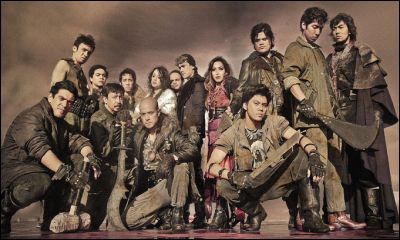
When I heard that Ana Abad Santos-Bitong, one of Reps' resident actors, would not only be directing Hamlet but also setting it in a "post-apocalyptic" world, it piqued my interest. As did the posters and production photos that showed the cast in costumes inspired by the video game Final Fantasy, textured fabrics and funky silhouettes, with goggles and all, designed by Faust Peneyra.
If you think this will be a cutesy, kawaii J-pop staging, the ominous opening tableau will completely erase any notion of that. As Jethro Joaquin's creepy mood music marks the beginning of the play, the entire cast descends from the audience area, brandishing their humongous weapons, clambering to the stark stage designed by Dennis Lagdameo, which is back-lit a bloody scarlet.
My decision to give Rep another chance at Shakespeare did not go unrewarded. Bitong gives us an exciting and tight staging, using an edited version of the text that runs only two hours?just the right length for fidgety students who may be required to watch and even for those of us whose attention spans have been severely mottled down by mass media.
In a strange counterpoint to the harsh, barbaric setting, Bitong steers clear of the incestuous sexual undertones usually connected to the material (which was a central theme in last year's staging of Hamlet by Dulaang U.P.).
It's all right. Perhaps it's a concession to the expected target audience of high school and college students and, after all, considering this is a Rep production, she's pushed the envelope a lot already with (and definitely wins points for) her brave choices. She's already gotten our attention visually, so now all she wants to do is to tell Hamlet's story.
She drives her cast quickly and assuredly through the play's distilled paces. Hamlet's father has just died. Hamlet suspects that his uncle, Claudius, is the murderer. Hamlet's mother, Gertrude, marries Claudius. He wants to avenge his father, but how? His girlfriend, Ophelia, is getting in the way of his plans. Ophelia's father Polonius is such a nosy busy-body. This Danish prince has got some problems all right.
Niccolo Manahan plays the titular role with an even hand and does not stray into histrionics. If anything, he may have been a tad too reserved, but perhaps it is only to further the idea that his Hamlet is a more cold and calculating strategist the character is usually given credit for. In a way, we realize that he is as cruelly scheming as his uncle. Clearly, Bitong shows us that there are no blacks and whites in the world she has created for Hamlet.
A victim of these emotional gray areas and off-kilter morals is Cris Villonco as Ophelia, who takes a decidedly more edgy turn compared to her goody-two-shoes roles from previous Rep productions. No doubt people will say that her character's meltdown in the second act is moving, but it doesn't seem like a stretch for her?we kind of expect her to be able to pull that off.
What is more impressive is the setup to this scene, when Hamlet rebuffs her and a slew of confusion, anger and fear erupts from her sweet face as she trembles and wields her fan knife at Hamlet. Villonco lets us know that Ophelia, despite that spunky exterior, is a delicate flower tremulously being strangled by all this craziness around her. In short, seeing Villonco acting crazed and kicking ass is a delightful highlight.
Rosencratz and Guildenstern are no bumbling, comic-relief idiots in Bitong's version. They brim with an undercurrent of murderous insanity and we are afraid for Hamlet every time they come near him. Bodjie Pascua (yes, the Kuya Bodjie of our Batibot childhoods and, yes, he speaks excellent English) is engaging as Polonius.
Jaime Wilson is a storm of raw anguish and tender loneliness as Laertes, but what has happened to his voice? He has this wheeze that is uncomfortable to hear and it makes him sound almost like he has a lisp. I thought it was deliberate when he did it in last year's "Into the Woods," but now it just sounds unhealthy. Apart from that, the entire cast's enunciation and diction are amazingly crystal clear.
Lots of fun in this production is the sword fight between Hamlet and Laertes. Kudos to weapons designer Lagdameo, whose oddly-shaped weapons provided an immediate, believable and visceral heft, and fight choreographer Paul Morales, for giving us a fully realized, metal-clanging-on-metal duel scene that was thrilling, suspenseful and realistic.
Overall, a highly recommended production of Hamlet, both to first-timers of any Shakespearean play and to the Bard's fans, who are likely to pick up some new insights with this unique staging.
Hamlet runs until February 17 at the Onstage theater of Greenbelt 1, Makati. Call 887?0710 or 891?9999 (Ticketworld).
Peta stages 'Skin Deep,' musical about beauty obssession
Skin, voices, melodies
By Walter Ang
Jan. 28, 2008
Philippine Daily Inquirer
 "Write a funny musical on beauty," was the instruction that Philippine Educational Theater Association (Peta) Artistic Director Maribel Legarda laid down for Vince de Jesus.
Known to theater audiences more as a lyricist, composer, musical arranger and musical director rather than a playwright, De Jesus was challenged by the directive. "When you talk about beauty as a topic, the scope is so huge," he says. After reviewing the other plays that had been performed for Peta's current season, he began to focus the issues he wanted to write about.
"We've had two productions for our 40th season. Walang Himala was about discovering the effects of People Power and Batang Rizal was about finding the hero within the child. I wanted my play to be about discovering your inner self," he says.
De Jesus eventually crafted "Skin-Deep," a story about an internationally famous balikbayan cosmetic surgeon who opens "the world's first one-stop beauty resort here in the Philippines - the Skin-Deep Sancutary!" For its grand opening promo, seven lucky texters win a chance to stay at the resort for a month and avail of all the beauty treatments, procedures and surgeries it has to offer for free.
The winners include "An obese female call-center agent, a troubled married couple, a male model wannabe, a flamboyant florist, an abused housewife burned beyond recognition and the reigning Miss Artificial Beauty," he lists. "The musical revolves around their struggles. How they go through different procedures hoping to become more aesthetically acceptable to the cruel world."
Inner beauty
"I'm not an expert on beauty, but I do know we all have our little indulgences. I get my facials and diamond peels from time to time," he says. "The question here is, to what extent should you go for outer beauty? I called a popular aesthetic center to ask how much butt implants cost. They told me it cost P120,000! I asked for a discount and if it's possible for me to pay only P60,000. They said it was possible, but I would only get an implant on one cheek," he laughs.
He qualifies that his musical "is not a complete attack on the cosmetic surgery industry. After all `walang manloloko kung walang magpapaloko.'" De Jesus does not hide the fact that he actually underwent a bit of cosmetic surgery himself (acne scar reduction) to immerse himself in the milieu of his musical.
"My point is, if you get a procedure done, you should know why you are getting it." De Jesus waxes philosophical on the effects of "media, advertising and companies who aggressively sell their products. Why are we being told that we are ugly if we have dark skin, a flat nose, no boobs or are chubby? Why do the white skinned girls get the boyfriend?"
Process
De Jesus began to play the piano in the second grade and eventually joined Peta's Metropolitan Teen Theater League in high school where he was able to merge his love for music with the performing arts. He soon decided to devote all his energies to creating music and lyrics not just for theater but for television, film and events as well.
One of this notable works is the libretto and music for the staged version of Tanghalang Pilipino's "Himala," which was recently shown in Shanghai, China for the Asian Contemporary Theater Festival. "I'm a crammer!" he laughs when asked about how he creates music. "I go to the beach, I go to the mall. I tell my collaborators that relaxing my nerves is part of the process. For Himala, I did the music only a few days before the first rehearsal!"
He points out that when he is the composer for a show, he has the leeway to adjust and modify the music during rehearsals. However, since he is only the librettist for Skin-Deep and would not have that kind of control over the music, he had prepared a first draft by July of last year. He was assisted in his efforts by the Writers' Bloc, an organization of established and aspiring playwrights, headed by Rody Vera and whose membership included the late multi-awarded playwright Rene Villanueva.
"They [Villanueva and Vera] would encourage me to make the script tougher, to make more of a statement." he recounts. After going through twelve major revisions, the play eventually came together with certain inspirations. "I wanted to evoke `Willy Wonka' and `A Chorus Line.' The ending started out simply as a bittersweet ending, but now it has become dark and open-ended. These people were not perfect when they went in the Skin-Deep Sanctuary, but they will leave more broken than when they entered."
Star-studded
The musical will be directed by Nor Domingo with music by Lucien Letaba, arranged by Melvin Corpin. Costume design is by Kalila Aguilos, choreography by Christine Crame-Santillan and Leo Abaya will design a "a high-tech, futuristic, magical set lighted by Jonjon Villareal," says De Jesus.
Bringing his characters to life are well-known theater luminaries such as pop R&B singer Bituin Escalante, husband and wife team Robert Seña and Isay Alvarez (both alumni of Miss Saigon, West End and Manila casts), and fresh from portraying the lead role in "Himala," May Bayot-de Castro, whom theater aficionados would love to see perform with her sister Lani Misalucha in a musical one day. Other featured actors in the cast members of Kalinangan Ensemble, Peta's resident group of actors.
"As far as I know, no one has made a musical about this topic. There are really so many factors and issues embedded in it: economic, political, cultural, gender issues, sexual politics, body politics, it goes on and on," says De Jesus. "In the end, these characters are archetypes but the audience will definitely be able to relate. We can all relate to being judged, being ugly and, ultimately, surviving scars."
Skin-Deep runs from Feb. 1 to March 9 at the PETA-Phinma Theater (5 Eymard Drive, New Manila, Quezon City. Behind Quezon City Sports Club). Call 725-6244 or 410-0821.
Also published online:
http://showbizandstyle.inquirer.net/lifestyle/lifestyle/view/20080127-115184/Skin-voices-melodies
By Walter Ang
Jan. 28, 2008
Philippine Daily Inquirer

Known to theater audiences more as a lyricist, composer, musical arranger and musical director rather than a playwright, De Jesus was challenged by the directive. "When you talk about beauty as a topic, the scope is so huge," he says. After reviewing the other plays that had been performed for Peta's current season, he began to focus the issues he wanted to write about.
"We've had two productions for our 40th season. Walang Himala was about discovering the effects of People Power and Batang Rizal was about finding the hero within the child. I wanted my play to be about discovering your inner self," he says.
De Jesus eventually crafted "Skin-Deep," a story about an internationally famous balikbayan cosmetic surgeon who opens "the world's first one-stop beauty resort here in the Philippines - the Skin-Deep Sancutary!" For its grand opening promo, seven lucky texters win a chance to stay at the resort for a month and avail of all the beauty treatments, procedures and surgeries it has to offer for free.
The winners include "An obese female call-center agent, a troubled married couple, a male model wannabe, a flamboyant florist, an abused housewife burned beyond recognition and the reigning Miss Artificial Beauty," he lists. "The musical revolves around their struggles. How they go through different procedures hoping to become more aesthetically acceptable to the cruel world."
Inner beauty
"I'm not an expert on beauty, but I do know we all have our little indulgences. I get my facials and diamond peels from time to time," he says. "The question here is, to what extent should you go for outer beauty? I called a popular aesthetic center to ask how much butt implants cost. They told me it cost P120,000! I asked for a discount and if it's possible for me to pay only P60,000. They said it was possible, but I would only get an implant on one cheek," he laughs.
He qualifies that his musical "is not a complete attack on the cosmetic surgery industry. After all `walang manloloko kung walang magpapaloko.'" De Jesus does not hide the fact that he actually underwent a bit of cosmetic surgery himself (acne scar reduction) to immerse himself in the milieu of his musical.
"My point is, if you get a procedure done, you should know why you are getting it." De Jesus waxes philosophical on the effects of "media, advertising and companies who aggressively sell their products. Why are we being told that we are ugly if we have dark skin, a flat nose, no boobs or are chubby? Why do the white skinned girls get the boyfriend?"
Process
De Jesus began to play the piano in the second grade and eventually joined Peta's Metropolitan Teen Theater League in high school where he was able to merge his love for music with the performing arts. He soon decided to devote all his energies to creating music and lyrics not just for theater but for television, film and events as well.
One of this notable works is the libretto and music for the staged version of Tanghalang Pilipino's "Himala," which was recently shown in Shanghai, China for the Asian Contemporary Theater Festival. "I'm a crammer!" he laughs when asked about how he creates music. "I go to the beach, I go to the mall. I tell my collaborators that relaxing my nerves is part of the process. For Himala, I did the music only a few days before the first rehearsal!"
He points out that when he is the composer for a show, he has the leeway to adjust and modify the music during rehearsals. However, since he is only the librettist for Skin-Deep and would not have that kind of control over the music, he had prepared a first draft by July of last year. He was assisted in his efforts by the Writers' Bloc, an organization of established and aspiring playwrights, headed by Rody Vera and whose membership included the late multi-awarded playwright Rene Villanueva.
"They [Villanueva and Vera] would encourage me to make the script tougher, to make more of a statement." he recounts. After going through twelve major revisions, the play eventually came together with certain inspirations. "I wanted to evoke `Willy Wonka' and `A Chorus Line.' The ending started out simply as a bittersweet ending, but now it has become dark and open-ended. These people were not perfect when they went in the Skin-Deep Sanctuary, but they will leave more broken than when they entered."
Star-studded
The musical will be directed by Nor Domingo with music by Lucien Letaba, arranged by Melvin Corpin. Costume design is by Kalila Aguilos, choreography by Christine Crame-Santillan and Leo Abaya will design a "a high-tech, futuristic, magical set lighted by Jonjon Villareal," says De Jesus.
Bringing his characters to life are well-known theater luminaries such as pop R&B singer Bituin Escalante, husband and wife team Robert Seña and Isay Alvarez (both alumni of Miss Saigon, West End and Manila casts), and fresh from portraying the lead role in "Himala," May Bayot-de Castro, whom theater aficionados would love to see perform with her sister Lani Misalucha in a musical one day. Other featured actors in the cast members of Kalinangan Ensemble, Peta's resident group of actors.
"As far as I know, no one has made a musical about this topic. There are really so many factors and issues embedded in it: economic, political, cultural, gender issues, sexual politics, body politics, it goes on and on," says De Jesus. "In the end, these characters are archetypes but the audience will definitely be able to relate. We can all relate to being judged, being ugly and, ultimately, surviving scars."
Skin-Deep runs from Feb. 1 to March 9 at the PETA-Phinma Theater (5 Eymard Drive, New Manila, Quezon City. Behind Quezon City Sports Club). Call 725-6244 or 410-0821.
Also published online:
http://showbizandstyle.inquirer.net/lifestyle/lifestyle/view/20080127-115184/Skin-voices-melodies
Mario O'Hara, creative powerhouse, back on stage
Mario O'Hara, creative powerhouse, back on stage
By Walter Ang
January 21, 2008
Philippine Daily Inquirer
 Some people know Mario O' Hara as a film maker. Noranians know him for "Tatlong Taong Walang Diyos" in the '70s and "Bulaklak ng City Jail" in the '80s. Younger audiences may know him more for the award-winning and critically acclaimed "Babae sa Breakwater."
Others know him as a scriptwriter. He penned Lino Brocka's "Insiang" and "Tinimbang Ka Ngunit Kulang." He's also a playwright; he won first prize in the Sarsuwela category of the Centennial Literary Prize back in 1998 for "Palasyo ni Valentin." And he is an actor for film, television and stage.
In other words, he's a creative powerhouse who slips from one craft to another without much effort. In Tanghalang Pilipino's (TP) "Kudeta!," his latest foray into theater, he plays the president of a Caribbean nation who is held captive after a coup, but manages to turn things around by exploiting his enemies' weaknesses.
Constant presence
O' Hara was thick in the middle of writing a script in Balagtasan style in an effort to update the language for younger audiences when the production was greenlighted.
"I had to drop everything. When you do theater, it occupies you, there's not much else you can do. I wake up thinking about the play and go to sleep still thinking about it. I can't do anything else that's creative in nature," he says. "I can only do manual labor," he adds with a laugh.
However, due to his rich experiences in almost all of the performing-arts disciplines, it was an easy transition from one form to the other.
"I'm used to doing theater. I've done all kinds of productions with companies that had money, some that didn't, productions with large casts, others with small casts."
O'Hara is a constant presence in the theater world. His script for "Insiang" (which had started out as radio play before becoming a TV and movie script), was restaged last year by TP.
As an actor, he was last seen onstage in Peta's "Belong Puti" and TP's "Ang Pokpok ng Ohio" in which he shared the stage with only two other actors. In "Kudeta!" he performs with the entire Actor's Company, TP's group of resident actors.
"There's one upside: I get to rest more! When you're in a play with a large cast, you don't have to be onstage all the time," he says. "When you're on stage with only a few other actors, you have to sustain your energy the entire time, you have to be clear. You need super energy! It's all about voice, emotions, action."
Same tools
These are the same tools that he uses to build his character. In this case, he points out that "My character is a president [of Trinidad and Tobago, birthplace of playwright Mustapha Matura]. Although we all have an idea of what a president's public persona should be, I didn't have too difficult a time creating the personality of my character's private self."
Translated to Filipino by George de Jesus III, the play is about a group of young military officers who is sent by the president abroad for training, but who comes back to lead a coup against him.
"I had to ask myself, `How does a president who is used to power, who is used to being followed, react when people don't follow his orders anymore? How does he deal with people who are not part of his private life?'" he says.
To help bring these situations to life, Tuxqs Rutaquio provides the production design and Dennis Marasigan, TP's artistic director, the lighting design.
O'Hara further crafted his character under the direction of Floy Quintos, for whom he has only praise. "He's great to work with. His mind is very quick. When I get an idea for my character or a scene, I like using the idea right away, otherwise it disappears. Fortunately, Floy allows the cast to experiment during rehearsals," he says.
"But you have to be alert when you're working with Floy. He thinks fast and you have to catch everything. He won't repeat himself. You have to work on his directions until you get it."
Having started performing for radio at the age of 17, O'Hara exudes a calm that only true expertise can establish as he rehearses for the show. "My delivery in theater is strong because of my radio background. I love radio work, I was blessed to be part of that industry during its golden years. I learned discipline from the people I worked with, they had the highest standards."
"Kudeta!" runs until Feb. 3 at the Tanghalang Huseng Batute of the Cultural Center of the Philippines at 8 p.m., Friday-Saturday; and 3 p.m. matinees, Saturday-Sunday. Call 8919999, 8323704, 8321125 loc. 1620/1621 and 8323661.
Also published online:
http://showbizandstyle.inquirer.net/lifestyle/lifestyle/view/20080121-113637/Mario-OHara-creative-powerhouse-back-on-stage
By Walter Ang
January 21, 2008
Philippine Daily Inquirer

Others know him as a scriptwriter. He penned Lino Brocka's "Insiang" and "Tinimbang Ka Ngunit Kulang." He's also a playwright; he won first prize in the Sarsuwela category of the Centennial Literary Prize back in 1998 for "Palasyo ni Valentin." And he is an actor for film, television and stage.
In other words, he's a creative powerhouse who slips from one craft to another without much effort. In Tanghalang Pilipino's (TP) "Kudeta!," his latest foray into theater, he plays the president of a Caribbean nation who is held captive after a coup, but manages to turn things around by exploiting his enemies' weaknesses.
Constant presence
O' Hara was thick in the middle of writing a script in Balagtasan style in an effort to update the language for younger audiences when the production was greenlighted.
"I had to drop everything. When you do theater, it occupies you, there's not much else you can do. I wake up thinking about the play and go to sleep still thinking about it. I can't do anything else that's creative in nature," he says. "I can only do manual labor," he adds with a laugh.
However, due to his rich experiences in almost all of the performing-arts disciplines, it was an easy transition from one form to the other.
"I'm used to doing theater. I've done all kinds of productions with companies that had money, some that didn't, productions with large casts, others with small casts."
O'Hara is a constant presence in the theater world. His script for "Insiang" (which had started out as radio play before becoming a TV and movie script), was restaged last year by TP.
As an actor, he was last seen onstage in Peta's "Belong Puti" and TP's "Ang Pokpok ng Ohio" in which he shared the stage with only two other actors. In "Kudeta!" he performs with the entire Actor's Company, TP's group of resident actors.
"There's one upside: I get to rest more! When you're in a play with a large cast, you don't have to be onstage all the time," he says. "When you're on stage with only a few other actors, you have to sustain your energy the entire time, you have to be clear. You need super energy! It's all about voice, emotions, action."
Same tools
These are the same tools that he uses to build his character. In this case, he points out that "My character is a president [of Trinidad and Tobago, birthplace of playwright Mustapha Matura]. Although we all have an idea of what a president's public persona should be, I didn't have too difficult a time creating the personality of my character's private self."
Translated to Filipino by George de Jesus III, the play is about a group of young military officers who is sent by the president abroad for training, but who comes back to lead a coup against him.
"I had to ask myself, `How does a president who is used to power, who is used to being followed, react when people don't follow his orders anymore? How does he deal with people who are not part of his private life?'" he says.
To help bring these situations to life, Tuxqs Rutaquio provides the production design and Dennis Marasigan, TP's artistic director, the lighting design.
O'Hara further crafted his character under the direction of Floy Quintos, for whom he has only praise. "He's great to work with. His mind is very quick. When I get an idea for my character or a scene, I like using the idea right away, otherwise it disappears. Fortunately, Floy allows the cast to experiment during rehearsals," he says.
"But you have to be alert when you're working with Floy. He thinks fast and you have to catch everything. He won't repeat himself. You have to work on his directions until you get it."
Having started performing for radio at the age of 17, O'Hara exudes a calm that only true expertise can establish as he rehearses for the show. "My delivery in theater is strong because of my radio background. I love radio work, I was blessed to be part of that industry during its golden years. I learned discipline from the people I worked with, they had the highest standards."
"Kudeta!" runs until Feb. 3 at the Tanghalang Huseng Batute of the Cultural Center of the Philippines at 8 p.m., Friday-Saturday; and 3 p.m. matinees, Saturday-Sunday. Call 8919999, 8323704, 8321125 loc. 1620/1621 and 8323661.
Also published online:
http://showbizandstyle.inquirer.net/lifestyle/lifestyle/view/20080121-113637/Mario-OHara-creative-powerhouse-back-on-stage
Review of Repertory Philippines' 'Tuesdays with Morrie'
No Toothaches Only Smiles
By Walter Ang
January 14, 2008
Clickthecity.com (http://guides.clickthecity.com/arts/?p=2649)
 Repertory Philippines' latest offering, Tuesdays with Morrie, is the stage adaptation of Mitch Albom's best selling book.
Bart Guingona plays the author Mitch Albom, a sports journalist who reconnects with his old college professor Morrie Schwartz.
Though successful in his chosen career, Albom feels empty and lost. Guingona aptly plays him as a high strung alpha male but is able to show his vulnerable sides.
Sixteen years after his college graduation, events lead Albom to seek out his old mentor, who unfortunately, has developed Lou Gehrig's disease.
Morrie, despite being stricken with this incurable degenerative disease of the nervous system, vows to live the remainder of his life to the fullest.
Albom is the lucky recipient of Morrie's relentless drive to remain a teacher (even if he's no longer an employee of his old university). In a clever move, Morrie convinces Albom to visit him every Tuesday of the week and "manages over the course of the following months to impart to his former student the most important lessons of all."
The premise of the play makes it seem dangerous to stage as it can easily slip into hokey melodrama. Admittedly, there were some dialogue that bordered precariously into giving the audience a toothache, but thankfully, under the direction of Rep co-founder Baby Barredo, the material unfolds without any nonsense and gimmicks. The tension is sustained and Albom's resistance to getting in touch with his "touchy feely" side provides a foil to any possibilities of the story turning into a cartoon.
It is interesting to see Rep using new and popular material for its line-up. Aside from the book, Tuesdays was adapted into a TV movie produced by Oprah Winfrey starring Hank Azaria (as Albom) and Jack Lemmon (as Schwartz). This decision to interweave more "modern" plays with classics (Hamlet is next in Rep's current line-up) may attract more audiences to the theater and build a stronger market for the performing arts.
The revelation of this production is the actor who plays Morrie: Jose Mari Avellana. He has incredible presence onstage and lends much gravitas to the character. His performance is nuanced, gentle, funny, powerful and heart wrenching. Although some of the timing for the punchlines are still a bit off on opening weekend, these two actors carry the story evenly and have a chemistry about them.
When one reads the short biography of Avellana in the souvenir programme, it's no wonder that his past work experience reveals extensive forays into theater, advertising, radio, television and film. Another interesting tidbit: his parents are National Artists Lambert and Daisy Avellana. If not for anything, go watch this play for his performance.
Tuesdays with Morrie runs until January 27 at Onstage Theater, 2/F Greenbelt 1, Ayala Center, Makati City. For details, call 887-0710 or visit www.repertory-philippines.com. Tickets also available at Ticketworld at 8919999 or their website at www.ticketworld.com.ph
Hendri Go of Little Boy Productions will be bringing this production to Cebu City on February 2 at SM City Cebu Cinema. For details about the Cebu staging, please call (63917)815-5794.
By Walter Ang
January 14, 2008
Clickthecity.com (http://guides.clickthecity.com/arts/?p=2649)
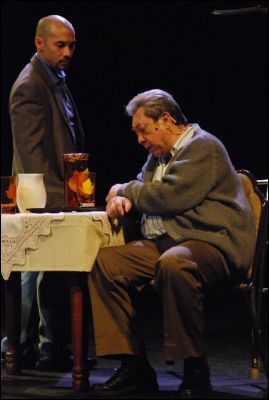
Bart Guingona plays the author Mitch Albom, a sports journalist who reconnects with his old college professor Morrie Schwartz.
Though successful in his chosen career, Albom feels empty and lost. Guingona aptly plays him as a high strung alpha male but is able to show his vulnerable sides.
Sixteen years after his college graduation, events lead Albom to seek out his old mentor, who unfortunately, has developed Lou Gehrig's disease.
Morrie, despite being stricken with this incurable degenerative disease of the nervous system, vows to live the remainder of his life to the fullest.
Albom is the lucky recipient of Morrie's relentless drive to remain a teacher (even if he's no longer an employee of his old university). In a clever move, Morrie convinces Albom to visit him every Tuesday of the week and "manages over the course of the following months to impart to his former student the most important lessons of all."
The premise of the play makes it seem dangerous to stage as it can easily slip into hokey melodrama. Admittedly, there were some dialogue that bordered precariously into giving the audience a toothache, but thankfully, under the direction of Rep co-founder Baby Barredo, the material unfolds without any nonsense and gimmicks. The tension is sustained and Albom's resistance to getting in touch with his "touchy feely" side provides a foil to any possibilities of the story turning into a cartoon.
It is interesting to see Rep using new and popular material for its line-up. Aside from the book, Tuesdays was adapted into a TV movie produced by Oprah Winfrey starring Hank Azaria (as Albom) and Jack Lemmon (as Schwartz). This decision to interweave more "modern" plays with classics (Hamlet is next in Rep's current line-up) may attract more audiences to the theater and build a stronger market for the performing arts.
The revelation of this production is the actor who plays Morrie: Jose Mari Avellana. He has incredible presence onstage and lends much gravitas to the character. His performance is nuanced, gentle, funny, powerful and heart wrenching. Although some of the timing for the punchlines are still a bit off on opening weekend, these two actors carry the story evenly and have a chemistry about them.
When one reads the short biography of Avellana in the souvenir programme, it's no wonder that his past work experience reveals extensive forays into theater, advertising, radio, television and film. Another interesting tidbit: his parents are National Artists Lambert and Daisy Avellana. If not for anything, go watch this play for his performance.
Tuesdays with Morrie runs until January 27 at Onstage Theater, 2/F Greenbelt 1, Ayala Center, Makati City. For details, call 887-0710 or visit www.repertory-philippines.com. Tickets also available at Ticketworld at 8919999 or their website at www.ticketworld.com.ph
Hendri Go of Little Boy Productions will be bringing this production to Cebu City on February 2 at SM City Cebu Cinema. For details about the Cebu staging, please call (63917)815-5794.
REVIEW: Repertory Philippines' 'Fiddler on the Roof' celebrates family ties
Celebrating Family Ties
By Walter Ang
December 3, 2007
Clickthecity.com (http://guides.clickthecity.com/arts/?p=2462)
Repertory Philippines' staging of the musical Fiddler of the Roof provides wholesome family fun with its story of Jewish milkman Tevye as he copes with the seemingly runaway love lives of three of his five daughters.
The entire cast, led by Tevye, comes onstage as the curtains rise to sing a rousing introduction to their insular village of Anatevka that includes a primer to their traditions and the social roles they all play.
Though he kvetches to God in amusing conversations and constantly misquotes the "good book," Tevye tries to live by these traditions while raising his children with wife Golde. Alternate leads Tyler Alan Strand (with Rep veteran Miguel Faustmann as main lead) is a bouncy, rolly-polly Tevye that grows on you and Pinky Marquez (main lead is Joy Virata) gives tenderness to the outwardly tough Golde.
Things get rough for Tevye when he has to reconcile his convictions with oldest daughter Tzeitel's, second daughter Hodel and third daughter Chava's choices in men and lifestyles. Though her young age shows through her characterization during some moments, sixteen year old Samantha Sewell shows potential as eldest daughter Tzeitel while Cris Villonco establishes the strongest presence amongst the sisters in her portrayal of Hodel.
Tevye is a protective, sensitive man who really does want his daughters to be happy and eventually acquiesces. He even comes up with an imaginative way of convincing his wife, ending in a wickedly funny number to end the first act. Tevye's daughters grow up to new responsibilities and possibilities in the second act while outside forces close in on the little town of Anatevka. The audience takes the ride with Tevye to see how he reacts and solves the problems that crop up.
The material, due to some historical and political underpinnings, may feel slow for some and the show's sense of humor may occasionally get lost on audiences. The cast's comic timing was a bit off when we caught the show and it would have been great to hear them deliver their punchlines with a bit more spunk, a mix of slight sarcasm and deadpan.
Nonetheless, Tevye's story is an endearing one. With direction by Robbie Guevarra, the show is a fun way for local audiences to catch a glimpse of Jewish history and to experience one of the more "classic" Broadway musicals. While one or two of the show's songs by by Jerry Bock and Sheldon Harnick, such as the opening number "Tradition," "Matchmaker," and "Sunrise, Sunset," may be familiar to audiences, the fact that this Rep's fifth restaging in its forty-year-history (and perhaps also that it is Rep's annual Christmas big musical) imbues the show with an intimate, comfortable and animated feel. And as with most Rep musicals, the songs where the chorus or entire cast has to sing all sound great.
As the story ends on a somewhat serious tone, one can always launch into discussions of families that are uprooted and separated, of the implications of reconciling personal convictions with the inevitability of change. However, at the end of the day, Fiddler is the stage equivalent of comfort food and shouldn't be overanalyzed. This holiday season, just enjoy the story of this musical's every-family and share in its celebration of the power of family ties and the enduring spirit of love.
Fiddler on the Roof runs until Dec. 16 at Onstage Theater, Greenbelt 1. Visit www.repertory-philippines.com or call 887-0710. Tickets are also available at Ticketworld ? Tel No. 891-9999.
By Walter Ang
December 3, 2007
Clickthecity.com (http://guides.clickthecity.com/arts/?p=2462)
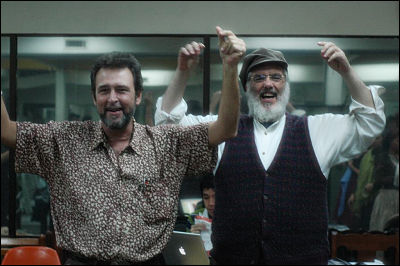 |
| Miguel Faustmann and Tyler Alan Strand |
The entire cast, led by Tevye, comes onstage as the curtains rise to sing a rousing introduction to their insular village of Anatevka that includes a primer to their traditions and the social roles they all play.
Though he kvetches to God in amusing conversations and constantly misquotes the "good book," Tevye tries to live by these traditions while raising his children with wife Golde. Alternate leads Tyler Alan Strand (with Rep veteran Miguel Faustmann as main lead) is a bouncy, rolly-polly Tevye that grows on you and Pinky Marquez (main lead is Joy Virata) gives tenderness to the outwardly tough Golde.
Things get rough for Tevye when he has to reconcile his convictions with oldest daughter Tzeitel's, second daughter Hodel and third daughter Chava's choices in men and lifestyles. Though her young age shows through her characterization during some moments, sixteen year old Samantha Sewell shows potential as eldest daughter Tzeitel while Cris Villonco establishes the strongest presence amongst the sisters in her portrayal of Hodel.
Tevye is a protective, sensitive man who really does want his daughters to be happy and eventually acquiesces. He even comes up with an imaginative way of convincing his wife, ending in a wickedly funny number to end the first act. Tevye's daughters grow up to new responsibilities and possibilities in the second act while outside forces close in on the little town of Anatevka. The audience takes the ride with Tevye to see how he reacts and solves the problems that crop up.
The material, due to some historical and political underpinnings, may feel slow for some and the show's sense of humor may occasionally get lost on audiences. The cast's comic timing was a bit off when we caught the show and it would have been great to hear them deliver their punchlines with a bit more spunk, a mix of slight sarcasm and deadpan.
Nonetheless, Tevye's story is an endearing one. With direction by Robbie Guevarra, the show is a fun way for local audiences to catch a glimpse of Jewish history and to experience one of the more "classic" Broadway musicals. While one or two of the show's songs by by Jerry Bock and Sheldon Harnick, such as the opening number "Tradition," "Matchmaker," and "Sunrise, Sunset," may be familiar to audiences, the fact that this Rep's fifth restaging in its forty-year-history (and perhaps also that it is Rep's annual Christmas big musical) imbues the show with an intimate, comfortable and animated feel. And as with most Rep musicals, the songs where the chorus or entire cast has to sing all sound great.
As the story ends on a somewhat serious tone, one can always launch into discussions of families that are uprooted and separated, of the implications of reconciling personal convictions with the inevitability of change. However, at the end of the day, Fiddler is the stage equivalent of comfort food and shouldn't be overanalyzed. This holiday season, just enjoy the story of this musical's every-family and share in its celebration of the power of family ties and the enduring spirit of love.
Fiddler on the Roof runs until Dec. 16 at Onstage Theater, Greenbelt 1. Visit www.repertory-philippines.com or call 887-0710. Tickets are also available at Ticketworld ? Tel No. 891-9999.
Bobson Jeans founder Victor Tan's success is more than pesos and centavos
By Walter Ang
Dec 2007-Feb 2008 issue
Asian Dragon Magazine


Dec 2007-Feb 2008 issue
Asian Dragon Magazine
Twenty years have passed since Bobson Jeans was introduced to the Philippine market. What began as a small venture in Divisoria has blossomed into a nationwide organization employing 500-plus people with a network of over 130 concessions outlets and 25 freestanding boutiques nationwide.

If you ask the man who started it all if he's reached the peak of his success, he promptly answers, "No." Victor Tan feels strongly that there is more to be done despite his having achieved more than what his contemporaries have been able to.
The eldest of six siblings, Victor started out as a salesman in bustling downtown Manila (comprised of the Chinatown commercial district Binondo, Sta Cruz, San Fernando and Tondo) while attending night classes in college. He speaks of an irrepressible spirit amidst his humble upbringing that led him to take on any job that came his way, whether it be tutoring grade school students or working in furniture and hardware businesses.
A passion for fashion led him to craft the dream he would build on. "I have always had a strong curiosity in what was going on around me. I tend to notice the tiniest details about clothes. I often comment on people's sense of style. I always make it a point to wear shirts/pants that is always in fashion."
He had been printing t-shirts for sale as Christmas giveaways for various companies and eventually worked for a garment manufacturing company, it was these entrepreneurial elements that finally came together when he wanted to create a "homegrown clothing brand that would prove itself through craftsmanship."
He then shares the birthing pains that came with making that dream a reality. "After spending a lot of time and money introducing Bobson to the market, getting rejected was becoming the norm. We got our first big break when the big department store chains in Manila allowed us to showcase our products," he says.
That began the continuous efforts of Victor to build on his brand. Bobson was only carrying its jeans line at that time, now it features an entire line of garments and accessories. His hard work has not gone unnoticed. For the years 2003 to 2005, the Consumer Union of the Philippines awarded Bobson as "Most Outstanding Manufacturer of Local Jeans Wear," while Parangal ng Bayan Foundation named it as "Best Jeans Manufacturer."
"Consumer satisfaction in our products and services has been the basic reason behind our steady growth these years," he says. "As a matter of business philosophy, we invest time, effort, and expense in building up our capability to design, create, and produce products that meet the needs and expectations of our target market." Given his steady hand in leading the company, it's no wonder that Victor was selected as one of the Top Ten Small-to-medium Entrepreneurs for 2005.
Central to all his achievements, Victor plays by a set of values: hard work, integrity and respect for others. Family also plays an important role in keeping him on track. A father of four children with wife Rosemarie, Victor says that his constant inspiration is the hard work and perseverance that his late father exhibited. "He was never daunted by poverty in his devotion to the family's welfare."
In addition, Victor is guided by Buddhist principles that advise, "all entrepreneurs should seek more than just business profits or materialistic wealth, but must seek inner peace, contentment and maintain lifelong integrity as well." He knows whereof he speaks since he is also currently the Director of the Philippine Buddha Light International Association.
"I do not measure success in terms of pesos and centavos only. Success to me becomes complete if along with my company's growth, it would have contributed to the betterment of society and our employees," he says.


Patty Limpe and her Antonio Pueo chocolate factory
Patty and her chocolate factory
By Walter Ang
Dec 2007-Feb 2008 issue
Asian Dragon Magazine
The Asian Dragon team is ushered into a high-ceilinged office with tables and equipment crammed into available space. There's nothing fancy about the wide hall except that it has a distinct aroma wafting through the door.


An invigorating scent cuts the air as Patricia Limpe offers us steaming hot chocolate in dainty porcelain cups. She smiles and announces, "They call me the chocolate lady." Patty, as she prefers to be called, is simply stating a fact. After all, she is the only woman who has stuck her nose into the male-dominated chocolate manufacturing industry.
But what a nose it is. As the manager of one of oldest chocolate factories in the Philippines ("I've been told that we're actually the oldest chocolate factory in Southeast Asia," she shares.), she's been able to sniff out a winning recipe to keep it alive and well.
Then
"The chocolates we make now are produced in exactly the same way they were made back then. We are faithful to the original recipe so we can preserve its distinct taste and its unique character," Patty says proudly. "We want to maintain the authenticity of our chocolates. In fact, we still use the original machines of the factory. No one makes those kinds of machines anymore."
Antonio Pueo Incorporada was founded in 1939 by Spanish immigrant Jose Maria Pueo. The company is named for his godfather, a Spanish friar, from whom he learned the knowledge of chocolate making. In the 80s, Pueo sold the factory to Patty's father, Julius, after losing a big account supplying to a fastfood chain.
"My father has a passion for acquiring food companies with a history. Pueo chose my father among other potential buyers because our family wasn't in it just for the money. Our family really cares about the process and the final product," she says.
Now
With a family business that has diverse interests across several food manufacturing companies, Patty is the designated member who "sets up new projects." However, despite managing other companies, most of her time is dedicated to the chocolate factory. It's a one-woman show where she handles almost every aspect of the process, from purchasing the raw ingredients to marketing the final products. "I'm even the one who designs the packaging!" she laughs.
The core of the business is still the tableas, round discs of chocolate goodness sold in rolls that come in pure form or mixed with milk. "Everyone wants the taste of chocolates but no one wants to bother with preparation anymore. I try to make it as easy for them as possible," she explains.
With this as the jumping off point, this self-confessed "food scientist" has created a whole line of new products ranging from instant chocolate drink mixes to chocolate cookie mixes. Popular are her oatmeal and champorado mixes as well as her churros con chocolate mixes. "These are the same stuff that people having been eating or drinking, but now it's easier to make." Her efforts are well appreciated, so much so that her churros mix has won an award for "Classic Products Made Convenient."
She is proud of the fact that they don't scrimp on quality when it comes to ingredients. "We use only the best fermented cacao beans. We don't use sun-dried beans because it lacks flavor and aroma. When it comes to chocolates, the higher cocoa butter content, the better its taste," she points out. "Antonio Pueo is made with all 100% cocoa butter still intact."
Legacy
"All the ingredients are locally sourced." Patty beams. "We're in the chocolate and coffee belt, the area twenty degrees above and below the equator. Countries that are in the belt have the humidity, sun, and shade to grow cacao beans." The results are definitely world-class since Pueoe chocolates are currently exported to countries such as the USA, Canada, Australia, and China.
It really is Patty's advocacy to bring chocolate to more and more kitchens and dining rooms. Starting them young, she has been teaching grade school children how to mix and bake using Pueo cookie mixes for years now. "It not only tastes good, it's good for you, too," she says. For proof of the health benefits of chocolate, Patty asks us to look no farther than the founder of the factory himself. "Jose Maria Pueo drank chocolate everyday of his life and passed away only last year. He was 97 years old."
As the sole custodian of his legacy, a healthy respect for tradition has guided Patty in maintaining the longevity of the Pueo name into our modern times. Patty brings out the original metal printing plates of the old labels used for packaging and proceeds to show us the delicate evolution of small adjustments and changes of the labels into their present designs. "We had to do a gradual process. We couldn't just change the labels right away since people are very familiar with the brand name."
It is this same careful thought and meticulous care that she imbues into the birthing of new products carrying the Pueo name. "I don't develop ideas only for them to become fads," she says. Now, her own vision comes to light as she proclaims, "I want to be like Kellogs, whose cereals have been around for hundreds of years. I create products that will last."
REVIEW: Atlantis Productions' 'Dogeaters' presents a multi-layered Philippines
A Multi-Layered Philippines
By Walter Ang
November 20, 2007
Clickthecity.com (http://guides.clickthecity.com/arts/?p=2408)
 Dogeaters, now playing at the Carlos Romulo Auditorium at RCBC Plaza though the staging of Atlantis Productions, begins with the ensemble cast announcing snippets of news reports, as if an invisible hand was tuning through all the stations of a radio, cleverly bringing the audience into the milieu of the this multi-layered play based on Jessica Hagedorn's novel of the same title.
The sentences are clipped and the sound weaves in and out, leaving the audience with only enough bits and pieces to make out that the setting is the beginning of the end of the Marcos regime.
A plethora of characters and their stories are introduced in the first act and the audience must stay attentive to grasp everything that is going on amidst the textured set designed by Kalila Aguilos. Smack in the middle of the galvanized iron sheets and barbed wire is a massive portrait of the former First Lady Imelda Marcos, whose off-stage ministrations, such as the construction of a film center and organizing a film festival, are a constant onstage presence that inexorably help bring the plot threads together.
Mirroring how many of the characters seem to be on the periphery of bigger events around them, however close to falling in to or quietly orchestrating the fray they are, the audience is made to feel like expectant voyeurs with all of the scenes being annotated by two broadcaster-announcer personalities Nestor Norales (a dapper Leo Rialp) and Barbara Villanueva (played with gusto by Ana Abad-Santos).
Much like the long running radio soap opera hosted by these announcers, the play unfolds in snatches of scenes where tawdry gossip and dangerous secrets are revealed.
The cast is populated by a wonderful mix of actors popular in TV and movies such as Michael de Mesa, Gina Alejar and Joel Torre as well as theater stalwarts like Rialp, Abad-Santos and Richard Cunanan with up-and-coming Philippine High School for the Arts alumnus Nicco Manalo in a convincing turn as a drugged-out Amerasian hustler.
Directed by Bobby Garcia, all sixteen actors take on double or triple roles.
Not to be missed is the fun and fabulous Diana Ross impersonation by Jon Santos, the scene-stealing thunder of Rez Cortez and the subtle but sure changes that Abad-Santos imbues her character as the play progresses.
The multitude of subplots soon builds up to the assassination of Benigno Aquino-inspired Senator Domingo Avila (Joel Torre), revealing two characters, his beauty pageant winner-turned-rebel daughter Daisy (Jenny Jamora) and witness-to-the-assassination Joey Sands (Nicco Manalo), to stand out and drive home the near epic story in a poignant, though somewhat curtailed, encounter.
For those of in the audience who lived through or grew up in the 70s and 80s, the stories in Dogeaters are at once familiar yet blurred, distinct yet fractured. Watching the play becomes an exercise in gaining perspective on the events that inspired the veiled retellings onstage as filtered by time and through the playwright's distance from where they actually happened.
Though it seems some scenes would have worked better if the dialogue were in Tagalog instead of English, it only goes to build on the fact that Dogeaters is decidedly a vision of the Philippines in Hagedorn's voice.
As a counterpoint to the play's insane, colorful array of drugs, guns, power, sex, politics, religion and everything in between, Hagedorn's alter-ego Rio Gonzaga (Teresa Herrera) provides the concluding commentary. The balikbayan, who returns after more than a decade of being away and is lost in the middle of it all, points out that "everything is different but nothing has changed."
By Walter Ang
November 20, 2007
Clickthecity.com (http://guides.clickthecity.com/arts/?p=2408)

The sentences are clipped and the sound weaves in and out, leaving the audience with only enough bits and pieces to make out that the setting is the beginning of the end of the Marcos regime.
A plethora of characters and their stories are introduced in the first act and the audience must stay attentive to grasp everything that is going on amidst the textured set designed by Kalila Aguilos. Smack in the middle of the galvanized iron sheets and barbed wire is a massive portrait of the former First Lady Imelda Marcos, whose off-stage ministrations, such as the construction of a film center and organizing a film festival, are a constant onstage presence that inexorably help bring the plot threads together.
Mirroring how many of the characters seem to be on the periphery of bigger events around them, however close to falling in to or quietly orchestrating the fray they are, the audience is made to feel like expectant voyeurs with all of the scenes being annotated by two broadcaster-announcer personalities Nestor Norales (a dapper Leo Rialp) and Barbara Villanueva (played with gusto by Ana Abad-Santos).
Much like the long running radio soap opera hosted by these announcers, the play unfolds in snatches of scenes where tawdry gossip and dangerous secrets are revealed.
The cast is populated by a wonderful mix of actors popular in TV and movies such as Michael de Mesa, Gina Alejar and Joel Torre as well as theater stalwarts like Rialp, Abad-Santos and Richard Cunanan with up-and-coming Philippine High School for the Arts alumnus Nicco Manalo in a convincing turn as a drugged-out Amerasian hustler.
Directed by Bobby Garcia, all sixteen actors take on double or triple roles.
Not to be missed is the fun and fabulous Diana Ross impersonation by Jon Santos, the scene-stealing thunder of Rez Cortez and the subtle but sure changes that Abad-Santos imbues her character as the play progresses.
The multitude of subplots soon builds up to the assassination of Benigno Aquino-inspired Senator Domingo Avila (Joel Torre), revealing two characters, his beauty pageant winner-turned-rebel daughter Daisy (Jenny Jamora) and witness-to-the-assassination Joey Sands (Nicco Manalo), to stand out and drive home the near epic story in a poignant, though somewhat curtailed, encounter.
For those of in the audience who lived through or grew up in the 70s and 80s, the stories in Dogeaters are at once familiar yet blurred, distinct yet fractured. Watching the play becomes an exercise in gaining perspective on the events that inspired the veiled retellings onstage as filtered by time and through the playwright's distance from where they actually happened.
Though it seems some scenes would have worked better if the dialogue were in Tagalog instead of English, it only goes to build on the fact that Dogeaters is decidedly a vision of the Philippines in Hagedorn's voice.
As a counterpoint to the play's insane, colorful array of drugs, guns, power, sex, politics, religion and everything in between, Hagedorn's alter-ego Rio Gonzaga (Teresa Herrera) provides the concluding commentary. The balikbayan, who returns after more than a decade of being away and is lost in the middle of it all, points out that "everything is different but nothing has changed."
REVIEW: Tanghalang Pilipino presents a heavy, uneven 'Mulan'
Heavy, uneven 'Mulan'
By Walter Ang
October 15, 2007
Philippine Daily Inquirer
A stark white stage with three scarlet arches greets audiences in Tanghalang Pilipino's production of Mulan, a new Tagalog musical version of the story popularized by the Disney animated movie a few years back.
The simplicity of the acting space provides the perfect canvass for the rainbow colors that soon fills it via sets and costume designer Gino Gonzales' highly textured outfits. The exaggerated shapes and cushioned fabrics filled the costumes with a life of their own. Anime-inspired hairpieces in wild, crazy shapes as well as wiggling ornaments and ribbons made to look as if they were permanently flapping in the wind are also fun touches.
The actors all have make-up designed by Dennis Tan evoking Chinese opera masks while the deities Jade Emeperor and Empress Wang Mu are provided larger-than-life masks that tower over the actors's head. With enlarged hand extensions and their faces showing through the costumes' "chest," this is a great design that recalls our very own higantes of Angono and reminiscent of the costumes used by Lion King director Julie Taymor in her production of the opera Oedipus in Japan.
The solidly red set pieces are life-size Chinese paper cuttings with the shapes and outlines of household furniture and landscapes intricately cut-out from delicate sheets of paper (although plywood is probably the material used).
Director Dennis Marasigan counters these massive motifs by having the cast perform in stylized movement (also inspired by Chinese opera) while choreographer Denisa Reyes provides graceful yet powerful action sequences that incorporate wu-shu martial arts. Bong Cabrera as a ballerina soldier is particularly hilarious. Marasigan also provides moments of tension and excitement for the audience by having enemy soldiers attack Mulan's camp from the back of the theater.
These extreme and zany elements are everything you would expect a children's musical to have. It is a wonder then, why the themes explored by librettist Rody Vera and composer Jed Balsamo were executed in such a heavy and uneven tone.
The poem on which different versions of Mulan's story have been inspired is a rich source of virtues for story-telling: filial piety, social obligations, patriotism, sacrifice, personal freewill, team effort, gender roles, etc. For this ninety minute children's musical, it could have proved too rich.
With what seemed an appropriate theme for children to learn from, Vera starts off with the classic case of boys versus girls where his two deities fight over why men like waging war so much.
He supports this by having Mulan's parents wish for a boy (they get Mulan instead with some divine intervention from the Empress Wang Mu), scenes of Mulan being taught to use a sword by her father and a matchmaking segment with the last available bachelor who Mulan promptly pummels.
However, his narrative soon does flying kicks and tangents into the weariness and loneliness that sets in during war mongering, though beautifully illuminated by lighting designer Jonjon Villareal who showcases the passage of time and distance with effective transitions from sharp yellow desert to cold dreary blue mountain terrain. Plot points introduced in the beginning lost their follow through and those revealed in the second half were denied the luxury of a proper build-up.
Balsamo's music, while imaginatively using instruments gleaned from Chinese opera, threads a loneliness throughout the production. He gives Mulan an elegy when she has to leave her family, which Mayen Estrañero sings with much bristle and brio, and follows with a hauntingly beautiful threnody "Gusto ko ng umuwi" for her camp when they hit the ten year mark of fighting the enemy.
These songs that pine and mourn are in aligned note for note with Vera's desire to explore vulnerability and realism. But wouldn't a marching ditty or jolly fraternal jingle or even a bouncy ballad about secret crushes been a little more ? fun?
The yin of this musical's exposition doesn't quite match the yang of its denoument. Like the dual concepts of yin and yang, the production feels like watching two different shows at the same time: one for children and one for adults. The production design and make up are perfect for young audiences.
The stylized movement and choreography can go either way. It would be interesting actually (because the themes and music do have potential), if Vera and Balsamo could consider further developing their current material and angst into a dark adult romance musical.
Also published online:
http://showbizandstyle.inquirer.net/lifestyle/lifestyle/view_article.php?article_id=94408
Actors' Actors stages Yasmina Reza's 'Art' in Tagalog translation
Art: Once more, in Filipino
By Walter Ang
Sept. 3, 2007
Philippine Daily Inquirer
Three men talking about a painting. It's easy to brush off the premise of this straight play, seeing as how it could easily be boring. Or weird. Or both.
Thankfully, Yasmina Reza's "Art" is none of the above. It is an engaging and hilarious time eavesdropping on three best buds as they traverse the fine line that defines their friendship.
Originally written in French and produced by Sean Connery in London, Art has won numerous awards, including the 1998 Tony Award for Best Play and the 1997 Olivier Award for Best Comedy, and has been translated into 20 languages including English, Mandarin, Japanese, German and Spanish.
The Philippine premiere of Art in 1998 featured Bart Guingona (who also directed), Audie Gemora, and Jaime del Mundo in the English translation. The show proved to be one of several productions that became trademarks of Actors' Actors, Inc., Guingona's theater company, enjoying repeat stagings throughout the years.
After Lito Albano saw one of these restagings, he approached Guingona and brought up the idea of translating the material to make it accessible to a wider audience. "I do poetry and copywriting, so I gave it a shot and translated the first ten pages for Bart's approval," said Albano. "I think he liked it because I got a text message instructing me to finish the entire play."
While the translation work continued, actors were rounded up to fill the roles. Michael de Mesa, who has become popular with the English theater crowd with his involvement in musicals, was chosen to play Serge (played by Audie Gemora in the English version) ? the character whose purchase of a painting, which happens to be completely white, sets off heated reactions from the other two characters.
Jett Pangan, front man of The Dawn and star of such musicals as Once on This Island, Beauty and the Beast, and Tick, Tick Boom!, was recruited to make his non-musical straight play debut. He would fill the role of Mar. "He is the quintessential leader-of-the-pack, head-of-the-gang alpha male," described Guingona, who played Marc in the English version. "He's the one who disagrees with Serge's foray into the art world.
Caught in between these two explosive personalities is Jun (Yvan in the original, played by Jaime del Mundo) , the milquetoast sidekick whose shoes were to be filled by Ricky Davao. Familiar to younger audiences as one of the villains in the television show "Lupin," Davao has graced the stage in Tanghalang Pilipino's "Insiang" and "Speaking in Tongues." He won an Aliw Award for Best Stage Actor for his work in the latter.
Everyone was excited to come on board. De Mesa revealed that he had been meaning to sink his teeth into a straight play as well as work with Guingona again. "You mean you wanted to work with me," joked Davao. The fraternal banter was present throughout the interview as both finished each other's sentences and joshed around. Both were also all praises for Pangan in his first foray into straight plays, citing his openness to learn new techniques and diligence in discovering dimensions to his acting.
The ease in the cast's working relationship helped them achieve a more dynamic tone when they worked with Albano to thresh out the translation. "We had to change some lines because there were jokes that had no direct translations. However, we remained faithful to the essence of the material," said de Mesa.
Long-time collaborating producer Hendri Go of Little Boy Productions bravely premiered this new version in his hometown of Cebu. "It was a real test, as you know how Cebuanos can be when it comes to Tagalog material," said Go. "But we feel that the material was adapted properly to Filipino sensibilities and humor."
It also helped that Guingona is intimately familiar with the play. "I know the material inside out already so I was able to guide them through the translation. I already know which parts where the audience will laugh, so if the Filipino wasn't working, we would test new ways of saying the lines," he said. "We would replace stilted dialogue with Taglish lines to make the repartee more realistic and fluid."
Despite the thorough preparation, a few butterflies lingered in the casts' stomachs. "I'm used to more intimate performance spaces where there would only be 400 seats. Our theater in Cebu had 1,100 seats, and there were only the three of us [actors]! We were nervous, we didn't know if people would come and watch," said Davao.
The nervousness promptly disappeared as two additional shows were added to the scheduled performances due to public demand. The successful Cebu run has emboldened the cast and crew to stage a special one-night-only Manila performance at the Music Museum on September 22, 2007 (Saturday) at 8:00 p.m. to allow potential show buyers to book the production for runs next year.
Tickets start from P300 and are available at National Bookstore Ticketworld. Call 891-9999 or visit www.ticketworld.com.ph.
Also published online:
http://showbizandstyle.inquirer.net/lifestyle/lifestyle/view_article.php?article_id=86215
Google scan:
https://news.google.com/newspapers?id=VVY1AAAAIBAJ&sjid=giUMAAAAIBAJ&pg=2103%2C1506605
Domini Primero's new groove
Domini Primero's new groove
By Walter Ang
July-September issue 2007
Metro hiM Magazine
Looking for the newest dance club in Metro Manila can be quite a challenge. As it's tucked away in a street that's not too commercialized, it's easy to miss if you're driving fast. Carinderias, massage parlors and a car repair shop are the few landmarks that pepper an expanse of similar-looking warehouses and brick walls lining the sidewalks.
When you do find Warehouse 135, its understated glass and steel entrance feels, strangely enough, very appropriate to its surroundings. If it seems carefully planned, that's because it has been by managing director Domini Primero. "I was inspired by New York City's meat-packing district. This alley has character. I'd been eyeing this spot for the past three years."
His vision of mixing grit and glamour finally came alive earlier this year. Upon entering, a long foyer ends in a wall of dramatic black velvet curtains. They open to reveal a cavernous chic interior throbbing with energy. Inside are the de rigueur components of a happening dance club: a prominently situated DJ's booth, a dancing area, a central bar and a satellite bar. Deep orange lounge chairs soften the industrial concrete pillars and walls.
An architecture graduate from the University of Santo Tomas, Domini lays claim to creating the lay-out design of the club as well as being the main "idea man" behind its over-all concept. Warehouse 135 has been brewing in his mind since he came to fore with the creation of Big Fish, a dance event company that bought in big name international DJs and branded dance parties to Philippine shores.
It all began when this son of a lawyer father and homemaker mother started working as a fashion model. "I was able to attend parties and always had a great time. I knew I couldn't model forever, so I figured why not turn what I liked doing into a source of income?"
The turning point was in 1995 when he went to Crowbar dance club in Chicago where Carl Cox was spinning. "It was my first underground club experience. I wanted to bring it over to Manila but I knew it was too soon." The late 90s saw the heyday of small and under-the-radar dance bars like ABGs, Insomnia and Orange. "That was when warehouse parties started to become popular. People were ready for what I had in mind."
"Since 1999, I've done over 100 parties, big and small, all over the country," he shares. All of which revolved around a love of music. "I'm really passionate about music. I loved the local dance parties and the vibe it can bring." He eventually partnered with the late DJ Tuck Cheah to create Big Fish. "Tuck was the music man, he brought in foreign acts like Paul Van Dyk and Chicane. I was the PR and marketing guy and we imported international dance event brands like Hed Kandy & Ms. Moneypenny, Slinky, and Cream."
In its prime, Big Fish had the reputation of being the leading dance production outfit in Southeast Asia. "We would get seven-figure sponsorships just like that," he claims. Toward the mid-2000s though, attendance and support began to plateau. Sponsors began looking for the next new thing and his partner Tuck passed away in 2003 from an aneurysm.
This middle child of three wanted to quit while he was ahead. "I wanted to reinvent myself. I'd always wanted my own venue." With the help of investors such as entrepreneurs Mickey Romero, Louie Kaw and JP Bautista as well as Raffy Florencio of TechnoMarine and Robbie Carmona of Saga Productions, the dream came to fruition.
"Now I can foster a new breed of clubbers. I want to give them a taste of the true meaning of `underground.' That's why I wanted to situate the venue in an out-of-the-way area." The effort to get there will not be without its rewards. Warehouse 135 is also the residence of Domini's new dance events company, Driven Manila.
"We don't compromise our music. You'll never hear cheesy, bubblegum house here." True to form, the club's pre-opening private party included Global Underground's Lee Burridge, Anton Ramos, and DJ Patch playing tunes. During the grand opening, guests danced to the sounds of DJ Shunji Moriwaki and Elmer Dado.
"We use sound systems by Eastern Acoustic Works, winner of the "Best Sound System" and "Best Sound Product" awards at last year's Club World Awards," he says. DJs like Lisa Loud, Deep Dish and Andy Caldwell have already broken in the equipment barely half a year since the club's opening. To complete the clubbing experience the 600-sqm converted warehouse uses Martin lighting equipment and special effects, a brand used by such institutions as London's Royal Shakespeare Company and Ministry of Sound.
With the meticulous eye of a true Virgo, this 38-year old has plotted and traversed the map of his success. He points out, however, that he's not alone in this journey. "My wife Joanne and I have three kids: Rafael, Mayumi and Mulawin. This fulfillment of my dreams is as much for them as it is for me." His eyes gleaming with excitement, Domini announces his newest goal: "We want to usher in the rebirth of the underground dance scene."
Subscribe to:
Posts (Atom)