Art: Once more, in Filipino
By Walter Ang
Sept. 3, 2007
Philippine Daily Inquirer
Three men talking about a painting. It's easy to brush off the premise of this straight play, seeing as how it could easily be boring. Or weird. Or both.
Thankfully, Yasmina Reza's "Art" is none of the above. It is an engaging and hilarious time eavesdropping on three best buds as they traverse the fine line that defines their friendship.
Originally written in French and produced by Sean Connery in London, Art has won numerous awards, including the 1998 Tony Award for Best Play and the 1997 Olivier Award for Best Comedy, and has been translated into 20 languages including English, Mandarin, Japanese, German and Spanish.
The Philippine premiere of Art in 1998 featured Bart Guingona (who also directed), Audie Gemora, and Jaime del Mundo in the English translation. The show proved to be one of several productions that became trademarks of Actors' Actors, Inc., Guingona's theater company, enjoying repeat stagings throughout the years.
After Lito Albano saw one of these restagings, he approached Guingona and brought up the idea of translating the material to make it accessible to a wider audience. "I do poetry and copywriting, so I gave it a shot and translated the first ten pages for Bart's approval," said Albano. "I think he liked it because I got a text message instructing me to finish the entire play."
While the translation work continued, actors were rounded up to fill the roles. Michael de Mesa, who has become popular with the English theater crowd with his involvement in musicals, was chosen to play Serge (played by Audie Gemora in the English version) ? the character whose purchase of a painting, which happens to be completely white, sets off heated reactions from the other two characters.
Jett Pangan, front man of The Dawn and star of such musicals as Once on This Island, Beauty and the Beast, and Tick, Tick Boom!, was recruited to make his non-musical straight play debut. He would fill the role of Mar. "He is the quintessential leader-of-the-pack, head-of-the-gang alpha male," described Guingona, who played Marc in the English version. "He's the one who disagrees with Serge's foray into the art world.
Caught in between these two explosive personalities is Jun (Yvan in the original, played by Jaime del Mundo) , the milquetoast sidekick whose shoes were to be filled by Ricky Davao. Familiar to younger audiences as one of the villains in the television show "Lupin," Davao has graced the stage in Tanghalang Pilipino's "Insiang" and "Speaking in Tongues." He won an Aliw Award for Best Stage Actor for his work in the latter.
Everyone was excited to come on board. De Mesa revealed that he had been meaning to sink his teeth into a straight play as well as work with Guingona again. "You mean you wanted to work with me," joked Davao. The fraternal banter was present throughout the interview as both finished each other's sentences and joshed around. Both were also all praises for Pangan in his first foray into straight plays, citing his openness to learn new techniques and diligence in discovering dimensions to his acting.
The ease in the cast's working relationship helped them achieve a more dynamic tone when they worked with Albano to thresh out the translation. "We had to change some lines because there were jokes that had no direct translations. However, we remained faithful to the essence of the material," said de Mesa.
Long-time collaborating producer Hendri Go of Little Boy Productions bravely premiered this new version in his hometown of Cebu. "It was a real test, as you know how Cebuanos can be when it comes to Tagalog material," said Go. "But we feel that the material was adapted properly to Filipino sensibilities and humor."
It also helped that Guingona is intimately familiar with the play. "I know the material inside out already so I was able to guide them through the translation. I already know which parts where the audience will laugh, so if the Filipino wasn't working, we would test new ways of saying the lines," he said. "We would replace stilted dialogue with Taglish lines to make the repartee more realistic and fluid."
Despite the thorough preparation, a few butterflies lingered in the casts' stomachs. "I'm used to more intimate performance spaces where there would only be 400 seats. Our theater in Cebu had 1,100 seats, and there were only the three of us [actors]! We were nervous, we didn't know if people would come and watch," said Davao.
The nervousness promptly disappeared as two additional shows were added to the scheduled performances due to public demand. The successful Cebu run has emboldened the cast and crew to stage a special one-night-only Manila performance at the Music Museum on September 22, 2007 (Saturday) at 8:00 p.m. to allow potential show buyers to book the production for runs next year.
Tickets start from P300 and are available at National Bookstore Ticketworld. Call 891-9999 or visit www.ticketworld.com.ph.
Also published online:
http://showbizandstyle.inquirer.net/lifestyle/lifestyle/view_article.php?article_id=86215
Google scan:
https://news.google.com/newspapers?id=VVY1AAAAIBAJ&sjid=giUMAAAAIBAJ&pg=2103%2C1506605
Domini Primero's new groove
Domini Primero's new groove
By Walter Ang
July-September issue 2007
Metro hiM Magazine
Looking for the newest dance club in Metro Manila can be quite a challenge. As it's tucked away in a street that's not too commercialized, it's easy to miss if you're driving fast. Carinderias, massage parlors and a car repair shop are the few landmarks that pepper an expanse of similar-looking warehouses and brick walls lining the sidewalks.
When you do find Warehouse 135, its understated glass and steel entrance feels, strangely enough, very appropriate to its surroundings. If it seems carefully planned, that's because it has been by managing director Domini Primero. "I was inspired by New York City's meat-packing district. This alley has character. I'd been eyeing this spot for the past three years."
His vision of mixing grit and glamour finally came alive earlier this year. Upon entering, a long foyer ends in a wall of dramatic black velvet curtains. They open to reveal a cavernous chic interior throbbing with energy. Inside are the de rigueur components of a happening dance club: a prominently situated DJ's booth, a dancing area, a central bar and a satellite bar. Deep orange lounge chairs soften the industrial concrete pillars and walls.
An architecture graduate from the University of Santo Tomas, Domini lays claim to creating the lay-out design of the club as well as being the main "idea man" behind its over-all concept. Warehouse 135 has been brewing in his mind since he came to fore with the creation of Big Fish, a dance event company that bought in big name international DJs and branded dance parties to Philippine shores.
It all began when this son of a lawyer father and homemaker mother started working as a fashion model. "I was able to attend parties and always had a great time. I knew I couldn't model forever, so I figured why not turn what I liked doing into a source of income?"
The turning point was in 1995 when he went to Crowbar dance club in Chicago where Carl Cox was spinning. "It was my first underground club experience. I wanted to bring it over to Manila but I knew it was too soon." The late 90s saw the heyday of small and under-the-radar dance bars like ABGs, Insomnia and Orange. "That was when warehouse parties started to become popular. People were ready for what I had in mind."
"Since 1999, I've done over 100 parties, big and small, all over the country," he shares. All of which revolved around a love of music. "I'm really passionate about music. I loved the local dance parties and the vibe it can bring." He eventually partnered with the late DJ Tuck Cheah to create Big Fish. "Tuck was the music man, he brought in foreign acts like Paul Van Dyk and Chicane. I was the PR and marketing guy and we imported international dance event brands like Hed Kandy & Ms. Moneypenny, Slinky, and Cream."
In its prime, Big Fish had the reputation of being the leading dance production outfit in Southeast Asia. "We would get seven-figure sponsorships just like that," he claims. Toward the mid-2000s though, attendance and support began to plateau. Sponsors began looking for the next new thing and his partner Tuck passed away in 2003 from an aneurysm.
This middle child of three wanted to quit while he was ahead. "I wanted to reinvent myself. I'd always wanted my own venue." With the help of investors such as entrepreneurs Mickey Romero, Louie Kaw and JP Bautista as well as Raffy Florencio of TechnoMarine and Robbie Carmona of Saga Productions, the dream came to fruition.
"Now I can foster a new breed of clubbers. I want to give them a taste of the true meaning of `underground.' That's why I wanted to situate the venue in an out-of-the-way area." The effort to get there will not be without its rewards. Warehouse 135 is also the residence of Domini's new dance events company, Driven Manila.
"We don't compromise our music. You'll never hear cheesy, bubblegum house here." True to form, the club's pre-opening private party included Global Underground's Lee Burridge, Anton Ramos, and DJ Patch playing tunes. During the grand opening, guests danced to the sounds of DJ Shunji Moriwaki and Elmer Dado.
"We use sound systems by Eastern Acoustic Works, winner of the "Best Sound System" and "Best Sound Product" awards at last year's Club World Awards," he says. DJs like Lisa Loud, Deep Dish and Andy Caldwell have already broken in the equipment barely half a year since the club's opening. To complete the clubbing experience the 600-sqm converted warehouse uses Martin lighting equipment and special effects, a brand used by such institutions as London's Royal Shakespeare Company and Ministry of Sound.
With the meticulous eye of a true Virgo, this 38-year old has plotted and traversed the map of his success. He points out, however, that he's not alone in this journey. "My wife Joanne and I have three kids: Rafael, Mayumi and Mulawin. This fulfillment of my dreams is as much for them as it is for me." His eyes gleaming with excitement, Domini announces his newest goal: "We want to usher in the rebirth of the underground dance scene."
By Walter Ang
July-September issue 2007
Metro hiM Magazine
Looking for the newest dance club in Metro Manila can be quite a challenge. As it's tucked away in a street that's not too commercialized, it's easy to miss if you're driving fast. Carinderias, massage parlors and a car repair shop are the few landmarks that pepper an expanse of similar-looking warehouses and brick walls lining the sidewalks.
When you do find Warehouse 135, its understated glass and steel entrance feels, strangely enough, very appropriate to its surroundings. If it seems carefully planned, that's because it has been by managing director Domini Primero. "I was inspired by New York City's meat-packing district. This alley has character. I'd been eyeing this spot for the past three years."
His vision of mixing grit and glamour finally came alive earlier this year. Upon entering, a long foyer ends in a wall of dramatic black velvet curtains. They open to reveal a cavernous chic interior throbbing with energy. Inside are the de rigueur components of a happening dance club: a prominently situated DJ's booth, a dancing area, a central bar and a satellite bar. Deep orange lounge chairs soften the industrial concrete pillars and walls.
An architecture graduate from the University of Santo Tomas, Domini lays claim to creating the lay-out design of the club as well as being the main "idea man" behind its over-all concept. Warehouse 135 has been brewing in his mind since he came to fore with the creation of Big Fish, a dance event company that bought in big name international DJs and branded dance parties to Philippine shores.
It all began when this son of a lawyer father and homemaker mother started working as a fashion model. "I was able to attend parties and always had a great time. I knew I couldn't model forever, so I figured why not turn what I liked doing into a source of income?"
The turning point was in 1995 when he went to Crowbar dance club in Chicago where Carl Cox was spinning. "It was my first underground club experience. I wanted to bring it over to Manila but I knew it was too soon." The late 90s saw the heyday of small and under-the-radar dance bars like ABGs, Insomnia and Orange. "That was when warehouse parties started to become popular. People were ready for what I had in mind."
"Since 1999, I've done over 100 parties, big and small, all over the country," he shares. All of which revolved around a love of music. "I'm really passionate about music. I loved the local dance parties and the vibe it can bring." He eventually partnered with the late DJ Tuck Cheah to create Big Fish. "Tuck was the music man, he brought in foreign acts like Paul Van Dyk and Chicane. I was the PR and marketing guy and we imported international dance event brands like Hed Kandy & Ms. Moneypenny, Slinky, and Cream."
In its prime, Big Fish had the reputation of being the leading dance production outfit in Southeast Asia. "We would get seven-figure sponsorships just like that," he claims. Toward the mid-2000s though, attendance and support began to plateau. Sponsors began looking for the next new thing and his partner Tuck passed away in 2003 from an aneurysm.
This middle child of three wanted to quit while he was ahead. "I wanted to reinvent myself. I'd always wanted my own venue." With the help of investors such as entrepreneurs Mickey Romero, Louie Kaw and JP Bautista as well as Raffy Florencio of TechnoMarine and Robbie Carmona of Saga Productions, the dream came to fruition.
"Now I can foster a new breed of clubbers. I want to give them a taste of the true meaning of `underground.' That's why I wanted to situate the venue in an out-of-the-way area." The effort to get there will not be without its rewards. Warehouse 135 is also the residence of Domini's new dance events company, Driven Manila.
"We don't compromise our music. You'll never hear cheesy, bubblegum house here." True to form, the club's pre-opening private party included Global Underground's Lee Burridge, Anton Ramos, and DJ Patch playing tunes. During the grand opening, guests danced to the sounds of DJ Shunji Moriwaki and Elmer Dado.
"We use sound systems by Eastern Acoustic Works, winner of the "Best Sound System" and "Best Sound Product" awards at last year's Club World Awards," he says. DJs like Lisa Loud, Deep Dish and Andy Caldwell have already broken in the equipment barely half a year since the club's opening. To complete the clubbing experience the 600-sqm converted warehouse uses Martin lighting equipment and special effects, a brand used by such institutions as London's Royal Shakespeare Company and Ministry of Sound.
With the meticulous eye of a true Virgo, this 38-year old has plotted and traversed the map of his success. He points out, however, that he's not alone in this journey. "My wife Joanne and I have three kids: Rafael, Mayumi and Mulawin. This fulfillment of my dreams is as much for them as it is for me." His eyes gleaming with excitement, Domini announces his newest goal: "We want to usher in the rebirth of the underground dance scene."
Philippine Chinese Charitable Association gets by with a little help from friends
Philippine Chinese Charitable Association gets by with a little help from friends
By Walter Ang
June-August 2007 issue
Asian Dragon Magazine
Institutions like the Chinese General Hospital and Medical Center and the Chinese Cemetery have been around for so long that many people take them for granted. What a lot of people don't know is that both were founded and is still managed by a not so little group called the Philippine Chinese Charitable Association (PCCA).
It is composed of Chinese-Filipino businessmen who, true to the name of the association, give back to the community that sustains them. The PCCA also owns and operates the hospital's nursing college, a charity clinic, and a retirement home.
The current crop of officers have been actively infusing changes and improvements to their resources, heeding the directives of the association for civic-action, and living up to the heritage passed down by more than a century of past leaders.
Origins
The PCCA traces it beginnings as far back as 1877, when the Spanish government created the position of Capitan de Sangley (Chinese Captain) to administer the affairs of the local Chinese which included monitoring their trade and commerce as well as overseeing education and civic programs.
Prominent Chinese were appointed to this position and the first capitan, Lim Ong, donated land for a cemetery due to the fact that Chinese weren't allowed to be buried in Catholic cemeteries. The second capitan, Mariano Yu, purchased additional land from Dominican friars for the construction of the Chung Hok Tong temple. A clinic, which would go on to become the Chinese General Hospital, was built in 1891 under the aegis of Capitan Carlos Palanca Tanchueco.
In 1907, after the defeat of the Spanish colonists and during the occupation of the Americans, the different properties and assets of the group were consolidated into a corporation named Communidad De Chinos. The collective's new legal status enabled to them to do more work, such as putting up a nursing school in 1921, and purchase more real estate, like their office space in downtown Manila in 1934.
Phoenix rising
When World War II broke out in 1941, then president Go Pin Chiu was arrested by the Japenese Kempeitai for his involvement in the anti-Japanese movement. Operations were halted and did not resume until Tan Unliong became president in 1945.
As the group started to become active again amidst the post-war rebuilding, it suffered an identity crisis in the late 1950s when its government registration was up for renewal. Despite some initial internal disputes, it was decided that Communidad De Chinos would be reborn with a new name: Philippine Chinese Charitable Association, Inc.
Chua Kwei Lim was named the new president on June 15, 1958, carrying on the mandate of using the group's assets for charitable endeavors. Since then, a host of notable personalities have served as president or chairman of the board.
Leadership
Even with term limits for the presidency, the likes of Vicente Dysun Sr., D.K. Chiong, George Lee See Kiat, and Johnny Cheng enjoyed the honor of being re-elected several times over. James Dy was elected into the presidency of the twelfth board of directors in 1987.
With business interests in music recording, real estate, manufacturing, pharmaceuticals, machinery, and travel-toursim, Dy has since been re-elected several times and has effectively been leading the PCCA for close to two decades now.
From the initial system of having fifteen directors, with three seats reserved for representatives of the Cantonese Association and the rest for Fookien representatives, the PCCA now has twenty-five directors. Current officers include executive vice-chairman Florante Dy, and vice-chairmen Chua Kee Lin and Siy Yap Chua.
Latest milestones
Among other achievements, this current batch of officers are credited with streamlining the management of PCCA's hospital and nursing college by implementing a separation of administrative responsibilities for the two institutions.
The nursing school started with only 21 students. Today, it is a full-fledged college with around 1,400 students. The hospital, on the other hand, undergoes continuous renovations and expansions. It celebrated the 10th year anniversary of its Heart Institute last year.
And, yes, charity still lies at the heart of these PCCA institutions. The hospital has more than one hundred beds in its charity ward, averaging 3,500 charity cases a year, and it provides free medical care for employees of many government agencies and NGOs. It also sends its staff to render free medical consultations to indigent patients at the group's charity clinic located in the PCCA office building in Binondo.
The PCCA has also recently inaugurated a newly constructed retirement home, aptly called the PCCA-Home for the Aged, located in one of the many properties owned by the group. The new structure cost P20M to build and is an addition to the original home built in 1951. Medical care for the residents are provided by the hospital while funding for the home is provided by contributions from the Filipino-Chinese community as well as annual fund-raising efforts done in partnership with United Daily News.
The PCCA does not limit its generosity to the Manila area. It has held medical and relief missions to provinces throughout the nation. Neither does it curb assistance to Chinese-Filipinos only. The credo is to help others regardless of race or religion. In a time when the world is making headway in breaking borders, extending aid and embracing diversity, it's good to know there's been a group of people who've been doing the same thing for quite a while now.
Philippine Chinese Charitable Association, Inc. (PCCA) 1122-1126 Soler St., Binondo, Manila Tels.: 244-7231 to 34
SIDEBAR
The mother of all business clubs
Prior to 1904, only music associations were legally permitted by the Spanish government. When business-interest groups were finally allowed to be formed, the same Chinese merchants who became involved and banded together in the seminal beginnings of the PCCA also became the same group of people who formed the Manila Chinese Chamber of Commerce. Since then, both groups have more or less shared the same members and officers.
James Dy, Emeritus President of Filipino-Chinese General Chamber of Commerce (FCGCC), claims, "We are the oldest business organization in the country. We are the mother of all business clubs."
It has been involved in protecting the business interests of the Chinese community and claims to have been the "biggest Chinese trade chamber" from the 40s to the 50s. The FCGCC celebrated its centennial anniversary in 2004 and marked the event with the creation of a commemorative postage stamp.
Dy admits that from the 50s to the 80s, it suffered a "low season" due to politics. In 1958, Ralph Nubla of the Federation of Filipino-Chinese Chamber of Commerce and Industry (FCCGCII), which had been formed in 1954, offered ten seats in its board to the leaders of the Manila Chinese Chamber of Commerce.
One of these seats was given to Dy. However, internal disagreements spurred Dy to leave the Federation with his colleagues in 1988 and return to what is now known as the Filipino-Chinese General Chamber of Commerce.
As with the PCCA, Dy has been leading the General Chamber of Commerce since then. He boasts that the individuals who were at loggerheads with him back in the Federation now concedes, "that it was a mistake to let me go." [The Federation and its splinter group, the Chinese Filipino Business Club, were featured in the first issue of Asian Dragon. Ed.]
He points out that the reins of leadership will eventually have to be passed on to a deserving candidate who understands the sacrifice involved. "I am scouting for a successor to lead both PCCA and FCGCC. It is more demanding than your own business and it takes time away from your family because you are, in effect, serving the entire Filipino-Chinese community."
By Walter Ang
June-August 2007 issue
Asian Dragon Magazine
Institutions like the Chinese General Hospital and Medical Center and the Chinese Cemetery have been around for so long that many people take them for granted. What a lot of people don't know is that both were founded and is still managed by a not so little group called the Philippine Chinese Charitable Association (PCCA).
It is composed of Chinese-Filipino businessmen who, true to the name of the association, give back to the community that sustains them. The PCCA also owns and operates the hospital's nursing college, a charity clinic, and a retirement home.
The current crop of officers have been actively infusing changes and improvements to their resources, heeding the directives of the association for civic-action, and living up to the heritage passed down by more than a century of past leaders.
Origins
The PCCA traces it beginnings as far back as 1877, when the Spanish government created the position of Capitan de Sangley (Chinese Captain) to administer the affairs of the local Chinese which included monitoring their trade and commerce as well as overseeing education and civic programs.
Prominent Chinese were appointed to this position and the first capitan, Lim Ong, donated land for a cemetery due to the fact that Chinese weren't allowed to be buried in Catholic cemeteries. The second capitan, Mariano Yu, purchased additional land from Dominican friars for the construction of the Chung Hok Tong temple. A clinic, which would go on to become the Chinese General Hospital, was built in 1891 under the aegis of Capitan Carlos Palanca Tanchueco.
In 1907, after the defeat of the Spanish colonists and during the occupation of the Americans, the different properties and assets of the group were consolidated into a corporation named Communidad De Chinos. The collective's new legal status enabled to them to do more work, such as putting up a nursing school in 1921, and purchase more real estate, like their office space in downtown Manila in 1934.
Phoenix rising
When World War II broke out in 1941, then president Go Pin Chiu was arrested by the Japenese Kempeitai for his involvement in the anti-Japanese movement. Operations were halted and did not resume until Tan Unliong became president in 1945.
As the group started to become active again amidst the post-war rebuilding, it suffered an identity crisis in the late 1950s when its government registration was up for renewal. Despite some initial internal disputes, it was decided that Communidad De Chinos would be reborn with a new name: Philippine Chinese Charitable Association, Inc.
Chua Kwei Lim was named the new president on June 15, 1958, carrying on the mandate of using the group's assets for charitable endeavors. Since then, a host of notable personalities have served as president or chairman of the board.
Leadership
Even with term limits for the presidency, the likes of Vicente Dysun Sr., D.K. Chiong, George Lee See Kiat, and Johnny Cheng enjoyed the honor of being re-elected several times over. James Dy was elected into the presidency of the twelfth board of directors in 1987.
With business interests in music recording, real estate, manufacturing, pharmaceuticals, machinery, and travel-toursim, Dy has since been re-elected several times and has effectively been leading the PCCA for close to two decades now.
From the initial system of having fifteen directors, with three seats reserved for representatives of the Cantonese Association and the rest for Fookien representatives, the PCCA now has twenty-five directors. Current officers include executive vice-chairman Florante Dy, and vice-chairmen Chua Kee Lin and Siy Yap Chua.
Latest milestones
Among other achievements, this current batch of officers are credited with streamlining the management of PCCA's hospital and nursing college by implementing a separation of administrative responsibilities for the two institutions.
The nursing school started with only 21 students. Today, it is a full-fledged college with around 1,400 students. The hospital, on the other hand, undergoes continuous renovations and expansions. It celebrated the 10th year anniversary of its Heart Institute last year.
And, yes, charity still lies at the heart of these PCCA institutions. The hospital has more than one hundred beds in its charity ward, averaging 3,500 charity cases a year, and it provides free medical care for employees of many government agencies and NGOs. It also sends its staff to render free medical consultations to indigent patients at the group's charity clinic located in the PCCA office building in Binondo.
The PCCA has also recently inaugurated a newly constructed retirement home, aptly called the PCCA-Home for the Aged, located in one of the many properties owned by the group. The new structure cost P20M to build and is an addition to the original home built in 1951. Medical care for the residents are provided by the hospital while funding for the home is provided by contributions from the Filipino-Chinese community as well as annual fund-raising efforts done in partnership with United Daily News.
The PCCA does not limit its generosity to the Manila area. It has held medical and relief missions to provinces throughout the nation. Neither does it curb assistance to Chinese-Filipinos only. The credo is to help others regardless of race or religion. In a time when the world is making headway in breaking borders, extending aid and embracing diversity, it's good to know there's been a group of people who've been doing the same thing for quite a while now.
Philippine Chinese Charitable Association, Inc. (PCCA) 1122-1126 Soler St., Binondo, Manila Tels.: 244-7231 to 34
SIDEBAR
The mother of all business clubs
Prior to 1904, only music associations were legally permitted by the Spanish government. When business-interest groups were finally allowed to be formed, the same Chinese merchants who became involved and banded together in the seminal beginnings of the PCCA also became the same group of people who formed the Manila Chinese Chamber of Commerce. Since then, both groups have more or less shared the same members and officers.
James Dy, Emeritus President of Filipino-Chinese General Chamber of Commerce (FCGCC), claims, "We are the oldest business organization in the country. We are the mother of all business clubs."
It has been involved in protecting the business interests of the Chinese community and claims to have been the "biggest Chinese trade chamber" from the 40s to the 50s. The FCGCC celebrated its centennial anniversary in 2004 and marked the event with the creation of a commemorative postage stamp.
Dy admits that from the 50s to the 80s, it suffered a "low season" due to politics. In 1958, Ralph Nubla of the Federation of Filipino-Chinese Chamber of Commerce and Industry (FCCGCII), which had been formed in 1954, offered ten seats in its board to the leaders of the Manila Chinese Chamber of Commerce.
One of these seats was given to Dy. However, internal disagreements spurred Dy to leave the Federation with his colleagues in 1988 and return to what is now known as the Filipino-Chinese General Chamber of Commerce.
As with the PCCA, Dy has been leading the General Chamber of Commerce since then. He boasts that the individuals who were at loggerheads with him back in the Federation now concedes, "that it was a mistake to let me go." [The Federation and its splinter group, the Chinese Filipino Business Club, were featured in the first issue of Asian Dragon. Ed.]
He points out that the reins of leadership will eventually have to be passed on to a deserving candidate who understands the sacrifice involved. "I am scouting for a successor to lead both PCCA and FCGCC. It is more demanding than your own business and it takes time away from your family because you are, in effect, serving the entire Filipino-Chinese community."
The Learning Connection School Teaches Tots
The Learning Connection School Teaches Tots
By Walter Ang
June-August 2007 issue
Asian Dragon Magazine
Julie Pascual-Peñalosa has been teaching little children for as long as she can remember. When she was a young student herself, Julie used to round up younger kids after class and tutor them. "The joke in my family is that I my resume should state that I've been teaching since I was in the first grade," she laughs.
Julie eventually went on to teach preschool and that was where she met Hazel Gan-Go, another teacher who had given up a life in the corporate world to follow her dreams of educating young minds. "I was miserable in my old job. I had no teaching background but when I was given an opportunity to teach, I took it. I really believe we should all end up doing what we are passionate about," she says.
The two became fast friends. Early in the morning, over cups of coffee while preparing for their classes, they would talk about opening their own school one day. At first, each thought the other was joking. When they realized that it was a serious ambition for both, they wasted no time in getting started.
Unique philosophy
Hazel took the role of navigator in their partnership and charted the course they would take. She started the ball rolling by acquiring a piece of land from her father in the San Juan area. Julie, on the other hand, serves as the pilot, steering the pair through the journey. "I have the foresight for planning," shares Hazel. "While Julie is the one who takes care of the here and now. Since we share the same core values, we really compliment each other."
The tandem didn't want to open a school just like all the other ones. "When I went back to school to take up further studies in education, my professor asked me what I remembered about my own experiences in preschool," recounts Hazel. "I remember little things like painting or dancing or having fun. In other words, I remember having new experiences."
This epiphany has guided them in developing the "progressive" teaching philosophy for their school, "The Learning Connection." The school aims to provide children 2 to 5 years old with an environment to explore what they want to explore in a hands-on manner. "We believe that children learn best through experience and discovery," says Hazel.
Different approach
"For example, we don't just teach them about colors using flash cards. We bring out poster paints and let them use their imagination and creativity. We don't just talk about animals, we invite people like Kim Atienza to bring over his pets and animals for the children to play with," explains Jules, as she is known to her students. "There's really no set curriculum because we pick up on what the children are interested in and build on that. We adjust to what they are attracted to because we want them to shine in that area. We nudge, not push, them towards building self-confidence."
This paradigm is actually so different that it didn't fit any of the government's prescribed rules and existing standards. "It was a challenge getting our permits to run the school. The government asked for our syllabus and we couldn't give them any since we don't operate that way."
"We had to invite them over to see how we actually held our classes so they would understand what we were talking about. Fortunately, they finally got what we were trying to do and they saw that it worked."
Maternal instincts
Just because their teaching methods are not standard, it didn't mean they could take it easy. In fact, they had to work even harder to prove themselves. Both took further studies in education to strengthen their skills and knowledge. They also regularly attend seminars and workshops to stay on top of new trends in child education.
It also helps that both partners have two children each. "I'm actually a better educator than a domesticated homemaker," jokes Hazel. "As mothers, we don't just look at the business per se. We bring a nurturing and caring atmosphere into our teaching. We treat all the students like our own children. Even when we buy materials for the school, we make sure to buy things that we would feel comfortable giving to our own children. We only want the best quality for our students, for example, toxic-free paints."
Jules adds, "We're able to work with every single child in our school. It's important that we get to know our students because we don't give out grades, we come up with detailed progress reports that we give the parents."
Small dreams
Although both dreamt of having a small, manageable school, the popularity and track record of their efforts have attracted so many new students that they've had to expand. "We started out with only twelve students in our first year, but now we have an average of sixty every year and we've had to add a second floor to our building to add more classrooms," Hazel says.
They are unfazed, however, and embrace the added responsibilities. "Our husbands and families are supportive," she says. "We have also earned the respect of our students' parents. In fact, a lot of our enrollees are from referrals and we also have `repeat' families who send their younger children to our school."
"There are new challenges all the time but at the end of the day, all we want is to give our students the best we can. It's a wonderful feeling to see them spark up when you enter the room," adds Jules. "We want to give them good memories they can look back on."
The Learning Connection is at 182 Pilar St., San Juan, Metro Manila 725-2300 and 725-2400.
By Walter Ang
June-August 2007 issue
Asian Dragon Magazine
Julie Pascual-Peñalosa has been teaching little children for as long as she can remember. When she was a young student herself, Julie used to round up younger kids after class and tutor them. "The joke in my family is that I my resume should state that I've been teaching since I was in the first grade," she laughs.
Julie eventually went on to teach preschool and that was where she met Hazel Gan-Go, another teacher who had given up a life in the corporate world to follow her dreams of educating young minds. "I was miserable in my old job. I had no teaching background but when I was given an opportunity to teach, I took it. I really believe we should all end up doing what we are passionate about," she says.
The two became fast friends. Early in the morning, over cups of coffee while preparing for their classes, they would talk about opening their own school one day. At first, each thought the other was joking. When they realized that it was a serious ambition for both, they wasted no time in getting started.
Unique philosophy
Hazel took the role of navigator in their partnership and charted the course they would take. She started the ball rolling by acquiring a piece of land from her father in the San Juan area. Julie, on the other hand, serves as the pilot, steering the pair through the journey. "I have the foresight for planning," shares Hazel. "While Julie is the one who takes care of the here and now. Since we share the same core values, we really compliment each other."
The tandem didn't want to open a school just like all the other ones. "When I went back to school to take up further studies in education, my professor asked me what I remembered about my own experiences in preschool," recounts Hazel. "I remember little things like painting or dancing or having fun. In other words, I remember having new experiences."
This epiphany has guided them in developing the "progressive" teaching philosophy for their school, "The Learning Connection." The school aims to provide children 2 to 5 years old with an environment to explore what they want to explore in a hands-on manner. "We believe that children learn best through experience and discovery," says Hazel.
Different approach
"For example, we don't just teach them about colors using flash cards. We bring out poster paints and let them use their imagination and creativity. We don't just talk about animals, we invite people like Kim Atienza to bring over his pets and animals for the children to play with," explains Jules, as she is known to her students. "There's really no set curriculum because we pick up on what the children are interested in and build on that. We adjust to what they are attracted to because we want them to shine in that area. We nudge, not push, them towards building self-confidence."
This paradigm is actually so different that it didn't fit any of the government's prescribed rules and existing standards. "It was a challenge getting our permits to run the school. The government asked for our syllabus and we couldn't give them any since we don't operate that way."
"We had to invite them over to see how we actually held our classes so they would understand what we were talking about. Fortunately, they finally got what we were trying to do and they saw that it worked."
Maternal instincts
Just because their teaching methods are not standard, it didn't mean they could take it easy. In fact, they had to work even harder to prove themselves. Both took further studies in education to strengthen their skills and knowledge. They also regularly attend seminars and workshops to stay on top of new trends in child education.
It also helps that both partners have two children each. "I'm actually a better educator than a domesticated homemaker," jokes Hazel. "As mothers, we don't just look at the business per se. We bring a nurturing and caring atmosphere into our teaching. We treat all the students like our own children. Even when we buy materials for the school, we make sure to buy things that we would feel comfortable giving to our own children. We only want the best quality for our students, for example, toxic-free paints."
Jules adds, "We're able to work with every single child in our school. It's important that we get to know our students because we don't give out grades, we come up with detailed progress reports that we give the parents."
Small dreams
Although both dreamt of having a small, manageable school, the popularity and track record of their efforts have attracted so many new students that they've had to expand. "We started out with only twelve students in our first year, but now we have an average of sixty every year and we've had to add a second floor to our building to add more classrooms," Hazel says.
They are unfazed, however, and embrace the added responsibilities. "Our husbands and families are supportive," she says. "We have also earned the respect of our students' parents. In fact, a lot of our enrollees are from referrals and we also have `repeat' families who send their younger children to our school."
"There are new challenges all the time but at the end of the day, all we want is to give our students the best we can. It's a wonderful feeling to see them spark up when you enter the room," adds Jules. "We want to give them good memories they can look back on."
The Learning Connection is at 182 Pilar St., San Juan, Metro Manila 725-2300 and 725-2400.
Equestrienne Rebecca Dosch is all about balance
Equestrienne Rebecca Dosch is all about balance
By Walter Ang
June-August 2007 issue
Asian Dragon Magazine
The morning dew is just beginning to evaporate from the tree leaves. Under the light of the morning sun, Rebecca Aragon Dosch impishly mentions that when she was in college she didn't care much for the studying and wanted to "just ride horses." If you were eavesdropping and this was all you heard, you might be tempted to conclude that she's one of those wild, reckless types with no respect for rules and discipline.
But then you would end up being very far from the truth. At a veranda near the stables, Rebecca is the picture of poise and grace. Her spine is arched just so, her words are clear and deliberate. She sometimes takes a moment of thought before she answers. This is a woman who has competed (and won) international equestrienne events, something that certainly requires control and discipline.
It's a good thing she continued to ride while studying business management in De La Salle University-Manila, because the training gave her the honor of bringing back medals for the country. She's part of an elite force of very few women, like Mikee Cojuangco and Tony Leviste, who have excelled in the sport. Quite a feat since "men and women compete on the same level in this sport. Unlike other sports, there are no separate divisions," she says.
After competing in the 90s and a stint as an assistant coach at the Olympic Youth Festival in Australia in 2005, in perhaps a funny twist for someone who claims to not have cared much for studying, Rebecca now teaches riding full-time.
"It's important that I pass on a passion that's very dear to me," she explains. There is no question that she simply loves what she does as her sultry eyes light up when she speaks of teaching.
Rebecca points out that "It's all about balance." This is a sport, after all, where you are working together with another living being and the relationship is key. "It's about coordination and rhythm. There's a point when I let my students ride bareback (i.e. without a saddle) to let them feel what the horse's muscles are doing. It's about being one with the horse."
The right mindset also helps. "It's not about strength. You need to have respect for this majestic and powerful creature. Like any sport, it takes hard work and determination. If you fall, you just have to get up."
Rebecca was recently requested to train the new White Castle girl, Roxanne Guinoo, to learn riding in just ten days. "She was able to do it because she had the right attitude and she was willing to work hard. She was a sweet girl and respected what I had to teach her. It didn't matter what she had to do to learn, she just did it."
While it usually takes a little longer than ten days to learn to ride, Rebecca says, "It really depends on the student. Children have less inhibitions so they learn faster." She reminds us however that, "Every horse has its own personality, so it's different every time. It's a never ending process of learning." As with life, persistence and endurance goes a long way, "The older you get, the better you get."
By Walter Ang
June-August 2007 issue
Asian Dragon Magazine
The morning dew is just beginning to evaporate from the tree leaves. Under the light of the morning sun, Rebecca Aragon Dosch impishly mentions that when she was in college she didn't care much for the studying and wanted to "just ride horses." If you were eavesdropping and this was all you heard, you might be tempted to conclude that she's one of those wild, reckless types with no respect for rules and discipline.
But then you would end up being very far from the truth. At a veranda near the stables, Rebecca is the picture of poise and grace. Her spine is arched just so, her words are clear and deliberate. She sometimes takes a moment of thought before she answers. This is a woman who has competed (and won) international equestrienne events, something that certainly requires control and discipline.
It's a good thing she continued to ride while studying business management in De La Salle University-Manila, because the training gave her the honor of bringing back medals for the country. She's part of an elite force of very few women, like Mikee Cojuangco and Tony Leviste, who have excelled in the sport. Quite a feat since "men and women compete on the same level in this sport. Unlike other sports, there are no separate divisions," she says.
After competing in the 90s and a stint as an assistant coach at the Olympic Youth Festival in Australia in 2005, in perhaps a funny twist for someone who claims to not have cared much for studying, Rebecca now teaches riding full-time.
"It's important that I pass on a passion that's very dear to me," she explains. There is no question that she simply loves what she does as her sultry eyes light up when she speaks of teaching.
Rebecca points out that "It's all about balance." This is a sport, after all, where you are working together with another living being and the relationship is key. "It's about coordination and rhythm. There's a point when I let my students ride bareback (i.e. without a saddle) to let them feel what the horse's muscles are doing. It's about being one with the horse."
The right mindset also helps. "It's not about strength. You need to have respect for this majestic and powerful creature. Like any sport, it takes hard work and determination. If you fall, you just have to get up."
Rebecca was recently requested to train the new White Castle girl, Roxanne Guinoo, to learn riding in just ten days. "She was able to do it because she had the right attitude and she was willing to work hard. She was a sweet girl and respected what I had to teach her. It didn't matter what she had to do to learn, she just did it."
While it usually takes a little longer than ten days to learn to ride, Rebecca says, "It really depends on the student. Children have less inhibitions so they learn faster." She reminds us however that, "Every horse has its own personality, so it's different every time. It's a never ending process of learning." As with life, persistence and endurance goes a long way, "The older you get, the better you get."
Roxanne Guinoo: Galloping to be an icon
Roxanne Guinoo: Galloping to be an icon
By Walter Ang
June-August 2007 issue
Asian Dragon Magazine
A young, nubile lass in a scarlet bikini astride a white horse. Ah, the seminal icon that has long been associated with a brand of whiskey called White Castle.
By Walter Ang
June-August 2007 issue
Asian Dragon Magazine
A young, nubile lass in a scarlet bikini astride a white horse. Ah, the seminal icon that has long been associated with a brand of whiskey called White Castle.
Women who have filled the role include such names as Carmi Martin, Cristina Gonzales, Glydel Mercado, Angela Velez, Maria Isabel Lopez, Lorna Tolentino, and Techie Agbayani.


And now, the newest White Castle girl has finally been chosen. Among many who auditioned, Roxanne Guinoo was handed the reins. After her initial euphoria upon hearing the news of her selection, she promptly got down to the business of learning to ride a horse.
"I was really excited and, at the same time, nervous," she says. Despite visits to vacation spots known for horse-riding like Baguio and Tagaytay, she'd never ridden one before. "It was really a challenge since I didn't have any experience."
Not one to back down from an obstacle, Roxanne learned to ride, without a saddle no less, in all of ten days. "It's funny because I never fell off [the horse] until our last day of training, but I guess it's really part of learning."
"My parents taught me the virtue of hard work and that I have to do things whole heartedly. That's why in everything I do, I put my 100% so I'll be able to do whatever is expected of me," she says. To look her best for the shooting of the commercial, "I tried to maintain a strict diet and went to the gym regularly."
Aside from her guts and determination, she credits her instructor Rebecca Dosch for her newfound riding skills. "She is the perfect trainor! She was very professional and focused on teaching me the basics. She made it a point that I understood whatever she teaches. And if it were not for her, I wouldn't have been able to do it well. I'm very thankful that she appreciates my eagerness to learn."
It also helped that she was given a good partner. Roxanne is all praises for Djina, the mare she learned to ride on and the same horse she shot the commercial with. "She's very nice and accommodating."
Currently one of the hosts of the popular lunchtime television show "Wowowee," Roxanne has a heavy schedule filled with rehearsals, photo shoots, tapings, and preparations to be part of a new teleserye. Through it all, she is fueled by the support of her family. "My family serve as my greatest inspiration. They are very supportive in whatever I do. My family is what keeps me going and give me the drive to fulfill my dreams."
Asked if she would accept if she were asked to perform in a movie with Djina as her co-star, she replied without batting an eyelash, "Of course! I love Djina and I had a lot of fun working with her."
"I was really excited and, at the same time, nervous," she says. Despite visits to vacation spots known for horse-riding like Baguio and Tagaytay, she'd never ridden one before. "It was really a challenge since I didn't have any experience."
Not one to back down from an obstacle, Roxanne learned to ride, without a saddle no less, in all of ten days. "It's funny because I never fell off [the horse] until our last day of training, but I guess it's really part of learning."
"My parents taught me the virtue of hard work and that I have to do things whole heartedly. That's why in everything I do, I put my 100% so I'll be able to do whatever is expected of me," she says. To look her best for the shooting of the commercial, "I tried to maintain a strict diet and went to the gym regularly."
Aside from her guts and determination, she credits her instructor Rebecca Dosch for her newfound riding skills. "She is the perfect trainor! She was very professional and focused on teaching me the basics. She made it a point that I understood whatever she teaches. And if it were not for her, I wouldn't have been able to do it well. I'm very thankful that she appreciates my eagerness to learn."
It also helped that she was given a good partner. Roxanne is all praises for Djina, the mare she learned to ride on and the same horse she shot the commercial with. "She's very nice and accommodating."
Currently one of the hosts of the popular lunchtime television show "Wowowee," Roxanne has a heavy schedule filled with rehearsals, photo shoots, tapings, and preparations to be part of a new teleserye. Through it all, she is fueled by the support of her family. "My family serve as my greatest inspiration. They are very supportive in whatever I do. My family is what keeps me going and give me the drive to fulfill my dreams."
Asked if she would accept if she were asked to perform in a movie with Djina as her co-star, she replied without batting an eyelash, "Of course! I love Djina and I had a lot of fun working with her."

Shrine of Peñafrancia needs help
Shrine of Peñafrancia needs help
By Walter Ang
April 16, 2007
Philippine Daily Inquirer
Barely twenty years has passed since its last renovation but the Shrine of Our Lady of Peñafrancia in Naga City, Bicol is once again in dire need of repairs. "When it rains outside," said Ninfa Saballegue, "it also rains inside."
Saballegue, chairperson of the shrine's pastoral council, explained that the church's internal wooden supports and trusses are being eaten away by termites, causing structural weaknesses. "Half the year is rainy season and it is difficult to maintain cleanliness because the floors become wet and muddy. The chandeliers cannot be lighted because of fear of shorting out the electrical circuits."
Further aggravation has been inflicted by numerous typhoons, the latest of which were typhoons Milenyo and Reming last year. With not much to go on, the council has spearheaded repair efforts under the aegis of Most Rev. Leonardo Legaspi, O.P., D.D., Archbishop of Caceres, and Rev. Fr. Gerardo Hernandez, the shrine's parish priest.
Fundraising
The council's vice-chairperson Ester Elopre said, "We would like to fast track the repairs, but we desperately need funds." The council is full of women like Saballegue and Elopre who have been working to hold raffles and contests, selling commemorative items, and generally drumming up awareness.
"Every little effort helps but we're not a very big group," said Elopre. "We'd like to get at least the structural repairs done so that parishioners can have a comfortable and safe place to worship. Later on, we hope to raise enough funds to continue with the interior repairs."
While the stone façade of the church stands strong, it's missing a baluster. Also, the painted mural on the ceiling is pockmarked with holes, broken tiles pepper the floor, and the sacristans' ready room has blown-out windows covered with plastic trash bags.
Heritage
The shrine's current state belies its rich history and lore. Originally made of nipa and bamboo, it was built in the early 1700s by Miguel de Cobarrubias, vicar general of Nueva Caceres (Naga). This Dominican missionary had pledged to build a church to honor the Virgin of Peñafrancia and was finally prompted to do so when fugitives and slaves requested a church for their needs. They wanted a church near the river so they could sneak in and out on their boats without alerting the authorities.
Devotion to the Virgin of Peñafrancia originated in Spain, where a Frenchman named Simoun Vela, following what he claimed was a divine voice, found an old image of the Virgin in a small Spanish village. A miracle related to the construction of the church established the devotion to the Lady of Peñafrancia in the Philippines.
When Cobarrubias commissioned a wooden statue of the Virgin, the sculptor needed blood to color it, so a dog was sacrificed. When the animal's carcass was cast to the river, Cobarrubias is attributed with saying, "The Virgin will work her first miracle in Nueva Carceres. She will bring back to life that innocent animal that gave the blood for her." The dog is supposedly to have started swimming and ran back up to its master's house.
The church was eventually replaced with a stone structure and has undergone modifications since then. An ornate façade donated by the local Chinese community was stripped down and made to look more austere in the late 1870s along with an expansion of the church's length. Chandeliers were donated by Spanish families in the late 1880s.
Malice and miracles
The shrine has had its share of mystery as well. In 1981, the statue of the Virgin disappeared from the altar. It reappeared a year later in Manila in five separated pieces. After confirming the authenticity of the image, it was returned to Naga amidst a roiling typhoon. It is said that the skies cleared and the moon shone during the one hour celebratory mass but became stormy again after the mass ended.
When major renovations were done in the late 1980s, the mural was discovered to have been painted on galvanized iron sheets. The sheets were so rusted that attempts to peel them off only crumbled them to dust.
Despite the loss of some undocumented details like the mural's original design (created by artisans from Pampanga), accounts from that particular renovation has a trove of little miracles. The chandeliers were discovered to be hanging from completely rotted wood that would have given at any moment. Donations would come at opportune times when the coffers ran dry and suppliers needed to be paid. Materials needed for construction appeared mysteriously and totally unaccounted for.
Fit for a queen
The stories from the last major renovation inspire the council ladies in their endeavor to bring the shrine back to its former glory. "We're trying to reach out to Bicolanos throughout the country and abroad to help us generate the money by way of any contributions they might be able to share," said Saballegue.
To this end, the council has been holding brainstorming sessions to come up with new activities to raise money. They've been brushing up on their shrine history so they can share more engaging stories to pique people's interests. Exploratory talks are underway to stage a fundraising dance-concert later this year featuring homegrown talents and with the possibility of an international performer.
"The renovation is a manifestation of our devotion to Ina, the Patroness of Bicolandia. No matter where they are, many Bicolanos come home every September for the feast of Our Lady while pilgrims and devotees come and visit her throughout the year," said Elopre. "We are simply responding to the parishioners' spiritual well-being and to have a home befitting a Queen for Our Lady."
For more information or to support the renovation efforts, email ina-shrine-restoration@yahoo.com.ph or call (054) 473-8468.
By Walter Ang
April 16, 2007
Philippine Daily Inquirer
Barely twenty years has passed since its last renovation but the Shrine of Our Lady of Peñafrancia in Naga City, Bicol is once again in dire need of repairs. "When it rains outside," said Ninfa Saballegue, "it also rains inside."
Saballegue, chairperson of the shrine's pastoral council, explained that the church's internal wooden supports and trusses are being eaten away by termites, causing structural weaknesses. "Half the year is rainy season and it is difficult to maintain cleanliness because the floors become wet and muddy. The chandeliers cannot be lighted because of fear of shorting out the electrical circuits."
Further aggravation has been inflicted by numerous typhoons, the latest of which were typhoons Milenyo and Reming last year. With not much to go on, the council has spearheaded repair efforts under the aegis of Most Rev. Leonardo Legaspi, O.P., D.D., Archbishop of Caceres, and Rev. Fr. Gerardo Hernandez, the shrine's parish priest.
Fundraising
The council's vice-chairperson Ester Elopre said, "We would like to fast track the repairs, but we desperately need funds." The council is full of women like Saballegue and Elopre who have been working to hold raffles and contests, selling commemorative items, and generally drumming up awareness.
"Every little effort helps but we're not a very big group," said Elopre. "We'd like to get at least the structural repairs done so that parishioners can have a comfortable and safe place to worship. Later on, we hope to raise enough funds to continue with the interior repairs."
While the stone façade of the church stands strong, it's missing a baluster. Also, the painted mural on the ceiling is pockmarked with holes, broken tiles pepper the floor, and the sacristans' ready room has blown-out windows covered with plastic trash bags.
Heritage
The shrine's current state belies its rich history and lore. Originally made of nipa and bamboo, it was built in the early 1700s by Miguel de Cobarrubias, vicar general of Nueva Caceres (Naga). This Dominican missionary had pledged to build a church to honor the Virgin of Peñafrancia and was finally prompted to do so when fugitives and slaves requested a church for their needs. They wanted a church near the river so they could sneak in and out on their boats without alerting the authorities.
Devotion to the Virgin of Peñafrancia originated in Spain, where a Frenchman named Simoun Vela, following what he claimed was a divine voice, found an old image of the Virgin in a small Spanish village. A miracle related to the construction of the church established the devotion to the Lady of Peñafrancia in the Philippines.
When Cobarrubias commissioned a wooden statue of the Virgin, the sculptor needed blood to color it, so a dog was sacrificed. When the animal's carcass was cast to the river, Cobarrubias is attributed with saying, "The Virgin will work her first miracle in Nueva Carceres. She will bring back to life that innocent animal that gave the blood for her." The dog is supposedly to have started swimming and ran back up to its master's house.
The church was eventually replaced with a stone structure and has undergone modifications since then. An ornate façade donated by the local Chinese community was stripped down and made to look more austere in the late 1870s along with an expansion of the church's length. Chandeliers were donated by Spanish families in the late 1880s.
Malice and miracles
The shrine has had its share of mystery as well. In 1981, the statue of the Virgin disappeared from the altar. It reappeared a year later in Manila in five separated pieces. After confirming the authenticity of the image, it was returned to Naga amidst a roiling typhoon. It is said that the skies cleared and the moon shone during the one hour celebratory mass but became stormy again after the mass ended.
When major renovations were done in the late 1980s, the mural was discovered to have been painted on galvanized iron sheets. The sheets were so rusted that attempts to peel them off only crumbled them to dust.
Despite the loss of some undocumented details like the mural's original design (created by artisans from Pampanga), accounts from that particular renovation has a trove of little miracles. The chandeliers were discovered to be hanging from completely rotted wood that would have given at any moment. Donations would come at opportune times when the coffers ran dry and suppliers needed to be paid. Materials needed for construction appeared mysteriously and totally unaccounted for.
Fit for a queen
The stories from the last major renovation inspire the council ladies in their endeavor to bring the shrine back to its former glory. "We're trying to reach out to Bicolanos throughout the country and abroad to help us generate the money by way of any contributions they might be able to share," said Saballegue.
To this end, the council has been holding brainstorming sessions to come up with new activities to raise money. They've been brushing up on their shrine history so they can share more engaging stories to pique people's interests. Exploratory talks are underway to stage a fundraising dance-concert later this year featuring homegrown talents and with the possibility of an international performer.
"The renovation is a manifestation of our devotion to Ina, the Patroness of Bicolandia. No matter where they are, many Bicolanos come home every September for the feast of Our Lady while pilgrims and devotees come and visit her throughout the year," said Elopre. "We are simply responding to the parishioners' spiritual well-being and to have a home befitting a Queen for Our Lady."
For more information or to support the renovation efforts, email ina-shrine-restoration@yahoo.com.ph or call (054) 473-8468.
Ayala Musuem's 'Chinese Diaspora: Art Streams from the Mainland'
Ayala Musuem's 'Chinese Diaspora: Art Streams from the Mainland'
By Walter Ang
March 21, 2007
Philippine Daily Inquirer
When I invited a Filipino friend of mine to my clan's annual new year's reunion party a few years ago, it struck me at how amazed he was at the proceedings.
To me, it was nothing out of the ordinary. It was our usual thing, a lauriat lunch at a Chinese restaurant with lazy susans and chopsticks, everyone wearing something red and speaking a mix of Chinese, English and Tagalog, the little kids scampering to the aquariums to look at the fish, things like that.
To my friend, it was out of this world. "I need subtitles! It's like 'Mano Po' the movie in real life! " he exclaimed. I was happy to have shared the occasion with my friend, giving him a glimpse into the world of Tsinoys. It occurred to me that a lot of my Pinoy friends don't really get a chance to know more about what it is to be Tsinoy. More to the point, did I and my generation knew enough of our own histories as well?
Then
Whenever my friends ask about my family history, I can usually go as far back as my paternal grandparents' story of how they came over in boats from Fujian province just a few years before WWII, of how my father and his eight siblings grew up in Tondo.
Growing up, I didn't ask about the reasons why my grandparents and, I assume, a whole wave of other mainland Chinese decided to settle here. It was something I took for granted. After all, watching Sesame Street was more fun than asking about how difficult life must have been back in my grandparents' hometowns to make them want to leave. How scary it must have been for them to stray so far from home, how brave they must have been to start a new life in a strange new world.
These thoughts filled my mind when I visited the Ayala Musuem's current exhibit entitled "Chinese Diaspora: Art Streams from the Mainland," a six-part collection that "celebrates the extraordinary achievements of syncretic Chinese cultures in Southeast Asia."
Exhibits
"The Peranakan Legacy," on loan from Singapore's Asian Civilizations Museum, shows the objects and furniture of Chinese who settled in Singapore. Peranakan is what Singaporeans call their Tsinoys, so to speak. I think this will appeal to Tsinoys the most because it mirrors our own experiences and attempts to hold on to our "old" culture while blending in with our "new" culture.
I liked it because it showed "ordinary" stuff -- everyday things used around the house like slippers, garments, altars, ceramics, etc. I found an intricate silver case for chewing betel nuts (apparently, something people used to enjoy doing) fascinating and funny at the same time. I wonder if a hundred years from now, museums will feature bejewled cellphone cases.
Closer to Philippine shores, the museum shows what Pinoys used to buy and trade from the Chinese before the opening of 168 mall: a collection of close to two hundred pottery and other trade ware from the Roberto T. Villanueva Collection.
On the other hand, "Tsinoy: Mestizo Art of Colonial Times" features jewelry and sculptures created by Tsinoy-Mestizos artisans and craftsmen of the 19th century. My favorite is actually some ornamental silver clips used for hanging mosquito nets. It seems a little silly now to have such beautiful pieces hung together with something as mundane as mosquito nets, but there you have it!
Art
The exhibit also features the paintings of Damian Domingo, regarded as "The First Great Filipino Painter." Domingo was a Tsinoy-Mestizo who did miniature portraits and albums of Philippine costumes. When I saw his painting of two Chinese women, their disproportionately small feet made me think of my very own grandmother whose toes are bent out of shape. She had to suffer foot-binding when she was much younger. Thank goodness for my grandmother, it was discontinued because it had already started to go out of style and, according to her, her family was too poor to keep up with it. Besides, it hurt a lot, she'd tell me and my siblings.
In "China Gaze," Filipino-Catalan artist Valeria Cavestany showcases her mixed-media artworks inspired by her love affair with the Chinese culture. So enamoured is she that Cavestany has studied Chinese history, Chinese painting, and the Mandarin language. Cavestany's artworks gave me a glimpse of how someone who is from another culture views my own.
Now
From the serene halls of the museum, I moved to the vibrant streets of Binondo to see how the past has morphed into the present. In conjunction with the exhibit, which runs until May 27, the museum had partnered with Ivan ManDy for a special combo-walk incorporating his regular eating tour and historical tour (www.oldmanilawalks.com).
Even though I grew up in Binondo, I still took the tour to visit old haunts and to see if there were new things I could discover about my hometown. We began at a Roman Catholic church that was, ironically, the focal point of Binondo's beginnings. ManDy informed the group that the Spanish colonists had spurred Chinese migration because of their need for cheap labor, in short, they needed Chinese OFWs to work in Manila. We came full circle as we ended the tour in a hidden, back-alley Chinese temple.
In between these bookends, ManDy took us up and down and all around the streets of Binondo, with stops at a Chinese drugstore, a family association hall, a Chinese wedding store, a combination Catholic/Taoist altar, and, yes, a Chinese factory making Spanish chocolate. He fed our bellies with Chinese food from hole-in-the-wall joints and fed our minds with stories of scandal, tenacity, rumors, perseverance, and love affairs. With his hilarious sense of humor and theatricality, it was a fun (and delicious) way to complement the museum exhibit.
It doesn't matter if you're Pinoy or Tsinoy or Whatever-noy, take a trip to the Ayala Musuem to see this exhibit. In a time when the world is truly getting smaller, it's a good thing to learn something about another culture or rediscover your own. Besides, it's only a few feet away from the Ayala malls, so it shouldn't be too hard to fit it in your weekend schedule. Plus, the jackfruit sans rival in their café is to die for.
The museum has a series of talks until May: March 23 features Ditas Samson, curator and Valeria Cavestany, artist, of China Glaze; April 28 features Rita Tan, curator of the Roberto T. Villanueva Collections of Chinese and Southeast Asian Trade Ware; and May 23 features Dr. Luciano Santiago, curator of Damian Domingo: His Life, Art & Times.
Ayala Museum is at the corner of Makati Avenue and De la Rosa Streets, Makati City. Call 757-7117 to 21 or visit www.ayalamuseum.com
Also published online:
http://showbizandstyle.inquirer.net/you/2bu/view_article.php?article_id=55971
Google Scan:
https://news.google.com/newspapers?id=3lY1AAAAIBAJ&sjid=eiUMAAAAIBAJ&pg=588%2C15599916
By Walter Ang
March 21, 2007
Philippine Daily Inquirer
When I invited a Filipino friend of mine to my clan's annual new year's reunion party a few years ago, it struck me at how amazed he was at the proceedings.
To me, it was nothing out of the ordinary. It was our usual thing, a lauriat lunch at a Chinese restaurant with lazy susans and chopsticks, everyone wearing something red and speaking a mix of Chinese, English and Tagalog, the little kids scampering to the aquariums to look at the fish, things like that.
To my friend, it was out of this world. "I need subtitles! It's like 'Mano Po' the movie in real life! " he exclaimed. I was happy to have shared the occasion with my friend, giving him a glimpse into the world of Tsinoys. It occurred to me that a lot of my Pinoy friends don't really get a chance to know more about what it is to be Tsinoy. More to the point, did I and my generation knew enough of our own histories as well?
Then
Whenever my friends ask about my family history, I can usually go as far back as my paternal grandparents' story of how they came over in boats from Fujian province just a few years before WWII, of how my father and his eight siblings grew up in Tondo.
Growing up, I didn't ask about the reasons why my grandparents and, I assume, a whole wave of other mainland Chinese decided to settle here. It was something I took for granted. After all, watching Sesame Street was more fun than asking about how difficult life must have been back in my grandparents' hometowns to make them want to leave. How scary it must have been for them to stray so far from home, how brave they must have been to start a new life in a strange new world.
These thoughts filled my mind when I visited the Ayala Musuem's current exhibit entitled "Chinese Diaspora: Art Streams from the Mainland," a six-part collection that "celebrates the extraordinary achievements of syncretic Chinese cultures in Southeast Asia."
Exhibits
"The Peranakan Legacy," on loan from Singapore's Asian Civilizations Museum, shows the objects and furniture of Chinese who settled in Singapore. Peranakan is what Singaporeans call their Tsinoys, so to speak. I think this will appeal to Tsinoys the most because it mirrors our own experiences and attempts to hold on to our "old" culture while blending in with our "new" culture.
I liked it because it showed "ordinary" stuff -- everyday things used around the house like slippers, garments, altars, ceramics, etc. I found an intricate silver case for chewing betel nuts (apparently, something people used to enjoy doing) fascinating and funny at the same time. I wonder if a hundred years from now, museums will feature bejewled cellphone cases.
Closer to Philippine shores, the museum shows what Pinoys used to buy and trade from the Chinese before the opening of 168 mall: a collection of close to two hundred pottery and other trade ware from the Roberto T. Villanueva Collection.
On the other hand, "Tsinoy: Mestizo Art of Colonial Times" features jewelry and sculptures created by Tsinoy-Mestizos artisans and craftsmen of the 19th century. My favorite is actually some ornamental silver clips used for hanging mosquito nets. It seems a little silly now to have such beautiful pieces hung together with something as mundane as mosquito nets, but there you have it!
Art
The exhibit also features the paintings of Damian Domingo, regarded as "The First Great Filipino Painter." Domingo was a Tsinoy-Mestizo who did miniature portraits and albums of Philippine costumes. When I saw his painting of two Chinese women, their disproportionately small feet made me think of my very own grandmother whose toes are bent out of shape. She had to suffer foot-binding when she was much younger. Thank goodness for my grandmother, it was discontinued because it had already started to go out of style and, according to her, her family was too poor to keep up with it. Besides, it hurt a lot, she'd tell me and my siblings.
In "China Gaze," Filipino-Catalan artist Valeria Cavestany showcases her mixed-media artworks inspired by her love affair with the Chinese culture. So enamoured is she that Cavestany has studied Chinese history, Chinese painting, and the Mandarin language. Cavestany's artworks gave me a glimpse of how someone who is from another culture views my own.
Now
From the serene halls of the museum, I moved to the vibrant streets of Binondo to see how the past has morphed into the present. In conjunction with the exhibit, which runs until May 27, the museum had partnered with Ivan ManDy for a special combo-walk incorporating his regular eating tour and historical tour (www.oldmanilawalks.com).
Even though I grew up in Binondo, I still took the tour to visit old haunts and to see if there were new things I could discover about my hometown. We began at a Roman Catholic church that was, ironically, the focal point of Binondo's beginnings. ManDy informed the group that the Spanish colonists had spurred Chinese migration because of their need for cheap labor, in short, they needed Chinese OFWs to work in Manila. We came full circle as we ended the tour in a hidden, back-alley Chinese temple.
In between these bookends, ManDy took us up and down and all around the streets of Binondo, with stops at a Chinese drugstore, a family association hall, a Chinese wedding store, a combination Catholic/Taoist altar, and, yes, a Chinese factory making Spanish chocolate. He fed our bellies with Chinese food from hole-in-the-wall joints and fed our minds with stories of scandal, tenacity, rumors, perseverance, and love affairs. With his hilarious sense of humor and theatricality, it was a fun (and delicious) way to complement the museum exhibit.
It doesn't matter if you're Pinoy or Tsinoy or Whatever-noy, take a trip to the Ayala Musuem to see this exhibit. In a time when the world is truly getting smaller, it's a good thing to learn something about another culture or rediscover your own. Besides, it's only a few feet away from the Ayala malls, so it shouldn't be too hard to fit it in your weekend schedule. Plus, the jackfruit sans rival in their café is to die for.
The museum has a series of talks until May: March 23 features Ditas Samson, curator and Valeria Cavestany, artist, of China Glaze; April 28 features Rita Tan, curator of the Roberto T. Villanueva Collections of Chinese and Southeast Asian Trade Ware; and May 23 features Dr. Luciano Santiago, curator of Damian Domingo: His Life, Art & Times.
Ayala Museum is at the corner of Makati Avenue and De la Rosa Streets, Makati City. Call 757-7117 to 21 or visit www.ayalamuseum.com
Also published online:
http://showbizandstyle.inquirer.net/you/2bu/view_article.php?article_id=55971
Google Scan:
https://news.google.com/newspapers?id=3lY1AAAAIBAJ&sjid=eiUMAAAAIBAJ&pg=588%2C15599916
Dulaang U.P. stages anti-sarswela 'Basilia ng Malolos"
Dulaang U.P. stages anti-sarswela
By Walter Ang
February 26, 2007
Philippine Daily Inquirer
After having directed several productions using foreign material without any "linear" plots, Dulaang U.P. artistic director Jose Estrella wanted to do something "with a storyline, something Filipino." She then came across "Basilia ng Malolos," a sarswela written by Nicanor Tiongson, and was instantly intrigued when the playwright informed her that it was actually an "anti-sarswela."
"It still includes the usual elements of the form like a bida (protagonist), contrabidas (antagonists), the music, and the 'morally correct' ending, but we reinterpreted and transformed, subverted even, these very elements to suit our storytelling needs," said Tiongson.
"Basilia ng Malolos" deals with a group of women that Jose Rizal had written to in 1889 to congratulate them on having a night-school opened. "That was the only thing people knew about them. That they made an innocuous, upper-class request from Governor-General Valeriano Weyler to have Spanish language classes."
There was certainly more than met the eye. After having written a book, entitled "Women of Malolos" and published in 2004, on the history and biographies of these women, Tiongson has intimate knowledge of the reach and implications of their little school.
"It wasn't just a school," claimed Tiongson. He contends that this group of "feisty and intrepid" women were deeply involved in the revolution efforts of the time. They made waves big enough to warrant notice from notables like Rizal and Marcelo Del Pilar. Wanting to bring their stories to a broader audience via an art form, "The sarswela seemed the logical choice. Also, her time period corresponds to the beginning of this form."
Changing the form
Tiongson already has one sarswela, "Pilipinas Circa 1907," under his belt. It was performed in the 80s and 90s by companies like Peta and Tanghalang Pilipino. "This time, I explore the life of Basilia Tantoco (to be essayed by Jenny Jamora) and her role as a leader of the women of Malolos. In the context of the whole reform movement, the things she did were a major salvo," he said.
"When I heard the term 'anti-sarswela,' I had to ask what it meant." laughed Estrella. However, the opportunity to reinvent and update the sarswela is just the kind of thing this innovative director likes to sink her teeth into. "The material is a challenge to direct. At the basic level, there's an idea that sarswelas follow the love angle of the protagonists and they live happily ever after. In Basilia, the surprise comes at the end when all of that is defied and we all see what she does after that."
Tiongson hopes that audiences will ultimately be led to question long-held perceptions and notions of society and culture. "We want people to examine the roles that society assigns them. How the colonial rulers and the feudal elite, with their patriarchy and oppression, have given us customs and beliefs that we hold as 'natural' and 'Filipino.' But are they really as natural and Filipino as we think they are?"
Contemporary sarswela
Tiongson's desired results are a tall order, "But I have one hundred percent trust in Jose. She's a very intelligent and original director." To this end and to further deconstruct the usual devices of the sarswela, Estrella collaborated with musical director Joy Marfil to retool the music of the songs to highlight the struggles of the characters. The objective is that, unlike the pretty melodies and kundimans of romantic sarswelas, the music for this anti-sarswela must not overpower the ideas conveyed by the lyrics.
Estrella is excited by the development of the production's different elements. "I like directing stories that have movement and songs. It's an interesting way to tell the story of Basilia, of feminist ideals, of equal rights. I want to give the audience a different way of looking at it all."
Executing this vision has attracted collaborators that include Dexter Santos for choreography, John Abul for costume design, Ludendorffo Decenteceo for set design, John Batalla for light design, and Mele Yamomo for video design.
And because the scope of Basilia's active life extends well into the 1920s, many years after the end of the revolution against Spain. "Most of the cast and staff have to do double and triple roles. It's really epic!" said Estrella. "But I staged it as simply as I could so that it's easy to follow. There's a contemporary touch to the staging to make it accessible and familiar."
"Basilia ng Malolos" runs until March 4 at the Geurrero Theater, University of the Philippines. Call 926-1349 loc. 2449.
Also published online:
http://showbizandstyle.inquirer.net/lifestyle/lifestyle/view_article.php? article_id=51563
Google Scan:
https://news.google.com/newspapers?id=olk1AAAAIBAJ&sjid=kSUMAAAAIBAJ&pg=564%2C10966068
By Walter Ang
February 26, 2007
Philippine Daily Inquirer
After having directed several productions using foreign material without any "linear" plots, Dulaang U.P. artistic director Jose Estrella wanted to do something "with a storyline, something Filipino." She then came across "Basilia ng Malolos," a sarswela written by Nicanor Tiongson, and was instantly intrigued when the playwright informed her that it was actually an "anti-sarswela."
"It still includes the usual elements of the form like a bida (protagonist), contrabidas (antagonists), the music, and the 'morally correct' ending, but we reinterpreted and transformed, subverted even, these very elements to suit our storytelling needs," said Tiongson.
"Basilia ng Malolos" deals with a group of women that Jose Rizal had written to in 1889 to congratulate them on having a night-school opened. "That was the only thing people knew about them. That they made an innocuous, upper-class request from Governor-General Valeriano Weyler to have Spanish language classes."
There was certainly more than met the eye. After having written a book, entitled "Women of Malolos" and published in 2004, on the history and biographies of these women, Tiongson has intimate knowledge of the reach and implications of their little school.
"It wasn't just a school," claimed Tiongson. He contends that this group of "feisty and intrepid" women were deeply involved in the revolution efforts of the time. They made waves big enough to warrant notice from notables like Rizal and Marcelo Del Pilar. Wanting to bring their stories to a broader audience via an art form, "The sarswela seemed the logical choice. Also, her time period corresponds to the beginning of this form."
Changing the form
Tiongson already has one sarswela, "Pilipinas Circa 1907," under his belt. It was performed in the 80s and 90s by companies like Peta and Tanghalang Pilipino. "This time, I explore the life of Basilia Tantoco (to be essayed by Jenny Jamora) and her role as a leader of the women of Malolos. In the context of the whole reform movement, the things she did were a major salvo," he said.
"When I heard the term 'anti-sarswela,' I had to ask what it meant." laughed Estrella. However, the opportunity to reinvent and update the sarswela is just the kind of thing this innovative director likes to sink her teeth into. "The material is a challenge to direct. At the basic level, there's an idea that sarswelas follow the love angle of the protagonists and they live happily ever after. In Basilia, the surprise comes at the end when all of that is defied and we all see what she does after that."
Tiongson hopes that audiences will ultimately be led to question long-held perceptions and notions of society and culture. "We want people to examine the roles that society assigns them. How the colonial rulers and the feudal elite, with their patriarchy and oppression, have given us customs and beliefs that we hold as 'natural' and 'Filipino.' But are they really as natural and Filipino as we think they are?"
Contemporary sarswela
Tiongson's desired results are a tall order, "But I have one hundred percent trust in Jose. She's a very intelligent and original director." To this end and to further deconstruct the usual devices of the sarswela, Estrella collaborated with musical director Joy Marfil to retool the music of the songs to highlight the struggles of the characters. The objective is that, unlike the pretty melodies and kundimans of romantic sarswelas, the music for this anti-sarswela must not overpower the ideas conveyed by the lyrics.
Estrella is excited by the development of the production's different elements. "I like directing stories that have movement and songs. It's an interesting way to tell the story of Basilia, of feminist ideals, of equal rights. I want to give the audience a different way of looking at it all."
Executing this vision has attracted collaborators that include Dexter Santos for choreography, John Abul for costume design, Ludendorffo Decenteceo for set design, John Batalla for light design, and Mele Yamomo for video design.
And because the scope of Basilia's active life extends well into the 1920s, many years after the end of the revolution against Spain. "Most of the cast and staff have to do double and triple roles. It's really epic!" said Estrella. "But I staged it as simply as I could so that it's easy to follow. There's a contemporary touch to the staging to make it accessible and familiar."
"Basilia ng Malolos" runs until March 4 at the Geurrero Theater, University of the Philippines. Call 926-1349 loc. 2449.
Also published online:
http://showbizandstyle.inquirer.net/lifestyle/lifestyle/view_article.php? article_id=51563
Google Scan:
https://news.google.com/newspapers?id=olk1AAAAIBAJ&sjid=kSUMAAAAIBAJ&pg=564%2C10966068
Alternative Valentine's Dates
Alternative Valentine's Dates
By Walter Ang
February 14, 2007
Philippine Daily Inquirer
We know the formula for Valentine's Day dates. You have the de rigueur chocolates, flowers, fancy dinners, soft music, the works. It's all fun and exciting and romantic, but if you'd rather not deal with the crowds, the traffic and the endless list of things that could go wrong, you can also try 2bU!'s alterna-date ideas. We've come up with a list of different date ideas you can try on the day of love. Hey, your time together can be just as romantic even without candlelight.
Take a hike.
Arrange for a private walking tour of either vibrant Escolta or bustling Chinatown or colorful Quiapo any area of downtown Manila you haven't been to before. If you've never been to these parts of the city, you might as well visit them with someone you like, right? The nostalgia in those old art-deco buildings, the aromas of the merchandise, the vigor of the people are all ingredients to this on-your-feet date. If you're feeling brave, you can go on your own and revel in the joy of the unplanned itinerary. If you'd rather have someone guide you along, check out the websites of streetwalkers Ivan ManDy (www.oldmanilawalks.com) and Carlos Celdran (http://celdrantours.blogspot.com/).
Picnic in the city.
Forget Tagaytay or Baguio. Have a picnic in the middle of the city. Where you ask? Away from the maddening crowds, you can spend a nice quiet evening together on the rooftop of a building. Sitting on your gingham blanket, you can dine under a canopy of stars and amidst the glow of city lights. You heard right, a night time picnic. The sound of the occasional car horn from down below will only add to the urban flair. You know what kind of soundtrack would make it feel like a scene right out of a movie? Bring along a transistor radio and tune into an AM station that plays those old Tagalog love songs. The crackle and static is all part of the fun.
You can make your cake (and eat it, too!).
Try learning something you both have never tried. Not only will you experience or learn something new, you create a new memory for the both of you to share. Why not learn how to ballroom dance or take a one-day cooking class? You don't have to say sweet nothings to each other but you can surely bake it right up. Remember the movie "Ghost"? Be your own Demi Moore and Patrick Swayze in a pottery class. The Instituto Cervantes (http://manila.cervantes.es/) has some upcoming gustatory-related classes like "Mastering Spanish Wine" and "Introduction to Spanish Cuisine."
Day at the museum. Admit it, the only time you've been to a museum was back in the fourth grade with your classmates. This time, no one is forcing you to go so you'll have a better chance of enjoying yourself. Plus, you're a little older now, which means you can finally actually appreciate the things you can see in a museum. There are lots of different kinds of museums (and art galleries) that will suit your fancy (art, history, etc.). To find one that will interest you both, you can visit the site of the Musuem Volunteers of the Philippines (http://mvphilippines.hypermart.net/index2.htm).
Also published online:
http://showbizandstyle.inquirer.net/you/2bu/view_article.php?article_id=49252
Google Scan:
https://news.google.com/newspapers?id=llk1AAAAIBAJ&sjid=kSUMAAAAIBAJ&pg=1167%2C5735590
By Walter Ang
February 14, 2007
Philippine Daily Inquirer
We know the formula for Valentine's Day dates. You have the de rigueur chocolates, flowers, fancy dinners, soft music, the works. It's all fun and exciting and romantic, but if you'd rather not deal with the crowds, the traffic and the endless list of things that could go wrong, you can also try 2bU!'s alterna-date ideas. We've come up with a list of different date ideas you can try on the day of love. Hey, your time together can be just as romantic even without candlelight.
Take a hike.
Arrange for a private walking tour of either vibrant Escolta or bustling Chinatown or colorful Quiapo any area of downtown Manila you haven't been to before. If you've never been to these parts of the city, you might as well visit them with someone you like, right? The nostalgia in those old art-deco buildings, the aromas of the merchandise, the vigor of the people are all ingredients to this on-your-feet date. If you're feeling brave, you can go on your own and revel in the joy of the unplanned itinerary. If you'd rather have someone guide you along, check out the websites of streetwalkers Ivan ManDy (www.oldmanilawalks.com) and Carlos Celdran (http://celdrantours.blogspot.com/).
Picnic in the city.
Forget Tagaytay or Baguio. Have a picnic in the middle of the city. Where you ask? Away from the maddening crowds, you can spend a nice quiet evening together on the rooftop of a building. Sitting on your gingham blanket, you can dine under a canopy of stars and amidst the glow of city lights. You heard right, a night time picnic. The sound of the occasional car horn from down below will only add to the urban flair. You know what kind of soundtrack would make it feel like a scene right out of a movie? Bring along a transistor radio and tune into an AM station that plays those old Tagalog love songs. The crackle and static is all part of the fun.
You can make your cake (and eat it, too!).
Try learning something you both have never tried. Not only will you experience or learn something new, you create a new memory for the both of you to share. Why not learn how to ballroom dance or take a one-day cooking class? You don't have to say sweet nothings to each other but you can surely bake it right up. Remember the movie "Ghost"? Be your own Demi Moore and Patrick Swayze in a pottery class. The Instituto Cervantes (http://manila.cervantes.es/) has some upcoming gustatory-related classes like "Mastering Spanish Wine" and "Introduction to Spanish Cuisine."
Day at the museum. Admit it, the only time you've been to a museum was back in the fourth grade with your classmates. This time, no one is forcing you to go so you'll have a better chance of enjoying yourself. Plus, you're a little older now, which means you can finally actually appreciate the things you can see in a museum. There are lots of different kinds of museums (and art galleries) that will suit your fancy (art, history, etc.). To find one that will interest you both, you can visit the site of the Musuem Volunteers of the Philippines (http://mvphilippines.hypermart.net/index2.htm).
Also published online:
http://showbizandstyle.inquirer.net/you/2bu/view_article.php?article_id=49252
Google Scan:
https://news.google.com/newspapers?id=llk1AAAAIBAJ&sjid=kSUMAAAAIBAJ&pg=1167%2C5735590
Toast 2006: The Art of Winemaking at Wine Depot
Bottoms up with Toast 2006: The Art of Winemaking at Wine Depot
By Walter Ang
December 6, 2006
Philippine Daily Inquirer
In his book "The Metrosexual Guide to Style," Michael Flocker concisely articulates a great way of looking at libations: Beer is easily consumed, fun to indulge in and comes in a variety of brands. There are light beers, dark beers, cheap beers and top-of-the-line beers. Wine is more complex and is more of an acquired taste. Defined by region and produced with a much greater attention to detail, wines are multifaceted and contain subtleties and distinctions that are not always immediately recognizable. Of course, there are also cheap wines.
That being said, he also provides a great analogy for both, likening beer to movies and wine to films. If that's the case, then the recent wine festival, "Toast 2006: The Art of Winemaking," was a veritable Metro Manila Filmfest for wine-lovers.
Organized by WineDepot, the festival featured booths of the different labels and wineries that they carry. Taking over the Rockwell tent, the festival gathered wine aficionados despite the balmy weather. Attendees got to taste all the wine they could while chatting up representatives of different wineries.
Now, wine is one of those things that many 2bU! readers might only have a fleeting encounter with. The occasional wedding reception, a birthday party here and there, or a fancy date when you're out to impress or be impressed. After all, it's so much easier to order a keg of beer if you're out with friends or to get your buzz via cocktails.
However, trying out something new and gaining a better appreciation or perspective for it is always a good thing to do. When it comes to food and drink, there's no other way to learn about it than to literally take it in.
Trying it out
For wines, you can, of course, read up a little bit about it before you buy a bottle or two. You can try out your selections at home with family and friends (that way, you can make faces and be as loud as you want with your commentary). One good trick is to buy two kinds so you can compare. The next time, get a new one to compare with the one you liked.
When it comes to red wine, the usual kinds are cabernet, chianti, merlot, shiraz, pinot noir, and zinfandel. The last two are considered more "light and sweet" and are a good first step for those who want to begin exploring the universe of wines. Not only that, zinfandels can be usually paired with easy, everyday meals like pizza, spaghetti with meat sauce, barbecue chicken, steaks, and burgers.
At one of the wine-tasting classes at the festival, Angus Lilley of Ravenswood Winery (based in Sonoma County, California) shared copious notes and insights on five different zinfandels namely Big River, Barricia, Belloni, Dickerson, and Teldeschi.
Lilley explained that where a wine is made greatly influences the way it tastes. Apparently, California has diverse winegrowing environments, such as varying soils and climates, that confer different grape characters. The way a wine is made also influences the outcome. How a wine is aged, in French oak barrels for example, and how long it is aged also creates different varieties of wine. Thus, a wide varietiey of zinfandels.
The possible combinations and permutations have given birth to Ravenswood's thee tiers of zinfandels: Vineyard Designates (select and limited production), County Series (a blend of modern and classic winemaking techniques), and Vinters Blend Series (wines for everyday drinking). As Lilley uncorked and espoused the differences of the five featured labels, attendees of the class partook and experienced a taste of each.
Mini tasting sessions
The good news is that wine festivals aren't the only time that wine tastings are held. In the three WineDepot showrooms in Makati, Pasig, and Alabang, a nominal fee of P150 lets anyone have a mini-wine tasting session of their own. Advice on what kinds of wine you might like come courtesy of the staff.
"Our staff are well trained to answer any question. We even send them abroad to the different wineries for training," shared Hazel Buenas of WineDepot. "All the wines we carry also have easy-to-read identity cards that note the taste, let's say sweet or spicy, as well as what kinds of food can be best paired with a particular wine. This makes it a bit easier for first-timers to narrow down their choices."
In their efforts to make wine more accessible to a wider audience, WineDepot has a text-message service for updates on featured labels, as well as a website, www.windepot.com.ph, that offers online shopping, information on highlighted selections, current promos, and a newsletter to boot. A prime launch pad for further adventures with wine.
Call WineDepot at 889-4889.
Also published online:
http://showbizandstyle.inquirer.net/lifestyle/lifestyle/view_article.php?article_id=36622
Google Scan:
https://news.google.com/newspapers?id=7VY1AAAAIBAJ&sjid=gyUMAAAAIBAJ&pg=1564%2C2873787
By Walter Ang
December 6, 2006
Philippine Daily Inquirer
In his book "The Metrosexual Guide to Style," Michael Flocker concisely articulates a great way of looking at libations: Beer is easily consumed, fun to indulge in and comes in a variety of brands. There are light beers, dark beers, cheap beers and top-of-the-line beers. Wine is more complex and is more of an acquired taste. Defined by region and produced with a much greater attention to detail, wines are multifaceted and contain subtleties and distinctions that are not always immediately recognizable. Of course, there are also cheap wines.
That being said, he also provides a great analogy for both, likening beer to movies and wine to films. If that's the case, then the recent wine festival, "Toast 2006: The Art of Winemaking," was a veritable Metro Manila Filmfest for wine-lovers.
Organized by WineDepot, the festival featured booths of the different labels and wineries that they carry. Taking over the Rockwell tent, the festival gathered wine aficionados despite the balmy weather. Attendees got to taste all the wine they could while chatting up representatives of different wineries.
Now, wine is one of those things that many 2bU! readers might only have a fleeting encounter with. The occasional wedding reception, a birthday party here and there, or a fancy date when you're out to impress or be impressed. After all, it's so much easier to order a keg of beer if you're out with friends or to get your buzz via cocktails.
However, trying out something new and gaining a better appreciation or perspective for it is always a good thing to do. When it comes to food and drink, there's no other way to learn about it than to literally take it in.
Trying it out
For wines, you can, of course, read up a little bit about it before you buy a bottle or two. You can try out your selections at home with family and friends (that way, you can make faces and be as loud as you want with your commentary). One good trick is to buy two kinds so you can compare. The next time, get a new one to compare with the one you liked.
When it comes to red wine, the usual kinds are cabernet, chianti, merlot, shiraz, pinot noir, and zinfandel. The last two are considered more "light and sweet" and are a good first step for those who want to begin exploring the universe of wines. Not only that, zinfandels can be usually paired with easy, everyday meals like pizza, spaghetti with meat sauce, barbecue chicken, steaks, and burgers.
At one of the wine-tasting classes at the festival, Angus Lilley of Ravenswood Winery (based in Sonoma County, California) shared copious notes and insights on five different zinfandels namely Big River, Barricia, Belloni, Dickerson, and Teldeschi.
Lilley explained that where a wine is made greatly influences the way it tastes. Apparently, California has diverse winegrowing environments, such as varying soils and climates, that confer different grape characters. The way a wine is made also influences the outcome. How a wine is aged, in French oak barrels for example, and how long it is aged also creates different varieties of wine. Thus, a wide varietiey of zinfandels.
The possible combinations and permutations have given birth to Ravenswood's thee tiers of zinfandels: Vineyard Designates (select and limited production), County Series (a blend of modern and classic winemaking techniques), and Vinters Blend Series (wines for everyday drinking). As Lilley uncorked and espoused the differences of the five featured labels, attendees of the class partook and experienced a taste of each.
Mini tasting sessions
The good news is that wine festivals aren't the only time that wine tastings are held. In the three WineDepot showrooms in Makati, Pasig, and Alabang, a nominal fee of P150 lets anyone have a mini-wine tasting session of their own. Advice on what kinds of wine you might like come courtesy of the staff.
"Our staff are well trained to answer any question. We even send them abroad to the different wineries for training," shared Hazel Buenas of WineDepot. "All the wines we carry also have easy-to-read identity cards that note the taste, let's say sweet or spicy, as well as what kinds of food can be best paired with a particular wine. This makes it a bit easier for first-timers to narrow down their choices."
In their efforts to make wine more accessible to a wider audience, WineDepot has a text-message service for updates on featured labels, as well as a website, www.windepot.com.ph, that offers online shopping, information on highlighted selections, current promos, and a newsletter to boot. A prime launch pad for further adventures with wine.
Call WineDepot at 889-4889.
Also published online:
http://showbizandstyle.inquirer.net/lifestyle/lifestyle/view_article.php?article_id=36622
Google Scan:
https://news.google.com/newspapers?id=7VY1AAAAIBAJ&sjid=gyUMAAAAIBAJ&pg=1564%2C2873787
First ever Student Advertising Congress held
Advertisers of tomorrow, first ever Student Advertising Congress held
By Walter Ang
November 29, 2006
Philippine Daily Inquirer
The first ever Student Advertising Congress, with the theme "By the Youth, For the Youth," was recently held at the Aliw Theater in Pasay City.
Philippine Information Agency director Conrad Limchaco gave the keynote speech and pointed out that there are currently 2.7 million students in advertising-related college courses like communications arts.
He cited the potentially "tremendous" contributions these students are capable of delivering for the Philippine economy once they graduate.
Opening remarks were given by Matec Villanueva, an officer of the Association of Accredited Advertising Agencies (4A's), who reminded that students and teachers that advertising is "not glamorous and sosyal," and that it is "first and foremost a service industry" wherein the excitement comes from "creating communications that work."
The congress began with a call to use advertising and other marketing communication disciplines for corporate social responsibility. Campaigns Advocacy and Public Relations (Capri) president Bong Osorio opened the first day's line-up of activities with a backgrounder on the said topic.
Avenues for expression
Philippine Daily Inquirer president Alexandra Prieto was also invited to speak to the over 2,000 participants about the available venues open to them for speaking their minds. Prieto cited PDI's various sections that "address the need of the youth to be heard."
She pointed out the broadsheet's "In the Know" series of "fast facts" that help explain background information on issues to readers, usually highlighted in a box and using layman's terms. Prieto then featured the "Talk of the Town" section that comes out every Sunday that "aims to address current issues from the views of various sectors. The page gives readers a comprehensive and balanced understanding of a current issue."
Most interesting to the congress participants was when Prieto listed PDI's initiatives specifically for the youth such as the Youngblood column in its Opinion section and 2bU!'s "Change the World" series of articles in its Lifestyle section. She urged the participants to take advantage of these opportunities to let their voice be heard and to make a difference.
Activities
The first day's activities featured a forum, dubbed "Saan ka Swak sa Advertising?," where industry experts helped students figure out what kind of advertising-related work they are most suited for apart from the most known creative positions of copywriter and art director.
Moderated by journalist Che-Che Lazaro, the panel consisted of Juliet M. Mendoza of Mediaedge (media planning and buying), Alex Syfu of Dm9jaymesyfu ad agency (account management), Oli Laparel of RS Video and Productions and Sid Maderazo of 88Storey Films (production work), Meckoy Quiogue of GMA Marketing and Production (TV network), Jun Nicdao of Manila Broadcasting Company (radio network), (production).
The second day showcased the awarding ceremonies of the student competitions. Judging was made by officers of the Creative Guild of the Philippines.
Team Espresso from Lyceum of the Phils. University, with Brandy Mae Coco, Ramir Cambiado, James Milo Gamoning, Myra Mirasol Magante and Ruth Luciano, took home the Best Sound Production award (PDI's single medium radio category); and Best Editing and Best TV Ad awards (PDI's single medium TV category).
Pantheon Advertising of Lyceum of the Phils. University, with Jonah Brocka, Jonalyn Balderas, Leenard Delegero, Luela Marie Almazan and Jovy Intal, won the top honors for Philippine Daily Inquirer's single radio and print categories.
However, it was Team Adversingko from University of Santo Tomas, composed of students in the Fine Arts major in Advertising course: Raymond Olano, Jeslie Anne Esperas, Stephanie Mangalindan, Arabella Beltran and Joy Mongado, that took home most of the top awards that included Globe's Single Medium categories for TV, radio and print and the top spot in both Globe and PDI's tri-media category.
Also published online:
http://showbizandstyle.inquirer.net/you/2bu/view_article.php?article_id=35229
Google Scan:
https://news.google.com/newspapers?id=w1c1AAAAIBAJ&sjid=iiUMAAAAIBAJ&pg=3436%2C26852301
By Walter Ang
November 29, 2006
Philippine Daily Inquirer
The first ever Student Advertising Congress, with the theme "By the Youth, For the Youth," was recently held at the Aliw Theater in Pasay City.
Philippine Information Agency director Conrad Limchaco gave the keynote speech and pointed out that there are currently 2.7 million students in advertising-related college courses like communications arts.
He cited the potentially "tremendous" contributions these students are capable of delivering for the Philippine economy once they graduate.
Opening remarks were given by Matec Villanueva, an officer of the Association of Accredited Advertising Agencies (4A's), who reminded that students and teachers that advertising is "not glamorous and sosyal," and that it is "first and foremost a service industry" wherein the excitement comes from "creating communications that work."
The congress began with a call to use advertising and other marketing communication disciplines for corporate social responsibility. Campaigns Advocacy and Public Relations (Capri) president Bong Osorio opened the first day's line-up of activities with a backgrounder on the said topic.
Avenues for expression
Philippine Daily Inquirer president Alexandra Prieto was also invited to speak to the over 2,000 participants about the available venues open to them for speaking their minds. Prieto cited PDI's various sections that "address the need of the youth to be heard."
She pointed out the broadsheet's "In the Know" series of "fast facts" that help explain background information on issues to readers, usually highlighted in a box and using layman's terms. Prieto then featured the "Talk of the Town" section that comes out every Sunday that "aims to address current issues from the views of various sectors. The page gives readers a comprehensive and balanced understanding of a current issue."
Most interesting to the congress participants was when Prieto listed PDI's initiatives specifically for the youth such as the Youngblood column in its Opinion section and 2bU!'s "Change the World" series of articles in its Lifestyle section. She urged the participants to take advantage of these opportunities to let their voice be heard and to make a difference.
Activities
The first day's activities featured a forum, dubbed "Saan ka Swak sa Advertising?," where industry experts helped students figure out what kind of advertising-related work they are most suited for apart from the most known creative positions of copywriter and art director.
Moderated by journalist Che-Che Lazaro, the panel consisted of Juliet M. Mendoza of Mediaedge (media planning and buying), Alex Syfu of Dm9jaymesyfu ad agency (account management), Oli Laparel of RS Video and Productions and Sid Maderazo of 88Storey Films (production work), Meckoy Quiogue of GMA Marketing and Production (TV network), Jun Nicdao of Manila Broadcasting Company (radio network), (production).
The second day showcased the awarding ceremonies of the student competitions. Judging was made by officers of the Creative Guild of the Philippines.
Team Espresso from Lyceum of the Phils. University, with Brandy Mae Coco, Ramir Cambiado, James Milo Gamoning, Myra Mirasol Magante and Ruth Luciano, took home the Best Sound Production award (PDI's single medium radio category); and Best Editing and Best TV Ad awards (PDI's single medium TV category).
Pantheon Advertising of Lyceum of the Phils. University, with Jonah Brocka, Jonalyn Balderas, Leenard Delegero, Luela Marie Almazan and Jovy Intal, won the top honors for Philippine Daily Inquirer's single radio and print categories.
However, it was Team Adversingko from University of Santo Tomas, composed of students in the Fine Arts major in Advertising course: Raymond Olano, Jeslie Anne Esperas, Stephanie Mangalindan, Arabella Beltran and Joy Mongado, that took home most of the top awards that included Globe's Single Medium categories for TV, radio and print and the top spot in both Globe and PDI's tri-media category.
Also published online:
http://showbizandstyle.inquirer.net/you/2bu/view_article.php?article_id=35229
Google Scan:
https://news.google.com/newspapers?id=w1c1AAAAIBAJ&sjid=iiUMAAAAIBAJ&pg=3436%2C26852301
Not just a camera phone: Sony Ericsson K800i
Not just a camera phone: Sony Ericsson K800i
By Walter Ang
November 29, 2006
Philippine Daily Inquirer
Apart from the K800's dandy camera capabilities, it's also packed with multimedia capabilities and lots of features that lets the user maximize wireless connectivity.
It's capable of 3G video calling as well as internet access. For insta-info junkies, it has a built in RSS reader. RSS, or Real Simple Syndication, is a way to find out the latest updates of a website (for example new entries from a blog, the latest articles from a news site or even emails from a Yahoogroup) without actually visiting the website. Instead, links to the newest articles are sent to your RSS reader.
The camera is also integrated with blogger.com software so that you can send your photos to your account. If you don't have an existing blogger.com account (like blogspot.com), the phone will create one for you. It also allows you to edit photos (cropping and such) as well as add text before uploading to the web.
With 64 MB (megabyte) of memory, you can store up to 2,500 numbers. If you're using another brand and want to transfer your phone book entries, one way to do it is to sync your phone to Microsoft Outlook first and then sync the info to your K800i.
On the other hand, you can also store video files or up 124 photos at the highest picture setting. You can upgrade to Sony Ericsson's Memory Stick Micro M2 which provides another 1 GIG (gigabyte) of memory. This memory stick format is new to the market, so let's hope they incorporate it into other Sony Ericsson and Sony products for best long-term value.
The unit comes with headphones that have an FM radio tuner built in. The phone can be plugged into a speaker unit (sold separately) if you want to party. Using Bluetooth, you can control your phone remotely while transferring music files from your laptop or computer. The phone comes bundled with a USB 2.0 cable for more conventional file transfers. It also infrared-capable and can stream MPEG4 and Real video.
Also published online:
http://showbizandstyle.inquirer.net/you/elife/view_article.php?article_id=35873
Google Scan:
https://news.google.com/newspapers?id=w1c1AAAAIBAJ&sjid=iiUMAAAAIBAJ&pg=1487%2C26857832
By Walter Ang
November 29, 2006
Philippine Daily Inquirer
Apart from the K800's dandy camera capabilities, it's also packed with multimedia capabilities and lots of features that lets the user maximize wireless connectivity.
It's capable of 3G video calling as well as internet access. For insta-info junkies, it has a built in RSS reader. RSS, or Real Simple Syndication, is a way to find out the latest updates of a website (for example new entries from a blog, the latest articles from a news site or even emails from a Yahoogroup) without actually visiting the website. Instead, links to the newest articles are sent to your RSS reader.
The camera is also integrated with blogger.com software so that you can send your photos to your account. If you don't have an existing blogger.com account (like blogspot.com), the phone will create one for you. It also allows you to edit photos (cropping and such) as well as add text before uploading to the web.
With 64 MB (megabyte) of memory, you can store up to 2,500 numbers. If you're using another brand and want to transfer your phone book entries, one way to do it is to sync your phone to Microsoft Outlook first and then sync the info to your K800i.
On the other hand, you can also store video files or up 124 photos at the highest picture setting. You can upgrade to Sony Ericsson's Memory Stick Micro M2 which provides another 1 GIG (gigabyte) of memory. This memory stick format is new to the market, so let's hope they incorporate it into other Sony Ericsson and Sony products for best long-term value.
The unit comes with headphones that have an FM radio tuner built in. The phone can be plugged into a speaker unit (sold separately) if you want to party. Using Bluetooth, you can control your phone remotely while transferring music files from your laptop or computer. The phone comes bundled with a USB 2.0 cable for more conventional file transfers. It also infrared-capable and can stream MPEG4 and Real video.
Also published online:
http://showbizandstyle.inquirer.net/you/elife/view_article.php?article_id=35873
Google Scan:
https://news.google.com/newspapers?id=w1c1AAAAIBAJ&sjid=iiUMAAAAIBAJ&pg=1487%2C26857832
REVIEW: Distilling Dulaang UP's 'Hamlet'
Distilling Dulaang UP's 'Hamlet'
By Walter Ang
November 27, 2006
Philippine Daily Inquirer
The world of Hamlet, prince of Denmark, is thrown into a doozy when he learns of his father's death and when his mother Getrude marries his uncle Claudius. He encounters his father's ghost who accuses Claudius of murder. Hamlet must now to find a way to confirm this claim and exact revenge.
In Shakespeare's most quoted play ("To be or not to be," "something is rotten in the state of Denmark," "murder most foul," "the lady doth protests too much," and so on.), death is assuredly a constant shadow hanging over the characters.
In Dulaang U.P.'s staging, dubbed "Hamlet: Redux," director Tony Mabesa couples death with its most famous partner: sex. He prologues the play with a bacchanalia of beasts and phantoms with oversized sex organs, then proceeds to immerse the characters in a world of sexual tension filled with shades of incest, Oedipal love and even voyeurism and cross-dressing.
With English and Tagalog shows, this production also attempts to bring the Bard closer to our times by having the cast wear modern dress and occasionally using pop-culture references like rock-and-roll music, cellphones and drugs, as well as utilizing a set design that incorporates video montages designed by Winter David. Mabesa uses these devices to effectively tighten the action and point out possible motivations of certain characters.
English and Tagalog
Mabesa has created this layered, complex world where his dual-language production offers subtle differences for each version.
Jeremy Domingo leads the English cast that channels a bit of good old British reserve, their emotions broil under the tough facades their characters so valiantly try to put up. Domingo imbues Hamlet with a constant rumbling interior confusion, he is torn by what's going on around him. Richard Cunanan as Claudius is incredibly at ease with the Bard's lines and uses them with great clever timing.
The Tagalog cast, led by Arnold Reyes, as Filipinos are wont to do, wear their emotions on their sleeves. Reyes takes Hamlet on a more frenzied path and lashes out at everyone around him. Angeli Bayani as Gertrudes and Cherry Canton as Ofelia deliver powerful nuanced characterizations.
Both casts maneuver through Mabesa's judicious editing of the text, sustaining the suspense and dread in this abridged two-hour version
(uncut, it runs for four hours).
Tongue-in-cheek
We feel for Hamlet. He is grieving, he's in torment, his loses his girlfriend, etc. Serious themes, for sure.
However, one trick to watching a Shakespearean tragedy is to mine it for all its inherent ridiculousness. On the other hand, if you think about it, Hamlet is paranoid, neurotic, suicidal, sees and believes in ghosts, and is prone to exaggeration and theatrics. After all, this is the guy who pretends to go insane and employs an acting troupe to help solve the mystery.
There's the rub. While the poetry makes us smile, the underlying melodrama makes us smirk. In fact, in National Artist for Theater Rolando Tinio's translation, some scenes unintentionally become quite funny as the Tagalog exposes a fresh take on how silly some of the situations or the English lines can be.
This is where we experience Mabesa showing us the "wink, wink, nudge, nudge"-ness of it all. He presents Hamlet's childhood friends Rosencratz and Guildenstern as bumbling pansies that recall Tin-tin's detective friends, Thomson and Thompson. He also chooses strong actors Alan Palileo (English) and Jacques Borlaza (Tagalog) to portray the "lowly" clown/gravedigger, whose flippant remarks about death mocks all the "high" characters and provides perspective for the audience.
For a cheeky coup d' grace, Mabesa stages the final duel in a way that's inspired by a widely emailed video of Japanese ping-pong players manipulated like bunraku puppets by men in black. Definitely a Hamlet for our times.
Hamlet runs until December 9. Call Dulaang U.P. at 926-1349.
Also published online:
http://showbizandstyle.inquirer.net/lifestyle/lifestyle/view_article.php?article_id=34915
Google Scan:
https://news.google.com/newspapers?id=wlc1AAAAIBAJ&sjid=iiUMAAAAIBAJ&pg=3176%2C26041436
By Walter Ang
November 27, 2006
Philippine Daily Inquirer
The world of Hamlet, prince of Denmark, is thrown into a doozy when he learns of his father's death and when his mother Getrude marries his uncle Claudius. He encounters his father's ghost who accuses Claudius of murder. Hamlet must now to find a way to confirm this claim and exact revenge.
In Shakespeare's most quoted play ("To be or not to be," "something is rotten in the state of Denmark," "murder most foul," "the lady doth protests too much," and so on.), death is assuredly a constant shadow hanging over the characters.
In Dulaang U.P.'s staging, dubbed "Hamlet: Redux," director Tony Mabesa couples death with its most famous partner: sex. He prologues the play with a bacchanalia of beasts and phantoms with oversized sex organs, then proceeds to immerse the characters in a world of sexual tension filled with shades of incest, Oedipal love and even voyeurism and cross-dressing.
With English and Tagalog shows, this production also attempts to bring the Bard closer to our times by having the cast wear modern dress and occasionally using pop-culture references like rock-and-roll music, cellphones and drugs, as well as utilizing a set design that incorporates video montages designed by Winter David. Mabesa uses these devices to effectively tighten the action and point out possible motivations of certain characters.
English and Tagalog
Mabesa has created this layered, complex world where his dual-language production offers subtle differences for each version.
Jeremy Domingo leads the English cast that channels a bit of good old British reserve, their emotions broil under the tough facades their characters so valiantly try to put up. Domingo imbues Hamlet with a constant rumbling interior confusion, he is torn by what's going on around him. Richard Cunanan as Claudius is incredibly at ease with the Bard's lines and uses them with great clever timing.
The Tagalog cast, led by Arnold Reyes, as Filipinos are wont to do, wear their emotions on their sleeves. Reyes takes Hamlet on a more frenzied path and lashes out at everyone around him. Angeli Bayani as Gertrudes and Cherry Canton as Ofelia deliver powerful nuanced characterizations.
Both casts maneuver through Mabesa's judicious editing of the text, sustaining the suspense and dread in this abridged two-hour version
(uncut, it runs for four hours).
Tongue-in-cheek
We feel for Hamlet. He is grieving, he's in torment, his loses his girlfriend, etc. Serious themes, for sure.
However, one trick to watching a Shakespearean tragedy is to mine it for all its inherent ridiculousness. On the other hand, if you think about it, Hamlet is paranoid, neurotic, suicidal, sees and believes in ghosts, and is prone to exaggeration and theatrics. After all, this is the guy who pretends to go insane and employs an acting troupe to help solve the mystery.
There's the rub. While the poetry makes us smile, the underlying melodrama makes us smirk. In fact, in National Artist for Theater Rolando Tinio's translation, some scenes unintentionally become quite funny as the Tagalog exposes a fresh take on how silly some of the situations or the English lines can be.
This is where we experience Mabesa showing us the "wink, wink, nudge, nudge"-ness of it all. He presents Hamlet's childhood friends Rosencratz and Guildenstern as bumbling pansies that recall Tin-tin's detective friends, Thomson and Thompson. He also chooses strong actors Alan Palileo (English) and Jacques Borlaza (Tagalog) to portray the "lowly" clown/gravedigger, whose flippant remarks about death mocks all the "high" characters and provides perspective for the audience.
For a cheeky coup d' grace, Mabesa stages the final duel in a way that's inspired by a widely emailed video of Japanese ping-pong players manipulated like bunraku puppets by men in black. Definitely a Hamlet for our times.
Hamlet runs until December 9. Call Dulaang U.P. at 926-1349.
Also published online:
http://showbizandstyle.inquirer.net/lifestyle/lifestyle/view_article.php?article_id=34915
Google Scan:
https://news.google.com/newspapers?id=wlc1AAAAIBAJ&sjid=iiUMAAAAIBAJ&pg=3176%2C26041436
Confessions of a 'Jewel in the Palace' addict
Confessions of a 'Jewel' addict
By Walter Ang
November 15, 2006
Philippine Daily Inquirer
By the time the first run of "Jewel in the Palace" was about to end earlier this year, I had become so enamored with the show that when two of its actors visited the Philippines, I waited three hours amidst a throng of fans to catch a glimpse of them.
When they finally appeared onstage, they were as small as ants from where I stood. They scurried away after only about three minutes in the spotlight.
I was first encouraged to watch this Koreanovela (the show is on its encore run, weeknights at 6 p.m. on GMA network) when a friend told me how funny it was. I remembered the seminal "Betty La Fea" back in the '90s and how hilarious it was, so I asked for more details.
"It's about Jang Geum, a little orphan girl who wants to become a kitchen chef in the King's palace. She's the 'jewel' the title alludes to," he explained. "When someone steals the flour she needs to use for her final exams, everyone cries."
Intrigued, I dutifully tuned in to see what the fuss was all about. I figured that I, too, could have a good laugh over all this melodramatic silliness of crying over spilt milk, or in this case, stolen flour.
First time
The episode I caught that fateful night had Jang Geum (already one of the junior kitchen staff since she was able to pass that exam by making her own flour) playing detective in an attempt to find out what was causing the paralysis of the King's son. Ah, a mystery as well!
As it turned out, one of the ingredients used in the prince's meal, while medicinal in small amounts, became a paralyzing agent when its effects were magnified by another ingredient in the recipe. How did Jang Geum prove her theory? She cooked the recipe again, adjusting the amount of the paralyzing ingredient, ate it herself, and promptly fell to the floor as she lost all feeling in her extremities.
The episode ended with her friends chiding her, "I don't know if you're smart or stupid." I was laughing so hard I thought I'd end up losing all sensation in my limbs myself. And I was hooked.
How could anyone not fall in love with this naive but determined heroine with a heart of gold who struggled at all costs and endured all to achieve her dreams? If that's quite a mouthful, it is. In the grand scheme of soap operas, her plight is nothing new. But finally, here is a fresh take on the same old themes and archetypes.
Production values
Jang Geum's trials, travails and ultimate triumph when she is forced to shift careers and becomes Korea's first lady doctor is based on a real historical figure. The show is set in another culture and in another time?something fanciful to take the mind away from our daily grind. Production values include gorgeous costumes, detailed sets and inventive camera framing. Let's not forget all those wonderful sequences dealing with food preparation!
However, it was the superb Tagalog translation and dubbing that really kept me glued. The emotions conveyed by the dubbers were spot on. The voice actors of Jang Geum's adopted parents had perfect comic timing to match the facial expressions of the Korean actors. They were absolutely hilarious.
Lessons learned
The translation also brought "deep" Tagalog closer to a huge audience. We have to admit, who among us can actually construct Tagalog sentences with correct grammar and syntax?
So it was great to hear the lyricism and poetry of our own language come to life. I don't know by how many notches my Tagalog skills went up during the run of the show, but I now know the Tagalog word for sulfur (from the episode when Jang Geum had to cook sulfur-fed ducklings for the King).
"Jewel in the Palace" came into my life at a time when I was dealing with my very own cast of dubious characters with ill motives. With Jang Geum, I could have some de-stressing entertainment and also pick up?hokey as this might sound?tidbits of inspiration as she outmaneuvered the many hurdles thrown her way.
I spent the next several months living vicariously through Jang Geum, screaming and shaking my fist at her enemies, laughing at their repeated comeuppances, and smirking at their eventual downfall. For all the months the show was on, I followed Jang Geum through her multiple stumbles and cheered her at her every rise. And, yes, I refused to attend weeknight meetings if it meant I would miss the show.
We all need a Korean fairy tale every now and then.
Also published online:
http://showbizandstyle.inquirer.net/lifestyle/lifestyle/view_article.php? article_id=32614
Google Scan:
https://news.google.com/newspapers?id=tlc1AAAAIBAJ&sjid=iiUMAAAAIBAJ&pg=846%2C19914498
By Walter Ang
November 15, 2006
Philippine Daily Inquirer
By the time the first run of "Jewel in the Palace" was about to end earlier this year, I had become so enamored with the show that when two of its actors visited the Philippines, I waited three hours amidst a throng of fans to catch a glimpse of them.
When they finally appeared onstage, they were as small as ants from where I stood. They scurried away after only about three minutes in the spotlight.
I was first encouraged to watch this Koreanovela (the show is on its encore run, weeknights at 6 p.m. on GMA network) when a friend told me how funny it was. I remembered the seminal "Betty La Fea" back in the '90s and how hilarious it was, so I asked for more details.
"It's about Jang Geum, a little orphan girl who wants to become a kitchen chef in the King's palace. She's the 'jewel' the title alludes to," he explained. "When someone steals the flour she needs to use for her final exams, everyone cries."
Intrigued, I dutifully tuned in to see what the fuss was all about. I figured that I, too, could have a good laugh over all this melodramatic silliness of crying over spilt milk, or in this case, stolen flour.
First time
The episode I caught that fateful night had Jang Geum (already one of the junior kitchen staff since she was able to pass that exam by making her own flour) playing detective in an attempt to find out what was causing the paralysis of the King's son. Ah, a mystery as well!
As it turned out, one of the ingredients used in the prince's meal, while medicinal in small amounts, became a paralyzing agent when its effects were magnified by another ingredient in the recipe. How did Jang Geum prove her theory? She cooked the recipe again, adjusting the amount of the paralyzing ingredient, ate it herself, and promptly fell to the floor as she lost all feeling in her extremities.
The episode ended with her friends chiding her, "I don't know if you're smart or stupid." I was laughing so hard I thought I'd end up losing all sensation in my limbs myself. And I was hooked.
How could anyone not fall in love with this naive but determined heroine with a heart of gold who struggled at all costs and endured all to achieve her dreams? If that's quite a mouthful, it is. In the grand scheme of soap operas, her plight is nothing new. But finally, here is a fresh take on the same old themes and archetypes.
Production values
Jang Geum's trials, travails and ultimate triumph when she is forced to shift careers and becomes Korea's first lady doctor is based on a real historical figure. The show is set in another culture and in another time?something fanciful to take the mind away from our daily grind. Production values include gorgeous costumes, detailed sets and inventive camera framing. Let's not forget all those wonderful sequences dealing with food preparation!
However, it was the superb Tagalog translation and dubbing that really kept me glued. The emotions conveyed by the dubbers were spot on. The voice actors of Jang Geum's adopted parents had perfect comic timing to match the facial expressions of the Korean actors. They were absolutely hilarious.
Lessons learned
The translation also brought "deep" Tagalog closer to a huge audience. We have to admit, who among us can actually construct Tagalog sentences with correct grammar and syntax?
So it was great to hear the lyricism and poetry of our own language come to life. I don't know by how many notches my Tagalog skills went up during the run of the show, but I now know the Tagalog word for sulfur (from the episode when Jang Geum had to cook sulfur-fed ducklings for the King).
"Jewel in the Palace" came into my life at a time when I was dealing with my very own cast of dubious characters with ill motives. With Jang Geum, I could have some de-stressing entertainment and also pick up?hokey as this might sound?tidbits of inspiration as she outmaneuvered the many hurdles thrown her way.
I spent the next several months living vicariously through Jang Geum, screaming and shaking my fist at her enemies, laughing at their repeated comeuppances, and smirking at their eventual downfall. For all the months the show was on, I followed Jang Geum through her multiple stumbles and cheered her at her every rise. And, yes, I refused to attend weeknight meetings if it meant I would miss the show.
We all need a Korean fairy tale every now and then.
Also published online:
http://showbizandstyle.inquirer.net/lifestyle/lifestyle/view_article.php? article_id=32614
Google Scan:
https://news.google.com/newspapers?id=tlc1AAAAIBAJ&sjid=iiUMAAAAIBAJ&pg=846%2C19914498
Kitchie and Barbie in back-to-back concert
Kitchie and Barbie in back-to-back concert
By Walter Ang
November 8, 2006
Philippine Daily Inquirer
Barbie Almabis and Kitchie Nadal recently performed back-to-back for the first time, albeit only a handful of selected people got to see the performance. The two musicians actually headlined a private concert for 19-year old Veron Samonte and forty of her friends and family.
A 19-year old nursing student from Kestergard College, Veron was treated to a free private concert as her winning prize in Sunsilk's "Great Hair Day" promo. Used to taking care of other people as part of her academic tranining, Veron said she enjoyed having the tables turned. "[The Sunsilk staff] made me feel special," she said. "Up until the concert ended, they gave me and my friends VIP treatment."
The concert was held at the intimate Teatrino Hall in Greenhills Promenade where a dinner buffet was also served to the guests. "I've always loved rock bands," exclaimed Veron. "That's why it was such a treat to watch Barbie and Kitchie sing their wonderful songs, just for me!"
As a bonus, Veron was even invited onstage by the two musicians to jam with them in a cover of Erasherheads' "Ligaya." And to think that Veron didn't initially believe that she had won. "It was too-good-to-be-true," revealed. When she was finally convinced that it was no hoax, she wasted no time in inviting her friends. "They said that I'm really lucky. I've never won anything in raffles or that sort of thing. Yup, winning Sunsilk's contest makes me a lucky girl."
In addition to the free concert, part of Veron's prize included outfits from Genevieve Gozum and shoes from Celine as well as a make-over package from David's Salon.
The Sunsilk "Great Hair Days" promo is still ongoing. Participating partners include Jollibee, Celine, Cinderella, Nafnaf, National Bookstore, YRYS, 99 Store, David's Salon, Netopia, Dunkin Donuts, Kamera World, Western Union, Odyssey, Toby's Sports, Super Ferry, Sari-Sari Store, Genevive Gozum, Marcela, SWATCH, and RRJ.
Also published online:
http://showbizandstyle.inquirer.net/lifestyle/lifestyle/view_article.php? article_id=31191
Google Scan:
https://news.google.com/newspapers?id=sFc1AAAAIBAJ&sjid=iiUMAAAAIBAJ&pg=2604%2C16644536
By Walter Ang
November 8, 2006
Philippine Daily Inquirer
Barbie Almabis and Kitchie Nadal recently performed back-to-back for the first time, albeit only a handful of selected people got to see the performance. The two musicians actually headlined a private concert for 19-year old Veron Samonte and forty of her friends and family.
A 19-year old nursing student from Kestergard College, Veron was treated to a free private concert as her winning prize in Sunsilk's "Great Hair Day" promo. Used to taking care of other people as part of her academic tranining, Veron said she enjoyed having the tables turned. "[The Sunsilk staff] made me feel special," she said. "Up until the concert ended, they gave me and my friends VIP treatment."
The concert was held at the intimate Teatrino Hall in Greenhills Promenade where a dinner buffet was also served to the guests. "I've always loved rock bands," exclaimed Veron. "That's why it was such a treat to watch Barbie and Kitchie sing their wonderful songs, just for me!"
As a bonus, Veron was even invited onstage by the two musicians to jam with them in a cover of Erasherheads' "Ligaya." And to think that Veron didn't initially believe that she had won. "It was too-good-to-be-true," revealed. When she was finally convinced that it was no hoax, she wasted no time in inviting her friends. "They said that I'm really lucky. I've never won anything in raffles or that sort of thing. Yup, winning Sunsilk's contest makes me a lucky girl."
In addition to the free concert, part of Veron's prize included outfits from Genevieve Gozum and shoes from Celine as well as a make-over package from David's Salon.
The Sunsilk "Great Hair Days" promo is still ongoing. Participating partners include Jollibee, Celine, Cinderella, Nafnaf, National Bookstore, YRYS, 99 Store, David's Salon, Netopia, Dunkin Donuts, Kamera World, Western Union, Odyssey, Toby's Sports, Super Ferry, Sari-Sari Store, Genevive Gozum, Marcela, SWATCH, and RRJ.
Also published online:
http://showbizandstyle.inquirer.net/lifestyle/lifestyle/view_article.php? article_id=31191
Google Scan:
https://news.google.com/newspapers?id=sFc1AAAAIBAJ&sjid=iiUMAAAAIBAJ&pg=2604%2C16644536
REVIEW: Ghosts in the toilet, skeletons in the closet
Ghosts in the toilet, skeletons in the closet
By Walter Ang
October 25, 2006
Philippine Daily Inquirer
THIS Halloween, you can opt to explore haunted, dingy bathrooms or you can just take a trip to a darkened theater situated in the basement of the Cultural Center of the Philippines (CCP).
Nope, no cobwebs and coffins here, only Tanghalang Pilipino's staging of "Bakeretta (Ghost Operetta)," a Filipino translation of a Japanese play that deals with an amateur theater company as they rehearse a ghost (bake) story "The Ghost in the Toilet."
In this horror-comedy-musical-drama, fans of Japanese horror movies like "Ring" and "The Grudge" will certainly enjoy the way this production pokes fun at the recently popular movie genre. For example, a gaggle of Sadako-wannabees make an appearance, however, they share the stage with one of our very own manananggals. In a recent preview held at lighting designer Shoko Matsumoto's Sinag Arts Studio, even the pacing seemed to mimic the halting rhythm of a suspense-thriller.
As the play was originally written in a provincial dialect of Japan, this Manila production transplants the action to Cebu in an attempt to retain the rustic flavor of the characters in a (mostly) Tagalog translation by Liza Magtoto.
Humor and laughs come as the strong and talented ensemble cast ham it up to effectively portray the not-so- strong and not-so-talented fledgling "actors" go through the paces of their hokey musical numbers (choreographed by Novy Bereber) and overly melodramatic scenes. It's a treat to see the entire cast switch effortlessly from comedy to serious drama and back again.
The audience watches the "rehearsals" unfold to find out if there really is a ghost in the toilet. Along the way, they see how the amateur theater group grapples with their own personal skeletons-in- the-closet: specters of mistrust, fading memories of the past, phantoms of disillusionment, the ephemeral nature of hope, and the ever-present and hanging shadow of death.
At the core of it all is a love triangle brilliantly threshed out by Ronnie Lazaro (to be alternated by Nonie Buencamino), Irma Adlawan-Marasigan, and Mailes Kanapi. These three theater veterans anchor the show with their highly nuanced and sensitive characterizations.
Playwright Chong Wishing flew in specially to direct this staging as part of the commemoration of 50 years of Philippine-Japan friendship, with support from the Japan Foundation Manila Office and the National Commission for Culture and the Arts.
The regular run will be held at the intimate Tanghalang Huseng Batute (Studio Theater) of the CCP from November 10 to 26.
For details, call Tanghalang Pilipino at 832-3661 or 832-1125 loc. 1620 or 1621.
Google Scan:
https://news.google.com/newspapers?id=0KVjAAAAIBAJ&sjid=biUMAAAAIBAJ&pg=2161%2C10501697
By Walter Ang
October 25, 2006
Philippine Daily Inquirer
THIS Halloween, you can opt to explore haunted, dingy bathrooms or you can just take a trip to a darkened theater situated in the basement of the Cultural Center of the Philippines (CCP).
Nope, no cobwebs and coffins here, only Tanghalang Pilipino's staging of "Bakeretta (Ghost Operetta)," a Filipino translation of a Japanese play that deals with an amateur theater company as they rehearse a ghost (bake) story "The Ghost in the Toilet."
In this horror-comedy-musical-drama, fans of Japanese horror movies like "Ring" and "The Grudge" will certainly enjoy the way this production pokes fun at the recently popular movie genre. For example, a gaggle of Sadako-wannabees make an appearance, however, they share the stage with one of our very own manananggals. In a recent preview held at lighting designer Shoko Matsumoto's Sinag Arts Studio, even the pacing seemed to mimic the halting rhythm of a suspense-thriller.
As the play was originally written in a provincial dialect of Japan, this Manila production transplants the action to Cebu in an attempt to retain the rustic flavor of the characters in a (mostly) Tagalog translation by Liza Magtoto.
Humor and laughs come as the strong and talented ensemble cast ham it up to effectively portray the not-so- strong and not-so-talented fledgling "actors" go through the paces of their hokey musical numbers (choreographed by Novy Bereber) and overly melodramatic scenes. It's a treat to see the entire cast switch effortlessly from comedy to serious drama and back again.
The audience watches the "rehearsals" unfold to find out if there really is a ghost in the toilet. Along the way, they see how the amateur theater group grapples with their own personal skeletons-in- the-closet: specters of mistrust, fading memories of the past, phantoms of disillusionment, the ephemeral nature of hope, and the ever-present and hanging shadow of death.
At the core of it all is a love triangle brilliantly threshed out by Ronnie Lazaro (to be alternated by Nonie Buencamino), Irma Adlawan-Marasigan, and Mailes Kanapi. These three theater veterans anchor the show with their highly nuanced and sensitive characterizations.
Playwright Chong Wishing flew in specially to direct this staging as part of the commemoration of 50 years of Philippine-Japan friendship, with support from the Japan Foundation Manila Office and the National Commission for Culture and the Arts.
The regular run will be held at the intimate Tanghalang Huseng Batute (Studio Theater) of the CCP from November 10 to 26.
For details, call Tanghalang Pilipino at 832-3661 or 832-1125 loc. 1620 or 1621.
Google Scan:
https://news.google.com/newspapers?id=0KVjAAAAIBAJ&sjid=biUMAAAAIBAJ&pg=2161%2C10501697
Halloween party madness
Halloween party madness
By Walter Ang
October 25, 2006
Philippine Daily Inquirer
So you're tired of the same old Halloween party themes where everyone puts red liptstick on their chins and runs around screaming, "Blood! I have blood running down my chin!" Pretending to be monsters, vampires, fairies and pirates sure are a fun way for us to let our hair down but they can get a little trite. For a change this year, try out some of these alternative themes.
Run, Tagpi, run!
Want the chance to scream, "Hayop ka!" to your friends? Fun and animal welfare consciousness come together when you organize an endangered-species party. Guests must announce the scientific name of the animal that their costume represents followed by "Save the (common name)!" For example, "Pithecophaga jeffreyii! Save the Philippine Eagle!"
Endangered human species like "honest politician" or "intelligent person" are not allowed. As a twist, you can just have an cartoon-animals--only party where barkadas must have a theme such as Sanrio characters, Disney characters or Hanna-Barbera characters. Use of real animal skin, fur, feathers, scales and what- have-you is strictly prohibited.
Your days are numbered.
Mathletes of the world, unite! Who says braniacs can't have fun? Get inspiration from the educational television show "Math-tinik," and stage your very own fraction party. Yes, fractions! Everyone must come as their favorite fraction. Wear it on your head, splash it across your shirt, come in color coded patches where one color is the numerator and the other color is the denominator, the possibilities are endless!
Keep the non-math fans at bay by requesting everyone to reduce their costume's fraction to the equivalent lowest term. If they can't compute, they're not true math fans.
Attack of the killer tomatoes.
Admit it. Whenever you see little preschool children dressed up as vegetables for their classroom play on healthy foods, deep down inside your heart of hearts, there is a little quivering tinge of regret. Oh how you wish you had raised your hand all those years ago when your very own teacher asked for volunteers.
What are you waiting for then? Throw a vegetable-costumes-only party. Finally, you now have a reason to dress up as a giant eggplant. No pressure of being graded either! For bonus fun, try using real vegetables as part of your costume. You can start eating your costume in the middle of the party and scream, "I'm becoming a cannibal!"
Google Scan:
https://news.google.com/newspapers?id=0KVjAAAAIBAJ&sjid=biUMAAAAIBAJ&pg=613%2C10509052
By Walter Ang
October 25, 2006
Philippine Daily Inquirer
So you're tired of the same old Halloween party themes where everyone puts red liptstick on their chins and runs around screaming, "Blood! I have blood running down my chin!" Pretending to be monsters, vampires, fairies and pirates sure are a fun way for us to let our hair down but they can get a little trite. For a change this year, try out some of these alternative themes.
Run, Tagpi, run!
Want the chance to scream, "Hayop ka!" to your friends? Fun and animal welfare consciousness come together when you organize an endangered-species party. Guests must announce the scientific name of the animal that their costume represents followed by "Save the (common name)!" For example, "Pithecophaga jeffreyii! Save the Philippine Eagle!"
Endangered human species like "honest politician" or "intelligent person" are not allowed. As a twist, you can just have an cartoon-animals--only party where barkadas must have a theme such as Sanrio characters, Disney characters or Hanna-Barbera characters. Use of real animal skin, fur, feathers, scales and what- have-you is strictly prohibited.
Your days are numbered.
Mathletes of the world, unite! Who says braniacs can't have fun? Get inspiration from the educational television show "Math-tinik," and stage your very own fraction party. Yes, fractions! Everyone must come as their favorite fraction. Wear it on your head, splash it across your shirt, come in color coded patches where one color is the numerator and the other color is the denominator, the possibilities are endless!
Keep the non-math fans at bay by requesting everyone to reduce their costume's fraction to the equivalent lowest term. If they can't compute, they're not true math fans.
Attack of the killer tomatoes.
Admit it. Whenever you see little preschool children dressed up as vegetables for their classroom play on healthy foods, deep down inside your heart of hearts, there is a little quivering tinge of regret. Oh how you wish you had raised your hand all those years ago when your very own teacher asked for volunteers.
What are you waiting for then? Throw a vegetable-costumes-only party. Finally, you now have a reason to dress up as a giant eggplant. No pressure of being graded either! For bonus fun, try using real vegetables as part of your costume. You can start eating your costume in the middle of the party and scream, "I'm becoming a cannibal!"
Google Scan:
https://news.google.com/newspapers?id=0KVjAAAAIBAJ&sjid=biUMAAAAIBAJ&pg=613%2C10509052
Tessa Prieto-Valdes and Rhett Eala do Bikram yoga
Tessa Prieto-Valdes and Rhett Eala do Bikram yoga
Some like it hot
By Walter Ang
Sept.-Nov. 2006 issue
Metroactive Magazine
Unlike most gyms that blast icy, cold air into your face, the lobby of Bikram Yoga Manila makes you feels as if you've stepped out into the street on a sunny day. Ceiling fans provide a semblance of a slight breeze in this sparse foyer as you step onto its hardwood floors that are lit just-so. None of the thumpa-thumpa beats of a remixed version of yet another Kylie Minogue song. More of the silence of a library with a similar palpable, mute energy.
The only sound you hear is the constant stream of directions barked out by Tristan Choa, instructor to a group of students striving to hold their asanas or yoga poses in the heated studio. Choa, who opened the studio late last year, explains that the raised temperature, 36 degrees Celsius, is the trademark of Bikram Yoga -- an attempt to simulate the climate of India, where all current iterations of yoga are derived from.
It's actually supposed to be hotter, 42 degress to be exact, but adjustments have been made for our country's humidity. Pioneered by Bikram Choudhury, this particular yoga style aims to allow for a loosening of tight muscles and profuse sweating, which is thought to be cleansing. Thus, its more popular moniker: hot yoga.
Even society maven Tessa Prieto-Valdes's usual effervescence takes on a completely subdued turn as she concentrates on the instructions, beads of sweat rolling off her body. "Even though we were supposed to be quiet," she recounts. "I complained the loudest about the heat when I first tried it out. But now, I don't even notice the heat anymore."
Despite the initial disorientation of working out in a room that makes you perspire even before you start moving, Tessa has come to espouse the merits of this kind of yoga. "I started doing Asthanga yoga five years ago but had to stop during my pregnancy," she says. "I tried Bikram yoga after some prodding and after a few months, I was back to my pre-pregnancy weight."
Because it is relatively new compared to other more established yoga styles such as Iyengar and Kundalini, "Purists say hot yoga is for lazy people, that it's the Hollywood version of yoga," confides Valdes. "But, hell, it works! You might as well get into it."
She is quick to point out that it is not a easy work-out at all. Concentration and endurance goes into achieving the sequence of 26 asanas (2 sets in a 90 minute class) that stretch and tone the entire body.
Lauded fashion designer Rhetta Eala remembers the first time he saw a class of students contorting themselves into pretzel shapes. "I just looked at them and laughed. I said to myself, 'They look so ridiculous!' But after I tried it, I felt so good. I loved it!" he raves.
Newbies are given orientations before their first class: Each class is always the same series of poses. It differs for beginners only in intensity. The more classes you take, the more you are able to do the poses correctly. Everyone is to try to do each pose if they can, but not to force themselves if they can't.
"That's why it's such a challenging work-out," explains Valdes. "You are constantly self-correcting yourself. You reinforce your muscle memory and you find yourself bending more and more each time without you really being conscious of the effort involved. I always feel so toned and fit after a class."
She also notes that because students go at their own pace, "Anyone can join regardless of age, gender, or physical condition. In fact, I encouraged my 60-year old friend to come and she's doing just fine. It's great for people who are getting back into fitness or just beginning to get into it."
Rhett, on the other hand, enjoys the low-impact cardio work-out that hot yoga provides. "I used to exercise on treadmills at the gym but my left knee can't take it anymore. With this kind of yoga, the heat loosens the muscles and lessens the chances of injury. It's not a painful way for me to get my cardio."
He dismisses the notion that it is a quick-fix for weight loss. "Yes, the heat helps in reducing injuries and it makes sweating easier, but at the end of the day, if you don't push yourself, nothing will happen to you." The slow-and-steady mindset is quite effective in Rhett's case as he's lost close to 50 lbs. over the course of a year.
Even as Rhett and Tessa have incorporated hot yoga into their schedules, "When I have a full evening schedule, I go to Pye Trinidad's home studio in the mornings. It's suited for those who want a more private environment," claims Tessa, they both agree that it is not the panacea to all of life's aches and extra pounds.
Rhett still religiously goes to the gym in between meeting clients while Tessa mixes it up with flamenco, belly dancing and swimming as she attends to her family and glamming it up for her many events and functions throughout the week.
Both also extol the added boost to their self-discipline as a result of taking hot yoga. "It helps in controlling my diet because yoga makes you feel more aware of your body. You become conscious of what it needs and what it doesn't. When I started doing yoga, I always felt so hungry afterwards, but now I don't," shares Rhett.
And while hot yoga may not be the most spiritual of yoga styles, it can act as a channel for meditation. "With other yoga styles, it's usually very quiet so sometimes your mind wanders. It can be hard to concentrate. I find the constant guidance of the instructors helps me focus on the yoga," enthuses Tessa. "Not only that, after each class, they allow you to stay for as long you need to. You get a chance to meditate on your own, too. It's like meditation for real people"
Rhett concurs, "Because of the guidance, by the time you know it, the class is over. Whenever I feel down or am in a foul mood when I start a class, everything is equalized at the end of it. I've become a much calmer person." He also enjoys the group dynamic of being in a class. "It helps boost your motivation when you see all these other people working hard. Their energy is infectious. It's also a nice way to meet new people. I've become friends with my classmates and all we can talk about when we go out is our poses."
Contact Bikram Yoga Manila at tel. no. 889-1011 or www.bikramyogamanila.com and Pye Trinidad at 0917-834-0659.
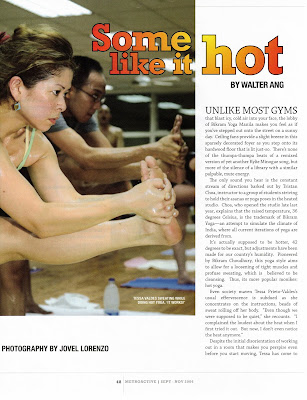
Some like it hot
By Walter Ang
Sept.-Nov. 2006 issue
Metroactive Magazine
Unlike most gyms that blast icy, cold air into your face, the lobby of Bikram Yoga Manila makes you feels as if you've stepped out into the street on a sunny day. Ceiling fans provide a semblance of a slight breeze in this sparse foyer as you step onto its hardwood floors that are lit just-so. None of the thumpa-thumpa beats of a remixed version of yet another Kylie Minogue song. More of the silence of a library with a similar palpable, mute energy.
The only sound you hear is the constant stream of directions barked out by Tristan Choa, instructor to a group of students striving to hold their asanas or yoga poses in the heated studio. Choa, who opened the studio late last year, explains that the raised temperature, 36 degrees Celsius, is the trademark of Bikram Yoga -- an attempt to simulate the climate of India, where all current iterations of yoga are derived from.
It's actually supposed to be hotter, 42 degress to be exact, but adjustments have been made for our country's humidity. Pioneered by Bikram Choudhury, this particular yoga style aims to allow for a loosening of tight muscles and profuse sweating, which is thought to be cleansing. Thus, its more popular moniker: hot yoga.
Even society maven Tessa Prieto-Valdes's usual effervescence takes on a completely subdued turn as she concentrates on the instructions, beads of sweat rolling off her body. "Even though we were supposed to be quiet," she recounts. "I complained the loudest about the heat when I first tried it out. But now, I don't even notice the heat anymore."
Despite the initial disorientation of working out in a room that makes you perspire even before you start moving, Tessa has come to espouse the merits of this kind of yoga. "I started doing Asthanga yoga five years ago but had to stop during my pregnancy," she says. "I tried Bikram yoga after some prodding and after a few months, I was back to my pre-pregnancy weight."
Because it is relatively new compared to other more established yoga styles such as Iyengar and Kundalini, "Purists say hot yoga is for lazy people, that it's the Hollywood version of yoga," confides Valdes. "But, hell, it works! You might as well get into it."
She is quick to point out that it is not a easy work-out at all. Concentration and endurance goes into achieving the sequence of 26 asanas (2 sets in a 90 minute class) that stretch and tone the entire body.
Lauded fashion designer Rhetta Eala remembers the first time he saw a class of students contorting themselves into pretzel shapes. "I just looked at them and laughed. I said to myself, 'They look so ridiculous!' But after I tried it, I felt so good. I loved it!" he raves.
Newbies are given orientations before their first class: Each class is always the same series of poses. It differs for beginners only in intensity. The more classes you take, the more you are able to do the poses correctly. Everyone is to try to do each pose if they can, but not to force themselves if they can't.
"That's why it's such a challenging work-out," explains Valdes. "You are constantly self-correcting yourself. You reinforce your muscle memory and you find yourself bending more and more each time without you really being conscious of the effort involved. I always feel so toned and fit after a class."
She also notes that because students go at their own pace, "Anyone can join regardless of age, gender, or physical condition. In fact, I encouraged my 60-year old friend to come and she's doing just fine. It's great for people who are getting back into fitness or just beginning to get into it."
Rhett, on the other hand, enjoys the low-impact cardio work-out that hot yoga provides. "I used to exercise on treadmills at the gym but my left knee can't take it anymore. With this kind of yoga, the heat loosens the muscles and lessens the chances of injury. It's not a painful way for me to get my cardio."
He dismisses the notion that it is a quick-fix for weight loss. "Yes, the heat helps in reducing injuries and it makes sweating easier, but at the end of the day, if you don't push yourself, nothing will happen to you." The slow-and-steady mindset is quite effective in Rhett's case as he's lost close to 50 lbs. over the course of a year.
Even as Rhett and Tessa have incorporated hot yoga into their schedules, "When I have a full evening schedule, I go to Pye Trinidad's home studio in the mornings. It's suited for those who want a more private environment," claims Tessa, they both agree that it is not the panacea to all of life's aches and extra pounds.
Rhett still religiously goes to the gym in between meeting clients while Tessa mixes it up with flamenco, belly dancing and swimming as she attends to her family and glamming it up for her many events and functions throughout the week.
Both also extol the added boost to their self-discipline as a result of taking hot yoga. "It helps in controlling my diet because yoga makes you feel more aware of your body. You become conscious of what it needs and what it doesn't. When I started doing yoga, I always felt so hungry afterwards, but now I don't," shares Rhett.
And while hot yoga may not be the most spiritual of yoga styles, it can act as a channel for meditation. "With other yoga styles, it's usually very quiet so sometimes your mind wanders. It can be hard to concentrate. I find the constant guidance of the instructors helps me focus on the yoga," enthuses Tessa. "Not only that, after each class, they allow you to stay for as long you need to. You get a chance to meditate on your own, too. It's like meditation for real people"
Rhett concurs, "Because of the guidance, by the time you know it, the class is over. Whenever I feel down or am in a foul mood when I start a class, everything is equalized at the end of it. I've become a much calmer person." He also enjoys the group dynamic of being in a class. "It helps boost your motivation when you see all these other people working hard. Their energy is infectious. It's also a nice way to meet new people. I've become friends with my classmates and all we can talk about when we go out is our poses."
Contact Bikram Yoga Manila at tel. no. 889-1011 or www.bikramyogamanila.com and Pye Trinidad at 0917-834-0659.


Lauren Dyogi is Walking Tall
Walking Tall
By Walter Ang
August-September 2006
Metro Him Magazine
Lauren Dyogi towers above everyone in an ABS-CBN studio bustling with production assistants and auditionees. A veritable lighthouse wearing a crisp white long-sleeved polo, you can feel him sending out invisible beams of guiding light to keep everyone on course. It is just another day in a busy week for this prolific director when we encounter him. Today, he is filtering out groups of hopefuls in order to distill a workable cast for his upcoming show ? the Pinoy version of international reality-TV hit "Big Brother."
As the 29th franchise in the world and the 2nd in Asia, the voyage of mounting our very own adaptation of the show is daunting to say the least. Dyogi, however, is blanketed in an aura of serenity. "I pace myself," he announces in a deep, deliberate voice. "As a director, I always believe that the particular ingredients for putting up a show will fall into place at the right time." He then mentions casually that he will be selecting 50 to 100 finalists from an original 30,000 applications. From there, Dyogi will whittle it down to the final 12 for the show which debuts in August.
The viewing public has a somewhat intimate knowledge of Dyogi's powers of selection when they used to watch him daily as one of the jurors on the talent-search show, "Star Circle Quest." His acerbic evaluations of the contestants made him the juror everyone loved to hate. In this behind-the-scenes process, however, fans of SCQ may find him uncharacteristically courteous as he softly thanks groups of auditionees after giving them a once through.
This is the real Lauren Dyogi, insiders assert. Congenial, professional and with an eye for detail, many readily claim that he is, "a reliable guy to get a show on the road." Dyogi joined ABS-CBN during its resurrection in the mid-80s after graduating Cum Laude with a Communications degree from the University of the Philippines.
"I never planned on becoming a director," the 6-foot tall director intimates. "But when I started doing directing work, it all seemed familiar and right." His decision to honor his gut-feel has served him well on a path towards sure success. Starting out as a production assistant, Dyogi has steadily climbed up the ranks while involved in shows that run the gamut of, as former colleague TV host Apa Ongpin shares, "drama, comedy, talk shows, family shows ? you name it, he's done it."
Of late, the limelight has shone on Dyogi's work with young actors. He is currently directing the winners of the SCQ in their show "SCQ Reload: Kilig ako," and recently helmed the romantic movie, "Now That I Have You," with John Llyod Cruz and Bea Alonzo. Yuppies who are just beginning to find their way through the workforce may remember him as the director of the seminal show that dealt with teenage triumphs and travails, "Gmik."
What audiences may not be aware of, though, is that he is also one of the brains behind meatier fare such as the pioneering dramatized police-cases show, "The Calvento Files," as well as arts and culture program, "Tatak Filipino." A wide and diverse body of work behind him, Dyogi is, "a good choice to handle [Pinoy Big Brother]'s complex technical and artistic issues," says Ongpin.
"It's a big project as you can imagine," concurs Dyogi. This time around, he has to deal not with actors, but with "real" people, so to speak. Technical considerations alone will have Dyogi overseeing, "Twelve people living in one house filled with 26 cameras and 52 microphones. The staff had to take a ten-day training workshop to learn the show's `bible'." Newly promoted as Vice- President for TV Production and a Business Unit Head, Dyogi is quite aware of his responsibilities to mentor newbies to the industry, "Part of the appeal for me is the transfer of technology. We will get a chance to learn the more progressive methods and techniques used globally in television production."
Named for the novel "1984" by Orson Wells, "Big Brother" will let audiences view the interactions between the 12 housemates (that Dyogi will finally select) as they are instructed by "Big Brother" to go through planned activities. Weekly evictions are held until the last remaining resident wins the contest. Dyogi is aware of the cultural sensitivities that the show touches on. "It might not be too Filipino since we will deal with issues like voyeurism and saving face, especially during the evictions."
Dyogi will strive for balance by, "Adjusting and adapting the show to local audiences. I want to make the show concentrate more on the contestants' interpersonal relationships." And that's why the casting process is so crucial. "I want to assemble a cross of different personalities. I want the contestants to be representative of the modern Filipino," he says. Having briefly worked as a fashion model, Dyogi would certainly know that interesting faces appeal to Filipino audiences. Be that as it may, this show, "is not just about being beautiful or handsome.," he promptly explains. "I want to have a good mix of pleasant and obnoxious personalities. No monotonous characters."
Since the contestants will be barred from any outside contact once they are inside the house, Dyogi will not be "directing" the contestants. Instead, he will be tasked to tell a story gleaned from the 24-hour surveillance tapes that record the residents' goings- on. "It's exciting because I cannot plan that much on what will happen. No matter what happens, I still need to be able to tell a story for the audiences," says Dyogi.
The prospect of taking on such a task could easily scare off even the most seasoned veteran. Instead, Dyogi is visibly excited and his large, penetrating eyes gleam in the light as he exclaims, "This show might change the history of Filipino television!" Perhaps it helps that he has decided not to let work take up too much of control of his life. "I remind myself that there is life outside of this edifice [the studio building]. I take time to be with my wife and daughter."
Things really are falling into place for "Direk," since he has been, "Getting a little tired of directing. I am a bit of a control freak and it's good that I will be having more control in this show as a producer (overseeing the editing of the storylines). I've missed being a producer." Fans need not worry that their favorite director might give up on guiding actors though. "Things are cyclical for me. Right now I want to be a producer again, but I'm sure there will come a time when I will want to direct again."
By Walter Ang
August-September 2006
Metro Him Magazine
Lauren Dyogi towers above everyone in an ABS-CBN studio bustling with production assistants and auditionees. A veritable lighthouse wearing a crisp white long-sleeved polo, you can feel him sending out invisible beams of guiding light to keep everyone on course. It is just another day in a busy week for this prolific director when we encounter him. Today, he is filtering out groups of hopefuls in order to distill a workable cast for his upcoming show ? the Pinoy version of international reality-TV hit "Big Brother."
As the 29th franchise in the world and the 2nd in Asia, the voyage of mounting our very own adaptation of the show is daunting to say the least. Dyogi, however, is blanketed in an aura of serenity. "I pace myself," he announces in a deep, deliberate voice. "As a director, I always believe that the particular ingredients for putting up a show will fall into place at the right time." He then mentions casually that he will be selecting 50 to 100 finalists from an original 30,000 applications. From there, Dyogi will whittle it down to the final 12 for the show which debuts in August.
The viewing public has a somewhat intimate knowledge of Dyogi's powers of selection when they used to watch him daily as one of the jurors on the talent-search show, "Star Circle Quest." His acerbic evaluations of the contestants made him the juror everyone loved to hate. In this behind-the-scenes process, however, fans of SCQ may find him uncharacteristically courteous as he softly thanks groups of auditionees after giving them a once through.
This is the real Lauren Dyogi, insiders assert. Congenial, professional and with an eye for detail, many readily claim that he is, "a reliable guy to get a show on the road." Dyogi joined ABS-CBN during its resurrection in the mid-80s after graduating Cum Laude with a Communications degree from the University of the Philippines.
"I never planned on becoming a director," the 6-foot tall director intimates. "But when I started doing directing work, it all seemed familiar and right." His decision to honor his gut-feel has served him well on a path towards sure success. Starting out as a production assistant, Dyogi has steadily climbed up the ranks while involved in shows that run the gamut of, as former colleague TV host Apa Ongpin shares, "drama, comedy, talk shows, family shows ? you name it, he's done it."
Of late, the limelight has shone on Dyogi's work with young actors. He is currently directing the winners of the SCQ in their show "SCQ Reload: Kilig ako," and recently helmed the romantic movie, "Now That I Have You," with John Llyod Cruz and Bea Alonzo. Yuppies who are just beginning to find their way through the workforce may remember him as the director of the seminal show that dealt with teenage triumphs and travails, "Gmik."
What audiences may not be aware of, though, is that he is also one of the brains behind meatier fare such as the pioneering dramatized police-cases show, "The Calvento Files," as well as arts and culture program, "Tatak Filipino." A wide and diverse body of work behind him, Dyogi is, "a good choice to handle [Pinoy Big Brother]'s complex technical and artistic issues," says Ongpin.
"It's a big project as you can imagine," concurs Dyogi. This time around, he has to deal not with actors, but with "real" people, so to speak. Technical considerations alone will have Dyogi overseeing, "Twelve people living in one house filled with 26 cameras and 52 microphones. The staff had to take a ten-day training workshop to learn the show's `bible'." Newly promoted as Vice- President for TV Production and a Business Unit Head, Dyogi is quite aware of his responsibilities to mentor newbies to the industry, "Part of the appeal for me is the transfer of technology. We will get a chance to learn the more progressive methods and techniques used globally in television production."
Named for the novel "1984" by Orson Wells, "Big Brother" will let audiences view the interactions between the 12 housemates (that Dyogi will finally select) as they are instructed by "Big Brother" to go through planned activities. Weekly evictions are held until the last remaining resident wins the contest. Dyogi is aware of the cultural sensitivities that the show touches on. "It might not be too Filipino since we will deal with issues like voyeurism and saving face, especially during the evictions."
Dyogi will strive for balance by, "Adjusting and adapting the show to local audiences. I want to make the show concentrate more on the contestants' interpersonal relationships." And that's why the casting process is so crucial. "I want to assemble a cross of different personalities. I want the contestants to be representative of the modern Filipino," he says. Having briefly worked as a fashion model, Dyogi would certainly know that interesting faces appeal to Filipino audiences. Be that as it may, this show, "is not just about being beautiful or handsome.," he promptly explains. "I want to have a good mix of pleasant and obnoxious personalities. No monotonous characters."
Since the contestants will be barred from any outside contact once they are inside the house, Dyogi will not be "directing" the contestants. Instead, he will be tasked to tell a story gleaned from the 24-hour surveillance tapes that record the residents' goings- on. "It's exciting because I cannot plan that much on what will happen. No matter what happens, I still need to be able to tell a story for the audiences," says Dyogi.
The prospect of taking on such a task could easily scare off even the most seasoned veteran. Instead, Dyogi is visibly excited and his large, penetrating eyes gleam in the light as he exclaims, "This show might change the history of Filipino television!" Perhaps it helps that he has decided not to let work take up too much of control of his life. "I remind myself that there is life outside of this edifice [the studio building]. I take time to be with my wife and daughter."
Things really are falling into place for "Direk," since he has been, "Getting a little tired of directing. I am a bit of a control freak and it's good that I will be having more control in this show as a producer (overseeing the editing of the storylines). I've missed being a producer." Fans need not worry that their favorite director might give up on guiding actors though. "Things are cyclical for me. Right now I want to be a producer again, but I'm sure there will come a time when I will want to direct again."
Subscribe to:
Posts (Atom)