Dulaang U.P. stages anti-sarswela
By Walter Ang
February 26, 2007
Philippine Daily Inquirer
After having directed several productions using foreign material without any "linear" plots, Dulaang U.P. artistic director Jose Estrella wanted to do something "with a storyline, something Filipino." She then came across "Basilia ng Malolos," a sarswela written by Nicanor Tiongson, and was instantly intrigued when the playwright informed her that it was actually an "anti-sarswela."
"It still includes the usual elements of the form like a bida (protagonist), contrabidas (antagonists), the music, and the 'morally correct' ending, but we reinterpreted and transformed, subverted even, these very elements to suit our storytelling needs," said Tiongson.
"Basilia ng Malolos" deals with a group of women that Jose Rizal had written to in 1889 to congratulate them on having a night-school opened. "That was the only thing people knew about them. That they made an innocuous, upper-class request from Governor-General Valeriano Weyler to have Spanish language classes."
There was certainly more than met the eye. After having written a book, entitled "Women of Malolos" and published in 2004, on the history and biographies of these women, Tiongson has intimate knowledge of the reach and implications of their little school.
"It wasn't just a school," claimed Tiongson. He contends that this group of "feisty and intrepid" women were deeply involved in the revolution efforts of the time. They made waves big enough to warrant notice from notables like Rizal and Marcelo Del Pilar. Wanting to bring their stories to a broader audience via an art form, "The sarswela seemed the logical choice. Also, her time period corresponds to the beginning of this form."
Changing the form
Tiongson already has one sarswela, "Pilipinas Circa 1907," under his belt. It was performed in the 80s and 90s by companies like Peta and Tanghalang Pilipino. "This time, I explore the life of Basilia Tantoco (to be essayed by Jenny Jamora) and her role as a leader of the women of Malolos. In the context of the whole reform movement, the things she did were a major salvo," he said.
"When I heard the term 'anti-sarswela,' I had to ask what it meant." laughed Estrella. However, the opportunity to reinvent and update the sarswela is just the kind of thing this innovative director likes to sink her teeth into. "The material is a challenge to direct. At the basic level, there's an idea that sarswelas follow the love angle of the protagonists and they live happily ever after. In Basilia, the surprise comes at the end when all of that is defied and we all see what she does after that."
Tiongson hopes that audiences will ultimately be led to question long-held perceptions and notions of society and culture. "We want people to examine the roles that society assigns them. How the colonial rulers and the feudal elite, with their patriarchy and oppression, have given us customs and beliefs that we hold as 'natural' and 'Filipino.' But are they really as natural and Filipino as we think they are?"
Contemporary sarswela
Tiongson's desired results are a tall order, "But I have one hundred percent trust in Jose. She's a very intelligent and original director." To this end and to further deconstruct the usual devices of the sarswela, Estrella collaborated with musical director Joy Marfil to retool the music of the songs to highlight the struggles of the characters. The objective is that, unlike the pretty melodies and kundimans of romantic sarswelas, the music for this anti-sarswela must not overpower the ideas conveyed by the lyrics.
Estrella is excited by the development of the production's different elements. "I like directing stories that have movement and songs. It's an interesting way to tell the story of Basilia, of feminist ideals, of equal rights. I want to give the audience a different way of looking at it all."
Executing this vision has attracted collaborators that include Dexter Santos for choreography, John Abul for costume design, Ludendorffo Decenteceo for set design, John Batalla for light design, and Mele Yamomo for video design.
And because the scope of Basilia's active life extends well into the 1920s, many years after the end of the revolution against Spain. "Most of the cast and staff have to do double and triple roles. It's really epic!" said Estrella. "But I staged it as simply as I could so that it's easy to follow. There's a contemporary touch to the staging to make it accessible and familiar."
"Basilia ng Malolos" runs until March 4 at the Geurrero Theater, University of the Philippines. Call 926-1349 loc. 2449.
Also published online:
http://showbizandstyle.inquirer.net/lifestyle/lifestyle/view_article.php? article_id=51563
Google Scan:
https://news.google.com/newspapers?id=olk1AAAAIBAJ&sjid=kSUMAAAAIBAJ&pg=564%2C10966068
Alternative Valentine's Dates
Alternative Valentine's Dates
By Walter Ang
February 14, 2007
Philippine Daily Inquirer
We know the formula for Valentine's Day dates. You have the de rigueur chocolates, flowers, fancy dinners, soft music, the works. It's all fun and exciting and romantic, but if you'd rather not deal with the crowds, the traffic and the endless list of things that could go wrong, you can also try 2bU!'s alterna-date ideas. We've come up with a list of different date ideas you can try on the day of love. Hey, your time together can be just as romantic even without candlelight.
Take a hike.
Arrange for a private walking tour of either vibrant Escolta or bustling Chinatown or colorful Quiapo any area of downtown Manila you haven't been to before. If you've never been to these parts of the city, you might as well visit them with someone you like, right? The nostalgia in those old art-deco buildings, the aromas of the merchandise, the vigor of the people are all ingredients to this on-your-feet date. If you're feeling brave, you can go on your own and revel in the joy of the unplanned itinerary. If you'd rather have someone guide you along, check out the websites of streetwalkers Ivan ManDy (www.oldmanilawalks.com) and Carlos Celdran (http://celdrantours.blogspot.com/).
Picnic in the city.
Forget Tagaytay or Baguio. Have a picnic in the middle of the city. Where you ask? Away from the maddening crowds, you can spend a nice quiet evening together on the rooftop of a building. Sitting on your gingham blanket, you can dine under a canopy of stars and amidst the glow of city lights. You heard right, a night time picnic. The sound of the occasional car horn from down below will only add to the urban flair. You know what kind of soundtrack would make it feel like a scene right out of a movie? Bring along a transistor radio and tune into an AM station that plays those old Tagalog love songs. The crackle and static is all part of the fun.
You can make your cake (and eat it, too!).
Try learning something you both have never tried. Not only will you experience or learn something new, you create a new memory for the both of you to share. Why not learn how to ballroom dance or take a one-day cooking class? You don't have to say sweet nothings to each other but you can surely bake it right up. Remember the movie "Ghost"? Be your own Demi Moore and Patrick Swayze in a pottery class. The Instituto Cervantes (http://manila.cervantes.es/) has some upcoming gustatory-related classes like "Mastering Spanish Wine" and "Introduction to Spanish Cuisine."
Day at the museum. Admit it, the only time you've been to a museum was back in the fourth grade with your classmates. This time, no one is forcing you to go so you'll have a better chance of enjoying yourself. Plus, you're a little older now, which means you can finally actually appreciate the things you can see in a museum. There are lots of different kinds of museums (and art galleries) that will suit your fancy (art, history, etc.). To find one that will interest you both, you can visit the site of the Musuem Volunteers of the Philippines (http://mvphilippines.hypermart.net/index2.htm).
Also published online:
http://showbizandstyle.inquirer.net/you/2bu/view_article.php?article_id=49252
Google Scan:
https://news.google.com/newspapers?id=llk1AAAAIBAJ&sjid=kSUMAAAAIBAJ&pg=1167%2C5735590
By Walter Ang
February 14, 2007
Philippine Daily Inquirer
We know the formula for Valentine's Day dates. You have the de rigueur chocolates, flowers, fancy dinners, soft music, the works. It's all fun and exciting and romantic, but if you'd rather not deal with the crowds, the traffic and the endless list of things that could go wrong, you can also try 2bU!'s alterna-date ideas. We've come up with a list of different date ideas you can try on the day of love. Hey, your time together can be just as romantic even without candlelight.
Take a hike.
Arrange for a private walking tour of either vibrant Escolta or bustling Chinatown or colorful Quiapo any area of downtown Manila you haven't been to before. If you've never been to these parts of the city, you might as well visit them with someone you like, right? The nostalgia in those old art-deco buildings, the aromas of the merchandise, the vigor of the people are all ingredients to this on-your-feet date. If you're feeling brave, you can go on your own and revel in the joy of the unplanned itinerary. If you'd rather have someone guide you along, check out the websites of streetwalkers Ivan ManDy (www.oldmanilawalks.com) and Carlos Celdran (http://celdrantours.blogspot.com/).
Picnic in the city.
Forget Tagaytay or Baguio. Have a picnic in the middle of the city. Where you ask? Away from the maddening crowds, you can spend a nice quiet evening together on the rooftop of a building. Sitting on your gingham blanket, you can dine under a canopy of stars and amidst the glow of city lights. You heard right, a night time picnic. The sound of the occasional car horn from down below will only add to the urban flair. You know what kind of soundtrack would make it feel like a scene right out of a movie? Bring along a transistor radio and tune into an AM station that plays those old Tagalog love songs. The crackle and static is all part of the fun.
You can make your cake (and eat it, too!).
Try learning something you both have never tried. Not only will you experience or learn something new, you create a new memory for the both of you to share. Why not learn how to ballroom dance or take a one-day cooking class? You don't have to say sweet nothings to each other but you can surely bake it right up. Remember the movie "Ghost"? Be your own Demi Moore and Patrick Swayze in a pottery class. The Instituto Cervantes (http://manila.cervantes.es/) has some upcoming gustatory-related classes like "Mastering Spanish Wine" and "Introduction to Spanish Cuisine."
Day at the museum. Admit it, the only time you've been to a museum was back in the fourth grade with your classmates. This time, no one is forcing you to go so you'll have a better chance of enjoying yourself. Plus, you're a little older now, which means you can finally actually appreciate the things you can see in a museum. There are lots of different kinds of museums (and art galleries) that will suit your fancy (art, history, etc.). To find one that will interest you both, you can visit the site of the Musuem Volunteers of the Philippines (http://mvphilippines.hypermart.net/index2.htm).
Also published online:
http://showbizandstyle.inquirer.net/you/2bu/view_article.php?article_id=49252
Google Scan:
https://news.google.com/newspapers?id=llk1AAAAIBAJ&sjid=kSUMAAAAIBAJ&pg=1167%2C5735590
Toast 2006: The Art of Winemaking at Wine Depot
Bottoms up with Toast 2006: The Art of Winemaking at Wine Depot
By Walter Ang
December 6, 2006
Philippine Daily Inquirer
In his book "The Metrosexual Guide to Style," Michael Flocker concisely articulates a great way of looking at libations: Beer is easily consumed, fun to indulge in and comes in a variety of brands. There are light beers, dark beers, cheap beers and top-of-the-line beers. Wine is more complex and is more of an acquired taste. Defined by region and produced with a much greater attention to detail, wines are multifaceted and contain subtleties and distinctions that are not always immediately recognizable. Of course, there are also cheap wines.
That being said, he also provides a great analogy for both, likening beer to movies and wine to films. If that's the case, then the recent wine festival, "Toast 2006: The Art of Winemaking," was a veritable Metro Manila Filmfest for wine-lovers.
Organized by WineDepot, the festival featured booths of the different labels and wineries that they carry. Taking over the Rockwell tent, the festival gathered wine aficionados despite the balmy weather. Attendees got to taste all the wine they could while chatting up representatives of different wineries.
Now, wine is one of those things that many 2bU! readers might only have a fleeting encounter with. The occasional wedding reception, a birthday party here and there, or a fancy date when you're out to impress or be impressed. After all, it's so much easier to order a keg of beer if you're out with friends or to get your buzz via cocktails.
However, trying out something new and gaining a better appreciation or perspective for it is always a good thing to do. When it comes to food and drink, there's no other way to learn about it than to literally take it in.
Trying it out
For wines, you can, of course, read up a little bit about it before you buy a bottle or two. You can try out your selections at home with family and friends (that way, you can make faces and be as loud as you want with your commentary). One good trick is to buy two kinds so you can compare. The next time, get a new one to compare with the one you liked.
When it comes to red wine, the usual kinds are cabernet, chianti, merlot, shiraz, pinot noir, and zinfandel. The last two are considered more "light and sweet" and are a good first step for those who want to begin exploring the universe of wines. Not only that, zinfandels can be usually paired with easy, everyday meals like pizza, spaghetti with meat sauce, barbecue chicken, steaks, and burgers.
At one of the wine-tasting classes at the festival, Angus Lilley of Ravenswood Winery (based in Sonoma County, California) shared copious notes and insights on five different zinfandels namely Big River, Barricia, Belloni, Dickerson, and Teldeschi.
Lilley explained that where a wine is made greatly influences the way it tastes. Apparently, California has diverse winegrowing environments, such as varying soils and climates, that confer different grape characters. The way a wine is made also influences the outcome. How a wine is aged, in French oak barrels for example, and how long it is aged also creates different varieties of wine. Thus, a wide varietiey of zinfandels.
The possible combinations and permutations have given birth to Ravenswood's thee tiers of zinfandels: Vineyard Designates (select and limited production), County Series (a blend of modern and classic winemaking techniques), and Vinters Blend Series (wines for everyday drinking). As Lilley uncorked and espoused the differences of the five featured labels, attendees of the class partook and experienced a taste of each.
Mini tasting sessions
The good news is that wine festivals aren't the only time that wine tastings are held. In the three WineDepot showrooms in Makati, Pasig, and Alabang, a nominal fee of P150 lets anyone have a mini-wine tasting session of their own. Advice on what kinds of wine you might like come courtesy of the staff.
"Our staff are well trained to answer any question. We even send them abroad to the different wineries for training," shared Hazel Buenas of WineDepot. "All the wines we carry also have easy-to-read identity cards that note the taste, let's say sweet or spicy, as well as what kinds of food can be best paired with a particular wine. This makes it a bit easier for first-timers to narrow down their choices."
In their efforts to make wine more accessible to a wider audience, WineDepot has a text-message service for updates on featured labels, as well as a website, www.windepot.com.ph, that offers online shopping, information on highlighted selections, current promos, and a newsletter to boot. A prime launch pad for further adventures with wine.
Call WineDepot at 889-4889.
Also published online:
http://showbizandstyle.inquirer.net/lifestyle/lifestyle/view_article.php?article_id=36622
Google Scan:
https://news.google.com/newspapers?id=7VY1AAAAIBAJ&sjid=gyUMAAAAIBAJ&pg=1564%2C2873787
By Walter Ang
December 6, 2006
Philippine Daily Inquirer
In his book "The Metrosexual Guide to Style," Michael Flocker concisely articulates a great way of looking at libations: Beer is easily consumed, fun to indulge in and comes in a variety of brands. There are light beers, dark beers, cheap beers and top-of-the-line beers. Wine is more complex and is more of an acquired taste. Defined by region and produced with a much greater attention to detail, wines are multifaceted and contain subtleties and distinctions that are not always immediately recognizable. Of course, there are also cheap wines.
That being said, he also provides a great analogy for both, likening beer to movies and wine to films. If that's the case, then the recent wine festival, "Toast 2006: The Art of Winemaking," was a veritable Metro Manila Filmfest for wine-lovers.
Organized by WineDepot, the festival featured booths of the different labels and wineries that they carry. Taking over the Rockwell tent, the festival gathered wine aficionados despite the balmy weather. Attendees got to taste all the wine they could while chatting up representatives of different wineries.
Now, wine is one of those things that many 2bU! readers might only have a fleeting encounter with. The occasional wedding reception, a birthday party here and there, or a fancy date when you're out to impress or be impressed. After all, it's so much easier to order a keg of beer if you're out with friends or to get your buzz via cocktails.
However, trying out something new and gaining a better appreciation or perspective for it is always a good thing to do. When it comes to food and drink, there's no other way to learn about it than to literally take it in.
Trying it out
For wines, you can, of course, read up a little bit about it before you buy a bottle or two. You can try out your selections at home with family and friends (that way, you can make faces and be as loud as you want with your commentary). One good trick is to buy two kinds so you can compare. The next time, get a new one to compare with the one you liked.
When it comes to red wine, the usual kinds are cabernet, chianti, merlot, shiraz, pinot noir, and zinfandel. The last two are considered more "light and sweet" and are a good first step for those who want to begin exploring the universe of wines. Not only that, zinfandels can be usually paired with easy, everyday meals like pizza, spaghetti with meat sauce, barbecue chicken, steaks, and burgers.
At one of the wine-tasting classes at the festival, Angus Lilley of Ravenswood Winery (based in Sonoma County, California) shared copious notes and insights on five different zinfandels namely Big River, Barricia, Belloni, Dickerson, and Teldeschi.
Lilley explained that where a wine is made greatly influences the way it tastes. Apparently, California has diverse winegrowing environments, such as varying soils and climates, that confer different grape characters. The way a wine is made also influences the outcome. How a wine is aged, in French oak barrels for example, and how long it is aged also creates different varieties of wine. Thus, a wide varietiey of zinfandels.
The possible combinations and permutations have given birth to Ravenswood's thee tiers of zinfandels: Vineyard Designates (select and limited production), County Series (a blend of modern and classic winemaking techniques), and Vinters Blend Series (wines for everyday drinking). As Lilley uncorked and espoused the differences of the five featured labels, attendees of the class partook and experienced a taste of each.
Mini tasting sessions
The good news is that wine festivals aren't the only time that wine tastings are held. In the three WineDepot showrooms in Makati, Pasig, and Alabang, a nominal fee of P150 lets anyone have a mini-wine tasting session of their own. Advice on what kinds of wine you might like come courtesy of the staff.
"Our staff are well trained to answer any question. We even send them abroad to the different wineries for training," shared Hazel Buenas of WineDepot. "All the wines we carry also have easy-to-read identity cards that note the taste, let's say sweet or spicy, as well as what kinds of food can be best paired with a particular wine. This makes it a bit easier for first-timers to narrow down their choices."
In their efforts to make wine more accessible to a wider audience, WineDepot has a text-message service for updates on featured labels, as well as a website, www.windepot.com.ph, that offers online shopping, information on highlighted selections, current promos, and a newsletter to boot. A prime launch pad for further adventures with wine.
Call WineDepot at 889-4889.
Also published online:
http://showbizandstyle.inquirer.net/lifestyle/lifestyle/view_article.php?article_id=36622
Google Scan:
https://news.google.com/newspapers?id=7VY1AAAAIBAJ&sjid=gyUMAAAAIBAJ&pg=1564%2C2873787
First ever Student Advertising Congress held
Advertisers of tomorrow, first ever Student Advertising Congress held
By Walter Ang
November 29, 2006
Philippine Daily Inquirer
The first ever Student Advertising Congress, with the theme "By the Youth, For the Youth," was recently held at the Aliw Theater in Pasay City.
Philippine Information Agency director Conrad Limchaco gave the keynote speech and pointed out that there are currently 2.7 million students in advertising-related college courses like communications arts.
He cited the potentially "tremendous" contributions these students are capable of delivering for the Philippine economy once they graduate.
Opening remarks were given by Matec Villanueva, an officer of the Association of Accredited Advertising Agencies (4A's), who reminded that students and teachers that advertising is "not glamorous and sosyal," and that it is "first and foremost a service industry" wherein the excitement comes from "creating communications that work."
The congress began with a call to use advertising and other marketing communication disciplines for corporate social responsibility. Campaigns Advocacy and Public Relations (Capri) president Bong Osorio opened the first day's line-up of activities with a backgrounder on the said topic.
Avenues for expression
Philippine Daily Inquirer president Alexandra Prieto was also invited to speak to the over 2,000 participants about the available venues open to them for speaking their minds. Prieto cited PDI's various sections that "address the need of the youth to be heard."
She pointed out the broadsheet's "In the Know" series of "fast facts" that help explain background information on issues to readers, usually highlighted in a box and using layman's terms. Prieto then featured the "Talk of the Town" section that comes out every Sunday that "aims to address current issues from the views of various sectors. The page gives readers a comprehensive and balanced understanding of a current issue."
Most interesting to the congress participants was when Prieto listed PDI's initiatives specifically for the youth such as the Youngblood column in its Opinion section and 2bU!'s "Change the World" series of articles in its Lifestyle section. She urged the participants to take advantage of these opportunities to let their voice be heard and to make a difference.
Activities
The first day's activities featured a forum, dubbed "Saan ka Swak sa Advertising?," where industry experts helped students figure out what kind of advertising-related work they are most suited for apart from the most known creative positions of copywriter and art director.
Moderated by journalist Che-Che Lazaro, the panel consisted of Juliet M. Mendoza of Mediaedge (media planning and buying), Alex Syfu of Dm9jaymesyfu ad agency (account management), Oli Laparel of RS Video and Productions and Sid Maderazo of 88Storey Films (production work), Meckoy Quiogue of GMA Marketing and Production (TV network), Jun Nicdao of Manila Broadcasting Company (radio network), (production).
The second day showcased the awarding ceremonies of the student competitions. Judging was made by officers of the Creative Guild of the Philippines.
Team Espresso from Lyceum of the Phils. University, with Brandy Mae Coco, Ramir Cambiado, James Milo Gamoning, Myra Mirasol Magante and Ruth Luciano, took home the Best Sound Production award (PDI's single medium radio category); and Best Editing and Best TV Ad awards (PDI's single medium TV category).
Pantheon Advertising of Lyceum of the Phils. University, with Jonah Brocka, Jonalyn Balderas, Leenard Delegero, Luela Marie Almazan and Jovy Intal, won the top honors for Philippine Daily Inquirer's single radio and print categories.
However, it was Team Adversingko from University of Santo Tomas, composed of students in the Fine Arts major in Advertising course: Raymond Olano, Jeslie Anne Esperas, Stephanie Mangalindan, Arabella Beltran and Joy Mongado, that took home most of the top awards that included Globe's Single Medium categories for TV, radio and print and the top spot in both Globe and PDI's tri-media category.
Also published online:
http://showbizandstyle.inquirer.net/you/2bu/view_article.php?article_id=35229
Google Scan:
https://news.google.com/newspapers?id=w1c1AAAAIBAJ&sjid=iiUMAAAAIBAJ&pg=3436%2C26852301
By Walter Ang
November 29, 2006
Philippine Daily Inquirer
The first ever Student Advertising Congress, with the theme "By the Youth, For the Youth," was recently held at the Aliw Theater in Pasay City.
Philippine Information Agency director Conrad Limchaco gave the keynote speech and pointed out that there are currently 2.7 million students in advertising-related college courses like communications arts.
He cited the potentially "tremendous" contributions these students are capable of delivering for the Philippine economy once they graduate.
Opening remarks were given by Matec Villanueva, an officer of the Association of Accredited Advertising Agencies (4A's), who reminded that students and teachers that advertising is "not glamorous and sosyal," and that it is "first and foremost a service industry" wherein the excitement comes from "creating communications that work."
The congress began with a call to use advertising and other marketing communication disciplines for corporate social responsibility. Campaigns Advocacy and Public Relations (Capri) president Bong Osorio opened the first day's line-up of activities with a backgrounder on the said topic.
Avenues for expression
Philippine Daily Inquirer president Alexandra Prieto was also invited to speak to the over 2,000 participants about the available venues open to them for speaking their minds. Prieto cited PDI's various sections that "address the need of the youth to be heard."
She pointed out the broadsheet's "In the Know" series of "fast facts" that help explain background information on issues to readers, usually highlighted in a box and using layman's terms. Prieto then featured the "Talk of the Town" section that comes out every Sunday that "aims to address current issues from the views of various sectors. The page gives readers a comprehensive and balanced understanding of a current issue."
Most interesting to the congress participants was when Prieto listed PDI's initiatives specifically for the youth such as the Youngblood column in its Opinion section and 2bU!'s "Change the World" series of articles in its Lifestyle section. She urged the participants to take advantage of these opportunities to let their voice be heard and to make a difference.
Activities
The first day's activities featured a forum, dubbed "Saan ka Swak sa Advertising?," where industry experts helped students figure out what kind of advertising-related work they are most suited for apart from the most known creative positions of copywriter and art director.
Moderated by journalist Che-Che Lazaro, the panel consisted of Juliet M. Mendoza of Mediaedge (media planning and buying), Alex Syfu of Dm9jaymesyfu ad agency (account management), Oli Laparel of RS Video and Productions and Sid Maderazo of 88Storey Films (production work), Meckoy Quiogue of GMA Marketing and Production (TV network), Jun Nicdao of Manila Broadcasting Company (radio network), (production).
The second day showcased the awarding ceremonies of the student competitions. Judging was made by officers of the Creative Guild of the Philippines.
Team Espresso from Lyceum of the Phils. University, with Brandy Mae Coco, Ramir Cambiado, James Milo Gamoning, Myra Mirasol Magante and Ruth Luciano, took home the Best Sound Production award (PDI's single medium radio category); and Best Editing and Best TV Ad awards (PDI's single medium TV category).
Pantheon Advertising of Lyceum of the Phils. University, with Jonah Brocka, Jonalyn Balderas, Leenard Delegero, Luela Marie Almazan and Jovy Intal, won the top honors for Philippine Daily Inquirer's single radio and print categories.
However, it was Team Adversingko from University of Santo Tomas, composed of students in the Fine Arts major in Advertising course: Raymond Olano, Jeslie Anne Esperas, Stephanie Mangalindan, Arabella Beltran and Joy Mongado, that took home most of the top awards that included Globe's Single Medium categories for TV, radio and print and the top spot in both Globe and PDI's tri-media category.
Also published online:
http://showbizandstyle.inquirer.net/you/2bu/view_article.php?article_id=35229
Google Scan:
https://news.google.com/newspapers?id=w1c1AAAAIBAJ&sjid=iiUMAAAAIBAJ&pg=3436%2C26852301
Not just a camera phone: Sony Ericsson K800i
Not just a camera phone: Sony Ericsson K800i
By Walter Ang
November 29, 2006
Philippine Daily Inquirer
Apart from the K800's dandy camera capabilities, it's also packed with multimedia capabilities and lots of features that lets the user maximize wireless connectivity.
It's capable of 3G video calling as well as internet access. For insta-info junkies, it has a built in RSS reader. RSS, or Real Simple Syndication, is a way to find out the latest updates of a website (for example new entries from a blog, the latest articles from a news site or even emails from a Yahoogroup) without actually visiting the website. Instead, links to the newest articles are sent to your RSS reader.
The camera is also integrated with blogger.com software so that you can send your photos to your account. If you don't have an existing blogger.com account (like blogspot.com), the phone will create one for you. It also allows you to edit photos (cropping and such) as well as add text before uploading to the web.
With 64 MB (megabyte) of memory, you can store up to 2,500 numbers. If you're using another brand and want to transfer your phone book entries, one way to do it is to sync your phone to Microsoft Outlook first and then sync the info to your K800i.
On the other hand, you can also store video files or up 124 photos at the highest picture setting. You can upgrade to Sony Ericsson's Memory Stick Micro M2 which provides another 1 GIG (gigabyte) of memory. This memory stick format is new to the market, so let's hope they incorporate it into other Sony Ericsson and Sony products for best long-term value.
The unit comes with headphones that have an FM radio tuner built in. The phone can be plugged into a speaker unit (sold separately) if you want to party. Using Bluetooth, you can control your phone remotely while transferring music files from your laptop or computer. The phone comes bundled with a USB 2.0 cable for more conventional file transfers. It also infrared-capable and can stream MPEG4 and Real video.
Also published online:
http://showbizandstyle.inquirer.net/you/elife/view_article.php?article_id=35873
Google Scan:
https://news.google.com/newspapers?id=w1c1AAAAIBAJ&sjid=iiUMAAAAIBAJ&pg=1487%2C26857832
By Walter Ang
November 29, 2006
Philippine Daily Inquirer
Apart from the K800's dandy camera capabilities, it's also packed with multimedia capabilities and lots of features that lets the user maximize wireless connectivity.
It's capable of 3G video calling as well as internet access. For insta-info junkies, it has a built in RSS reader. RSS, or Real Simple Syndication, is a way to find out the latest updates of a website (for example new entries from a blog, the latest articles from a news site or even emails from a Yahoogroup) without actually visiting the website. Instead, links to the newest articles are sent to your RSS reader.
The camera is also integrated with blogger.com software so that you can send your photos to your account. If you don't have an existing blogger.com account (like blogspot.com), the phone will create one for you. It also allows you to edit photos (cropping and such) as well as add text before uploading to the web.
With 64 MB (megabyte) of memory, you can store up to 2,500 numbers. If you're using another brand and want to transfer your phone book entries, one way to do it is to sync your phone to Microsoft Outlook first and then sync the info to your K800i.
On the other hand, you can also store video files or up 124 photos at the highest picture setting. You can upgrade to Sony Ericsson's Memory Stick Micro M2 which provides another 1 GIG (gigabyte) of memory. This memory stick format is new to the market, so let's hope they incorporate it into other Sony Ericsson and Sony products for best long-term value.
The unit comes with headphones that have an FM radio tuner built in. The phone can be plugged into a speaker unit (sold separately) if you want to party. Using Bluetooth, you can control your phone remotely while transferring music files from your laptop or computer. The phone comes bundled with a USB 2.0 cable for more conventional file transfers. It also infrared-capable and can stream MPEG4 and Real video.
Also published online:
http://showbizandstyle.inquirer.net/you/elife/view_article.php?article_id=35873
Google Scan:
https://news.google.com/newspapers?id=w1c1AAAAIBAJ&sjid=iiUMAAAAIBAJ&pg=1487%2C26857832
REVIEW: Distilling Dulaang UP's 'Hamlet'
Distilling Dulaang UP's 'Hamlet'
By Walter Ang
November 27, 2006
Philippine Daily Inquirer
The world of Hamlet, prince of Denmark, is thrown into a doozy when he learns of his father's death and when his mother Getrude marries his uncle Claudius. He encounters his father's ghost who accuses Claudius of murder. Hamlet must now to find a way to confirm this claim and exact revenge.
In Shakespeare's most quoted play ("To be or not to be," "something is rotten in the state of Denmark," "murder most foul," "the lady doth protests too much," and so on.), death is assuredly a constant shadow hanging over the characters.
In Dulaang U.P.'s staging, dubbed "Hamlet: Redux," director Tony Mabesa couples death with its most famous partner: sex. He prologues the play with a bacchanalia of beasts and phantoms with oversized sex organs, then proceeds to immerse the characters in a world of sexual tension filled with shades of incest, Oedipal love and even voyeurism and cross-dressing.
With English and Tagalog shows, this production also attempts to bring the Bard closer to our times by having the cast wear modern dress and occasionally using pop-culture references like rock-and-roll music, cellphones and drugs, as well as utilizing a set design that incorporates video montages designed by Winter David. Mabesa uses these devices to effectively tighten the action and point out possible motivations of certain characters.
English and Tagalog
Mabesa has created this layered, complex world where his dual-language production offers subtle differences for each version.
Jeremy Domingo leads the English cast that channels a bit of good old British reserve, their emotions broil under the tough facades their characters so valiantly try to put up. Domingo imbues Hamlet with a constant rumbling interior confusion, he is torn by what's going on around him. Richard Cunanan as Claudius is incredibly at ease with the Bard's lines and uses them with great clever timing.
The Tagalog cast, led by Arnold Reyes, as Filipinos are wont to do, wear their emotions on their sleeves. Reyes takes Hamlet on a more frenzied path and lashes out at everyone around him. Angeli Bayani as Gertrudes and Cherry Canton as Ofelia deliver powerful nuanced characterizations.
Both casts maneuver through Mabesa's judicious editing of the text, sustaining the suspense and dread in this abridged two-hour version
(uncut, it runs for four hours).
Tongue-in-cheek
We feel for Hamlet. He is grieving, he's in torment, his loses his girlfriend, etc. Serious themes, for sure.
However, one trick to watching a Shakespearean tragedy is to mine it for all its inherent ridiculousness. On the other hand, if you think about it, Hamlet is paranoid, neurotic, suicidal, sees and believes in ghosts, and is prone to exaggeration and theatrics. After all, this is the guy who pretends to go insane and employs an acting troupe to help solve the mystery.
There's the rub. While the poetry makes us smile, the underlying melodrama makes us smirk. In fact, in National Artist for Theater Rolando Tinio's translation, some scenes unintentionally become quite funny as the Tagalog exposes a fresh take on how silly some of the situations or the English lines can be.
This is where we experience Mabesa showing us the "wink, wink, nudge, nudge"-ness of it all. He presents Hamlet's childhood friends Rosencratz and Guildenstern as bumbling pansies that recall Tin-tin's detective friends, Thomson and Thompson. He also chooses strong actors Alan Palileo (English) and Jacques Borlaza (Tagalog) to portray the "lowly" clown/gravedigger, whose flippant remarks about death mocks all the "high" characters and provides perspective for the audience.
For a cheeky coup d' grace, Mabesa stages the final duel in a way that's inspired by a widely emailed video of Japanese ping-pong players manipulated like bunraku puppets by men in black. Definitely a Hamlet for our times.
Hamlet runs until December 9. Call Dulaang U.P. at 926-1349.
Also published online:
http://showbizandstyle.inquirer.net/lifestyle/lifestyle/view_article.php?article_id=34915
Google Scan:
https://news.google.com/newspapers?id=wlc1AAAAIBAJ&sjid=iiUMAAAAIBAJ&pg=3176%2C26041436
By Walter Ang
November 27, 2006
Philippine Daily Inquirer
The world of Hamlet, prince of Denmark, is thrown into a doozy when he learns of his father's death and when his mother Getrude marries his uncle Claudius. He encounters his father's ghost who accuses Claudius of murder. Hamlet must now to find a way to confirm this claim and exact revenge.
In Shakespeare's most quoted play ("To be or not to be," "something is rotten in the state of Denmark," "murder most foul," "the lady doth protests too much," and so on.), death is assuredly a constant shadow hanging over the characters.
In Dulaang U.P.'s staging, dubbed "Hamlet: Redux," director Tony Mabesa couples death with its most famous partner: sex. He prologues the play with a bacchanalia of beasts and phantoms with oversized sex organs, then proceeds to immerse the characters in a world of sexual tension filled with shades of incest, Oedipal love and even voyeurism and cross-dressing.
With English and Tagalog shows, this production also attempts to bring the Bard closer to our times by having the cast wear modern dress and occasionally using pop-culture references like rock-and-roll music, cellphones and drugs, as well as utilizing a set design that incorporates video montages designed by Winter David. Mabesa uses these devices to effectively tighten the action and point out possible motivations of certain characters.
English and Tagalog
Mabesa has created this layered, complex world where his dual-language production offers subtle differences for each version.
Jeremy Domingo leads the English cast that channels a bit of good old British reserve, their emotions broil under the tough facades their characters so valiantly try to put up. Domingo imbues Hamlet with a constant rumbling interior confusion, he is torn by what's going on around him. Richard Cunanan as Claudius is incredibly at ease with the Bard's lines and uses them with great clever timing.
The Tagalog cast, led by Arnold Reyes, as Filipinos are wont to do, wear their emotions on their sleeves. Reyes takes Hamlet on a more frenzied path and lashes out at everyone around him. Angeli Bayani as Gertrudes and Cherry Canton as Ofelia deliver powerful nuanced characterizations.
Both casts maneuver through Mabesa's judicious editing of the text, sustaining the suspense and dread in this abridged two-hour version
(uncut, it runs for four hours).
Tongue-in-cheek
We feel for Hamlet. He is grieving, he's in torment, his loses his girlfriend, etc. Serious themes, for sure.
However, one trick to watching a Shakespearean tragedy is to mine it for all its inherent ridiculousness. On the other hand, if you think about it, Hamlet is paranoid, neurotic, suicidal, sees and believes in ghosts, and is prone to exaggeration and theatrics. After all, this is the guy who pretends to go insane and employs an acting troupe to help solve the mystery.
There's the rub. While the poetry makes us smile, the underlying melodrama makes us smirk. In fact, in National Artist for Theater Rolando Tinio's translation, some scenes unintentionally become quite funny as the Tagalog exposes a fresh take on how silly some of the situations or the English lines can be.
This is where we experience Mabesa showing us the "wink, wink, nudge, nudge"-ness of it all. He presents Hamlet's childhood friends Rosencratz and Guildenstern as bumbling pansies that recall Tin-tin's detective friends, Thomson and Thompson. He also chooses strong actors Alan Palileo (English) and Jacques Borlaza (Tagalog) to portray the "lowly" clown/gravedigger, whose flippant remarks about death mocks all the "high" characters and provides perspective for the audience.
For a cheeky coup d' grace, Mabesa stages the final duel in a way that's inspired by a widely emailed video of Japanese ping-pong players manipulated like bunraku puppets by men in black. Definitely a Hamlet for our times.
Hamlet runs until December 9. Call Dulaang U.P. at 926-1349.
Also published online:
http://showbizandstyle.inquirer.net/lifestyle/lifestyle/view_article.php?article_id=34915
Google Scan:
https://news.google.com/newspapers?id=wlc1AAAAIBAJ&sjid=iiUMAAAAIBAJ&pg=3176%2C26041436
Confessions of a 'Jewel in the Palace' addict
Confessions of a 'Jewel' addict
By Walter Ang
November 15, 2006
Philippine Daily Inquirer
By the time the first run of "Jewel in the Palace" was about to end earlier this year, I had become so enamored with the show that when two of its actors visited the Philippines, I waited three hours amidst a throng of fans to catch a glimpse of them.
When they finally appeared onstage, they were as small as ants from where I stood. They scurried away after only about three minutes in the spotlight.
I was first encouraged to watch this Koreanovela (the show is on its encore run, weeknights at 6 p.m. on GMA network) when a friend told me how funny it was. I remembered the seminal "Betty La Fea" back in the '90s and how hilarious it was, so I asked for more details.
"It's about Jang Geum, a little orphan girl who wants to become a kitchen chef in the King's palace. She's the 'jewel' the title alludes to," he explained. "When someone steals the flour she needs to use for her final exams, everyone cries."
Intrigued, I dutifully tuned in to see what the fuss was all about. I figured that I, too, could have a good laugh over all this melodramatic silliness of crying over spilt milk, or in this case, stolen flour.
First time
The episode I caught that fateful night had Jang Geum (already one of the junior kitchen staff since she was able to pass that exam by making her own flour) playing detective in an attempt to find out what was causing the paralysis of the King's son. Ah, a mystery as well!
As it turned out, one of the ingredients used in the prince's meal, while medicinal in small amounts, became a paralyzing agent when its effects were magnified by another ingredient in the recipe. How did Jang Geum prove her theory? She cooked the recipe again, adjusting the amount of the paralyzing ingredient, ate it herself, and promptly fell to the floor as she lost all feeling in her extremities.
The episode ended with her friends chiding her, "I don't know if you're smart or stupid." I was laughing so hard I thought I'd end up losing all sensation in my limbs myself. And I was hooked.
How could anyone not fall in love with this naive but determined heroine with a heart of gold who struggled at all costs and endured all to achieve her dreams? If that's quite a mouthful, it is. In the grand scheme of soap operas, her plight is nothing new. But finally, here is a fresh take on the same old themes and archetypes.
Production values
Jang Geum's trials, travails and ultimate triumph when she is forced to shift careers and becomes Korea's first lady doctor is based on a real historical figure. The show is set in another culture and in another time?something fanciful to take the mind away from our daily grind. Production values include gorgeous costumes, detailed sets and inventive camera framing. Let's not forget all those wonderful sequences dealing with food preparation!
However, it was the superb Tagalog translation and dubbing that really kept me glued. The emotions conveyed by the dubbers were spot on. The voice actors of Jang Geum's adopted parents had perfect comic timing to match the facial expressions of the Korean actors. They were absolutely hilarious.
Lessons learned
The translation also brought "deep" Tagalog closer to a huge audience. We have to admit, who among us can actually construct Tagalog sentences with correct grammar and syntax?
So it was great to hear the lyricism and poetry of our own language come to life. I don't know by how many notches my Tagalog skills went up during the run of the show, but I now know the Tagalog word for sulfur (from the episode when Jang Geum had to cook sulfur-fed ducklings for the King).
"Jewel in the Palace" came into my life at a time when I was dealing with my very own cast of dubious characters with ill motives. With Jang Geum, I could have some de-stressing entertainment and also pick up?hokey as this might sound?tidbits of inspiration as she outmaneuvered the many hurdles thrown her way.
I spent the next several months living vicariously through Jang Geum, screaming and shaking my fist at her enemies, laughing at their repeated comeuppances, and smirking at their eventual downfall. For all the months the show was on, I followed Jang Geum through her multiple stumbles and cheered her at her every rise. And, yes, I refused to attend weeknight meetings if it meant I would miss the show.
We all need a Korean fairy tale every now and then.
Also published online:
http://showbizandstyle.inquirer.net/lifestyle/lifestyle/view_article.php? article_id=32614
Google Scan:
https://news.google.com/newspapers?id=tlc1AAAAIBAJ&sjid=iiUMAAAAIBAJ&pg=846%2C19914498
By Walter Ang
November 15, 2006
Philippine Daily Inquirer
By the time the first run of "Jewel in the Palace" was about to end earlier this year, I had become so enamored with the show that when two of its actors visited the Philippines, I waited three hours amidst a throng of fans to catch a glimpse of them.
When they finally appeared onstage, they were as small as ants from where I stood. They scurried away after only about three minutes in the spotlight.
I was first encouraged to watch this Koreanovela (the show is on its encore run, weeknights at 6 p.m. on GMA network) when a friend told me how funny it was. I remembered the seminal "Betty La Fea" back in the '90s and how hilarious it was, so I asked for more details.
"It's about Jang Geum, a little orphan girl who wants to become a kitchen chef in the King's palace. She's the 'jewel' the title alludes to," he explained. "When someone steals the flour she needs to use for her final exams, everyone cries."
Intrigued, I dutifully tuned in to see what the fuss was all about. I figured that I, too, could have a good laugh over all this melodramatic silliness of crying over spilt milk, or in this case, stolen flour.
First time
The episode I caught that fateful night had Jang Geum (already one of the junior kitchen staff since she was able to pass that exam by making her own flour) playing detective in an attempt to find out what was causing the paralysis of the King's son. Ah, a mystery as well!
As it turned out, one of the ingredients used in the prince's meal, while medicinal in small amounts, became a paralyzing agent when its effects were magnified by another ingredient in the recipe. How did Jang Geum prove her theory? She cooked the recipe again, adjusting the amount of the paralyzing ingredient, ate it herself, and promptly fell to the floor as she lost all feeling in her extremities.
The episode ended with her friends chiding her, "I don't know if you're smart or stupid." I was laughing so hard I thought I'd end up losing all sensation in my limbs myself. And I was hooked.
How could anyone not fall in love with this naive but determined heroine with a heart of gold who struggled at all costs and endured all to achieve her dreams? If that's quite a mouthful, it is. In the grand scheme of soap operas, her plight is nothing new. But finally, here is a fresh take on the same old themes and archetypes.
Production values
Jang Geum's trials, travails and ultimate triumph when she is forced to shift careers and becomes Korea's first lady doctor is based on a real historical figure. The show is set in another culture and in another time?something fanciful to take the mind away from our daily grind. Production values include gorgeous costumes, detailed sets and inventive camera framing. Let's not forget all those wonderful sequences dealing with food preparation!
However, it was the superb Tagalog translation and dubbing that really kept me glued. The emotions conveyed by the dubbers were spot on. The voice actors of Jang Geum's adopted parents had perfect comic timing to match the facial expressions of the Korean actors. They were absolutely hilarious.
Lessons learned
The translation also brought "deep" Tagalog closer to a huge audience. We have to admit, who among us can actually construct Tagalog sentences with correct grammar and syntax?
So it was great to hear the lyricism and poetry of our own language come to life. I don't know by how many notches my Tagalog skills went up during the run of the show, but I now know the Tagalog word for sulfur (from the episode when Jang Geum had to cook sulfur-fed ducklings for the King).
"Jewel in the Palace" came into my life at a time when I was dealing with my very own cast of dubious characters with ill motives. With Jang Geum, I could have some de-stressing entertainment and also pick up?hokey as this might sound?tidbits of inspiration as she outmaneuvered the many hurdles thrown her way.
I spent the next several months living vicariously through Jang Geum, screaming and shaking my fist at her enemies, laughing at their repeated comeuppances, and smirking at their eventual downfall. For all the months the show was on, I followed Jang Geum through her multiple stumbles and cheered her at her every rise. And, yes, I refused to attend weeknight meetings if it meant I would miss the show.
We all need a Korean fairy tale every now and then.
Also published online:
http://showbizandstyle.inquirer.net/lifestyle/lifestyle/view_article.php? article_id=32614
Google Scan:
https://news.google.com/newspapers?id=tlc1AAAAIBAJ&sjid=iiUMAAAAIBAJ&pg=846%2C19914498
Kitchie and Barbie in back-to-back concert
Kitchie and Barbie in back-to-back concert
By Walter Ang
November 8, 2006
Philippine Daily Inquirer
Barbie Almabis and Kitchie Nadal recently performed back-to-back for the first time, albeit only a handful of selected people got to see the performance. The two musicians actually headlined a private concert for 19-year old Veron Samonte and forty of her friends and family.
A 19-year old nursing student from Kestergard College, Veron was treated to a free private concert as her winning prize in Sunsilk's "Great Hair Day" promo. Used to taking care of other people as part of her academic tranining, Veron said she enjoyed having the tables turned. "[The Sunsilk staff] made me feel special," she said. "Up until the concert ended, they gave me and my friends VIP treatment."
The concert was held at the intimate Teatrino Hall in Greenhills Promenade where a dinner buffet was also served to the guests. "I've always loved rock bands," exclaimed Veron. "That's why it was such a treat to watch Barbie and Kitchie sing their wonderful songs, just for me!"
As a bonus, Veron was even invited onstage by the two musicians to jam with them in a cover of Erasherheads' "Ligaya." And to think that Veron didn't initially believe that she had won. "It was too-good-to-be-true," revealed. When she was finally convinced that it was no hoax, she wasted no time in inviting her friends. "They said that I'm really lucky. I've never won anything in raffles or that sort of thing. Yup, winning Sunsilk's contest makes me a lucky girl."
In addition to the free concert, part of Veron's prize included outfits from Genevieve Gozum and shoes from Celine as well as a make-over package from David's Salon.
The Sunsilk "Great Hair Days" promo is still ongoing. Participating partners include Jollibee, Celine, Cinderella, Nafnaf, National Bookstore, YRYS, 99 Store, David's Salon, Netopia, Dunkin Donuts, Kamera World, Western Union, Odyssey, Toby's Sports, Super Ferry, Sari-Sari Store, Genevive Gozum, Marcela, SWATCH, and RRJ.
Also published online:
http://showbizandstyle.inquirer.net/lifestyle/lifestyle/view_article.php? article_id=31191
Google Scan:
https://news.google.com/newspapers?id=sFc1AAAAIBAJ&sjid=iiUMAAAAIBAJ&pg=2604%2C16644536
By Walter Ang
November 8, 2006
Philippine Daily Inquirer
Barbie Almabis and Kitchie Nadal recently performed back-to-back for the first time, albeit only a handful of selected people got to see the performance. The two musicians actually headlined a private concert for 19-year old Veron Samonte and forty of her friends and family.
A 19-year old nursing student from Kestergard College, Veron was treated to a free private concert as her winning prize in Sunsilk's "Great Hair Day" promo. Used to taking care of other people as part of her academic tranining, Veron said she enjoyed having the tables turned. "[The Sunsilk staff] made me feel special," she said. "Up until the concert ended, they gave me and my friends VIP treatment."
The concert was held at the intimate Teatrino Hall in Greenhills Promenade where a dinner buffet was also served to the guests. "I've always loved rock bands," exclaimed Veron. "That's why it was such a treat to watch Barbie and Kitchie sing their wonderful songs, just for me!"
As a bonus, Veron was even invited onstage by the two musicians to jam with them in a cover of Erasherheads' "Ligaya." And to think that Veron didn't initially believe that she had won. "It was too-good-to-be-true," revealed. When she was finally convinced that it was no hoax, she wasted no time in inviting her friends. "They said that I'm really lucky. I've never won anything in raffles or that sort of thing. Yup, winning Sunsilk's contest makes me a lucky girl."
In addition to the free concert, part of Veron's prize included outfits from Genevieve Gozum and shoes from Celine as well as a make-over package from David's Salon.
The Sunsilk "Great Hair Days" promo is still ongoing. Participating partners include Jollibee, Celine, Cinderella, Nafnaf, National Bookstore, YRYS, 99 Store, David's Salon, Netopia, Dunkin Donuts, Kamera World, Western Union, Odyssey, Toby's Sports, Super Ferry, Sari-Sari Store, Genevive Gozum, Marcela, SWATCH, and RRJ.
Also published online:
http://showbizandstyle.inquirer.net/lifestyle/lifestyle/view_article.php? article_id=31191
Google Scan:
https://news.google.com/newspapers?id=sFc1AAAAIBAJ&sjid=iiUMAAAAIBAJ&pg=2604%2C16644536
REVIEW: Ghosts in the toilet, skeletons in the closet
Ghosts in the toilet, skeletons in the closet
By Walter Ang
October 25, 2006
Philippine Daily Inquirer
THIS Halloween, you can opt to explore haunted, dingy bathrooms or you can just take a trip to a darkened theater situated in the basement of the Cultural Center of the Philippines (CCP).
Nope, no cobwebs and coffins here, only Tanghalang Pilipino's staging of "Bakeretta (Ghost Operetta)," a Filipino translation of a Japanese play that deals with an amateur theater company as they rehearse a ghost (bake) story "The Ghost in the Toilet."
In this horror-comedy-musical-drama, fans of Japanese horror movies like "Ring" and "The Grudge" will certainly enjoy the way this production pokes fun at the recently popular movie genre. For example, a gaggle of Sadako-wannabees make an appearance, however, they share the stage with one of our very own manananggals. In a recent preview held at lighting designer Shoko Matsumoto's Sinag Arts Studio, even the pacing seemed to mimic the halting rhythm of a suspense-thriller.
As the play was originally written in a provincial dialect of Japan, this Manila production transplants the action to Cebu in an attempt to retain the rustic flavor of the characters in a (mostly) Tagalog translation by Liza Magtoto.
Humor and laughs come as the strong and talented ensemble cast ham it up to effectively portray the not-so- strong and not-so-talented fledgling "actors" go through the paces of their hokey musical numbers (choreographed by Novy Bereber) and overly melodramatic scenes. It's a treat to see the entire cast switch effortlessly from comedy to serious drama and back again.
The audience watches the "rehearsals" unfold to find out if there really is a ghost in the toilet. Along the way, they see how the amateur theater group grapples with their own personal skeletons-in- the-closet: specters of mistrust, fading memories of the past, phantoms of disillusionment, the ephemeral nature of hope, and the ever-present and hanging shadow of death.
At the core of it all is a love triangle brilliantly threshed out by Ronnie Lazaro (to be alternated by Nonie Buencamino), Irma Adlawan-Marasigan, and Mailes Kanapi. These three theater veterans anchor the show with their highly nuanced and sensitive characterizations.
Playwright Chong Wishing flew in specially to direct this staging as part of the commemoration of 50 years of Philippine-Japan friendship, with support from the Japan Foundation Manila Office and the National Commission for Culture and the Arts.
The regular run will be held at the intimate Tanghalang Huseng Batute (Studio Theater) of the CCP from November 10 to 26.
For details, call Tanghalang Pilipino at 832-3661 or 832-1125 loc. 1620 or 1621.
Google Scan:
https://news.google.com/newspapers?id=0KVjAAAAIBAJ&sjid=biUMAAAAIBAJ&pg=2161%2C10501697
By Walter Ang
October 25, 2006
Philippine Daily Inquirer
THIS Halloween, you can opt to explore haunted, dingy bathrooms or you can just take a trip to a darkened theater situated in the basement of the Cultural Center of the Philippines (CCP).
Nope, no cobwebs and coffins here, only Tanghalang Pilipino's staging of "Bakeretta (Ghost Operetta)," a Filipino translation of a Japanese play that deals with an amateur theater company as they rehearse a ghost (bake) story "The Ghost in the Toilet."
In this horror-comedy-musical-drama, fans of Japanese horror movies like "Ring" and "The Grudge" will certainly enjoy the way this production pokes fun at the recently popular movie genre. For example, a gaggle of Sadako-wannabees make an appearance, however, they share the stage with one of our very own manananggals. In a recent preview held at lighting designer Shoko Matsumoto's Sinag Arts Studio, even the pacing seemed to mimic the halting rhythm of a suspense-thriller.
As the play was originally written in a provincial dialect of Japan, this Manila production transplants the action to Cebu in an attempt to retain the rustic flavor of the characters in a (mostly) Tagalog translation by Liza Magtoto.
Humor and laughs come as the strong and talented ensemble cast ham it up to effectively portray the not-so- strong and not-so-talented fledgling "actors" go through the paces of their hokey musical numbers (choreographed by Novy Bereber) and overly melodramatic scenes. It's a treat to see the entire cast switch effortlessly from comedy to serious drama and back again.
The audience watches the "rehearsals" unfold to find out if there really is a ghost in the toilet. Along the way, they see how the amateur theater group grapples with their own personal skeletons-in- the-closet: specters of mistrust, fading memories of the past, phantoms of disillusionment, the ephemeral nature of hope, and the ever-present and hanging shadow of death.
At the core of it all is a love triangle brilliantly threshed out by Ronnie Lazaro (to be alternated by Nonie Buencamino), Irma Adlawan-Marasigan, and Mailes Kanapi. These three theater veterans anchor the show with their highly nuanced and sensitive characterizations.
Playwright Chong Wishing flew in specially to direct this staging as part of the commemoration of 50 years of Philippine-Japan friendship, with support from the Japan Foundation Manila Office and the National Commission for Culture and the Arts.
The regular run will be held at the intimate Tanghalang Huseng Batute (Studio Theater) of the CCP from November 10 to 26.
For details, call Tanghalang Pilipino at 832-3661 or 832-1125 loc. 1620 or 1621.
Google Scan:
https://news.google.com/newspapers?id=0KVjAAAAIBAJ&sjid=biUMAAAAIBAJ&pg=2161%2C10501697
Halloween party madness
Halloween party madness
By Walter Ang
October 25, 2006
Philippine Daily Inquirer
So you're tired of the same old Halloween party themes where everyone puts red liptstick on their chins and runs around screaming, "Blood! I have blood running down my chin!" Pretending to be monsters, vampires, fairies and pirates sure are a fun way for us to let our hair down but they can get a little trite. For a change this year, try out some of these alternative themes.
Run, Tagpi, run!
Want the chance to scream, "Hayop ka!" to your friends? Fun and animal welfare consciousness come together when you organize an endangered-species party. Guests must announce the scientific name of the animal that their costume represents followed by "Save the (common name)!" For example, "Pithecophaga jeffreyii! Save the Philippine Eagle!"
Endangered human species like "honest politician" or "intelligent person" are not allowed. As a twist, you can just have an cartoon-animals--only party where barkadas must have a theme such as Sanrio characters, Disney characters or Hanna-Barbera characters. Use of real animal skin, fur, feathers, scales and what- have-you is strictly prohibited.
Your days are numbered.
Mathletes of the world, unite! Who says braniacs can't have fun? Get inspiration from the educational television show "Math-tinik," and stage your very own fraction party. Yes, fractions! Everyone must come as their favorite fraction. Wear it on your head, splash it across your shirt, come in color coded patches where one color is the numerator and the other color is the denominator, the possibilities are endless!
Keep the non-math fans at bay by requesting everyone to reduce their costume's fraction to the equivalent lowest term. If they can't compute, they're not true math fans.
Attack of the killer tomatoes.
Admit it. Whenever you see little preschool children dressed up as vegetables for their classroom play on healthy foods, deep down inside your heart of hearts, there is a little quivering tinge of regret. Oh how you wish you had raised your hand all those years ago when your very own teacher asked for volunteers.
What are you waiting for then? Throw a vegetable-costumes-only party. Finally, you now have a reason to dress up as a giant eggplant. No pressure of being graded either! For bonus fun, try using real vegetables as part of your costume. You can start eating your costume in the middle of the party and scream, "I'm becoming a cannibal!"
Google Scan:
https://news.google.com/newspapers?id=0KVjAAAAIBAJ&sjid=biUMAAAAIBAJ&pg=613%2C10509052
By Walter Ang
October 25, 2006
Philippine Daily Inquirer
So you're tired of the same old Halloween party themes where everyone puts red liptstick on their chins and runs around screaming, "Blood! I have blood running down my chin!" Pretending to be monsters, vampires, fairies and pirates sure are a fun way for us to let our hair down but they can get a little trite. For a change this year, try out some of these alternative themes.
Run, Tagpi, run!
Want the chance to scream, "Hayop ka!" to your friends? Fun and animal welfare consciousness come together when you organize an endangered-species party. Guests must announce the scientific name of the animal that their costume represents followed by "Save the (common name)!" For example, "Pithecophaga jeffreyii! Save the Philippine Eagle!"
Endangered human species like "honest politician" or "intelligent person" are not allowed. As a twist, you can just have an cartoon-animals--only party where barkadas must have a theme such as Sanrio characters, Disney characters or Hanna-Barbera characters. Use of real animal skin, fur, feathers, scales and what- have-you is strictly prohibited.
Your days are numbered.
Mathletes of the world, unite! Who says braniacs can't have fun? Get inspiration from the educational television show "Math-tinik," and stage your very own fraction party. Yes, fractions! Everyone must come as their favorite fraction. Wear it on your head, splash it across your shirt, come in color coded patches where one color is the numerator and the other color is the denominator, the possibilities are endless!
Keep the non-math fans at bay by requesting everyone to reduce their costume's fraction to the equivalent lowest term. If they can't compute, they're not true math fans.
Attack of the killer tomatoes.
Admit it. Whenever you see little preschool children dressed up as vegetables for their classroom play on healthy foods, deep down inside your heart of hearts, there is a little quivering tinge of regret. Oh how you wish you had raised your hand all those years ago when your very own teacher asked for volunteers.
What are you waiting for then? Throw a vegetable-costumes-only party. Finally, you now have a reason to dress up as a giant eggplant. No pressure of being graded either! For bonus fun, try using real vegetables as part of your costume. You can start eating your costume in the middle of the party and scream, "I'm becoming a cannibal!"
Google Scan:
https://news.google.com/newspapers?id=0KVjAAAAIBAJ&sjid=biUMAAAAIBAJ&pg=613%2C10509052
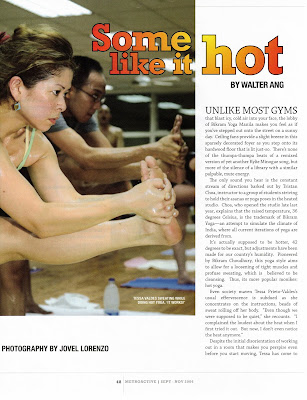
Tessa Prieto-Valdes and Rhett Eala do Bikram yoga
Tessa Prieto-Valdes and Rhett Eala do Bikram yoga
Some like it hot
By Walter Ang
Sept.-Nov. 2006 issue
Metroactive Magazine
Unlike most gyms that blast icy, cold air into your face, the lobby of Bikram Yoga Manila makes you feels as if you've stepped out into the street on a sunny day. Ceiling fans provide a semblance of a slight breeze in this sparse foyer as you step onto its hardwood floors that are lit just-so. None of the thumpa-thumpa beats of a remixed version of yet another Kylie Minogue song. More of the silence of a library with a similar palpable, mute energy.
The only sound you hear is the constant stream of directions barked out by Tristan Choa, instructor to a group of students striving to hold their asanas or yoga poses in the heated studio. Choa, who opened the studio late last year, explains that the raised temperature, 36 degrees Celsius, is the trademark of Bikram Yoga -- an attempt to simulate the climate of India, where all current iterations of yoga are derived from.
It's actually supposed to be hotter, 42 degress to be exact, but adjustments have been made for our country's humidity. Pioneered by Bikram Choudhury, this particular yoga style aims to allow for a loosening of tight muscles and profuse sweating, which is thought to be cleansing. Thus, its more popular moniker: hot yoga.
Even society maven Tessa Prieto-Valdes's usual effervescence takes on a completely subdued turn as she concentrates on the instructions, beads of sweat rolling off her body. "Even though we were supposed to be quiet," she recounts. "I complained the loudest about the heat when I first tried it out. But now, I don't even notice the heat anymore."
Despite the initial disorientation of working out in a room that makes you perspire even before you start moving, Tessa has come to espouse the merits of this kind of yoga. "I started doing Asthanga yoga five years ago but had to stop during my pregnancy," she says. "I tried Bikram yoga after some prodding and after a few months, I was back to my pre-pregnancy weight."
Because it is relatively new compared to other more established yoga styles such as Iyengar and Kundalini, "Purists say hot yoga is for lazy people, that it's the Hollywood version of yoga," confides Valdes. "But, hell, it works! You might as well get into it."
She is quick to point out that it is not a easy work-out at all. Concentration and endurance goes into achieving the sequence of 26 asanas (2 sets in a 90 minute class) that stretch and tone the entire body.
Lauded fashion designer Rhetta Eala remembers the first time he saw a class of students contorting themselves into pretzel shapes. "I just looked at them and laughed. I said to myself, 'They look so ridiculous!' But after I tried it, I felt so good. I loved it!" he raves.
Newbies are given orientations before their first class: Each class is always the same series of poses. It differs for beginners only in intensity. The more classes you take, the more you are able to do the poses correctly. Everyone is to try to do each pose if they can, but not to force themselves if they can't.
"That's why it's such a challenging work-out," explains Valdes. "You are constantly self-correcting yourself. You reinforce your muscle memory and you find yourself bending more and more each time without you really being conscious of the effort involved. I always feel so toned and fit after a class."
She also notes that because students go at their own pace, "Anyone can join regardless of age, gender, or physical condition. In fact, I encouraged my 60-year old friend to come and she's doing just fine. It's great for people who are getting back into fitness or just beginning to get into it."
Rhett, on the other hand, enjoys the low-impact cardio work-out that hot yoga provides. "I used to exercise on treadmills at the gym but my left knee can't take it anymore. With this kind of yoga, the heat loosens the muscles and lessens the chances of injury. It's not a painful way for me to get my cardio."
He dismisses the notion that it is a quick-fix for weight loss. "Yes, the heat helps in reducing injuries and it makes sweating easier, but at the end of the day, if you don't push yourself, nothing will happen to you." The slow-and-steady mindset is quite effective in Rhett's case as he's lost close to 50 lbs. over the course of a year.
Even as Rhett and Tessa have incorporated hot yoga into their schedules, "When I have a full evening schedule, I go to Pye Trinidad's home studio in the mornings. It's suited for those who want a more private environment," claims Tessa, they both agree that it is not the panacea to all of life's aches and extra pounds.
Rhett still religiously goes to the gym in between meeting clients while Tessa mixes it up with flamenco, belly dancing and swimming as she attends to her family and glamming it up for her many events and functions throughout the week.
Both also extol the added boost to their self-discipline as a result of taking hot yoga. "It helps in controlling my diet because yoga makes you feel more aware of your body. You become conscious of what it needs and what it doesn't. When I started doing yoga, I always felt so hungry afterwards, but now I don't," shares Rhett.
And while hot yoga may not be the most spiritual of yoga styles, it can act as a channel for meditation. "With other yoga styles, it's usually very quiet so sometimes your mind wanders. It can be hard to concentrate. I find the constant guidance of the instructors helps me focus on the yoga," enthuses Tessa. "Not only that, after each class, they allow you to stay for as long you need to. You get a chance to meditate on your own, too. It's like meditation for real people"
Rhett concurs, "Because of the guidance, by the time you know it, the class is over. Whenever I feel down or am in a foul mood when I start a class, everything is equalized at the end of it. I've become a much calmer person." He also enjoys the group dynamic of being in a class. "It helps boost your motivation when you see all these other people working hard. Their energy is infectious. It's also a nice way to meet new people. I've become friends with my classmates and all we can talk about when we go out is our poses."
Contact Bikram Yoga Manila at tel. no. 889-1011 or www.bikramyogamanila.com and Pye Trinidad at 0917-834-0659.
Some like it hot
By Walter Ang
Sept.-Nov. 2006 issue
Metroactive Magazine
Unlike most gyms that blast icy, cold air into your face, the lobby of Bikram Yoga Manila makes you feels as if you've stepped out into the street on a sunny day. Ceiling fans provide a semblance of a slight breeze in this sparse foyer as you step onto its hardwood floors that are lit just-so. None of the thumpa-thumpa beats of a remixed version of yet another Kylie Minogue song. More of the silence of a library with a similar palpable, mute energy.
The only sound you hear is the constant stream of directions barked out by Tristan Choa, instructor to a group of students striving to hold their asanas or yoga poses in the heated studio. Choa, who opened the studio late last year, explains that the raised temperature, 36 degrees Celsius, is the trademark of Bikram Yoga -- an attempt to simulate the climate of India, where all current iterations of yoga are derived from.
It's actually supposed to be hotter, 42 degress to be exact, but adjustments have been made for our country's humidity. Pioneered by Bikram Choudhury, this particular yoga style aims to allow for a loosening of tight muscles and profuse sweating, which is thought to be cleansing. Thus, its more popular moniker: hot yoga.
Even society maven Tessa Prieto-Valdes's usual effervescence takes on a completely subdued turn as she concentrates on the instructions, beads of sweat rolling off her body. "Even though we were supposed to be quiet," she recounts. "I complained the loudest about the heat when I first tried it out. But now, I don't even notice the heat anymore."
Despite the initial disorientation of working out in a room that makes you perspire even before you start moving, Tessa has come to espouse the merits of this kind of yoga. "I started doing Asthanga yoga five years ago but had to stop during my pregnancy," she says. "I tried Bikram yoga after some prodding and after a few months, I was back to my pre-pregnancy weight."
Because it is relatively new compared to other more established yoga styles such as Iyengar and Kundalini, "Purists say hot yoga is for lazy people, that it's the Hollywood version of yoga," confides Valdes. "But, hell, it works! You might as well get into it."
She is quick to point out that it is not a easy work-out at all. Concentration and endurance goes into achieving the sequence of 26 asanas (2 sets in a 90 minute class) that stretch and tone the entire body.
Lauded fashion designer Rhetta Eala remembers the first time he saw a class of students contorting themselves into pretzel shapes. "I just looked at them and laughed. I said to myself, 'They look so ridiculous!' But after I tried it, I felt so good. I loved it!" he raves.
Newbies are given orientations before their first class: Each class is always the same series of poses. It differs for beginners only in intensity. The more classes you take, the more you are able to do the poses correctly. Everyone is to try to do each pose if they can, but not to force themselves if they can't.
"That's why it's such a challenging work-out," explains Valdes. "You are constantly self-correcting yourself. You reinforce your muscle memory and you find yourself bending more and more each time without you really being conscious of the effort involved. I always feel so toned and fit after a class."
She also notes that because students go at their own pace, "Anyone can join regardless of age, gender, or physical condition. In fact, I encouraged my 60-year old friend to come and she's doing just fine. It's great for people who are getting back into fitness or just beginning to get into it."
Rhett, on the other hand, enjoys the low-impact cardio work-out that hot yoga provides. "I used to exercise on treadmills at the gym but my left knee can't take it anymore. With this kind of yoga, the heat loosens the muscles and lessens the chances of injury. It's not a painful way for me to get my cardio."
He dismisses the notion that it is a quick-fix for weight loss. "Yes, the heat helps in reducing injuries and it makes sweating easier, but at the end of the day, if you don't push yourself, nothing will happen to you." The slow-and-steady mindset is quite effective in Rhett's case as he's lost close to 50 lbs. over the course of a year.
Even as Rhett and Tessa have incorporated hot yoga into their schedules, "When I have a full evening schedule, I go to Pye Trinidad's home studio in the mornings. It's suited for those who want a more private environment," claims Tessa, they both agree that it is not the panacea to all of life's aches and extra pounds.
Rhett still religiously goes to the gym in between meeting clients while Tessa mixes it up with flamenco, belly dancing and swimming as she attends to her family and glamming it up for her many events and functions throughout the week.
Both also extol the added boost to their self-discipline as a result of taking hot yoga. "It helps in controlling my diet because yoga makes you feel more aware of your body. You become conscious of what it needs and what it doesn't. When I started doing yoga, I always felt so hungry afterwards, but now I don't," shares Rhett.
And while hot yoga may not be the most spiritual of yoga styles, it can act as a channel for meditation. "With other yoga styles, it's usually very quiet so sometimes your mind wanders. It can be hard to concentrate. I find the constant guidance of the instructors helps me focus on the yoga," enthuses Tessa. "Not only that, after each class, they allow you to stay for as long you need to. You get a chance to meditate on your own, too. It's like meditation for real people"
Rhett concurs, "Because of the guidance, by the time you know it, the class is over. Whenever I feel down or am in a foul mood when I start a class, everything is equalized at the end of it. I've become a much calmer person." He also enjoys the group dynamic of being in a class. "It helps boost your motivation when you see all these other people working hard. Their energy is infectious. It's also a nice way to meet new people. I've become friends with my classmates and all we can talk about when we go out is our poses."
Contact Bikram Yoga Manila at tel. no. 889-1011 or www.bikramyogamanila.com and Pye Trinidad at 0917-834-0659.


Lauren Dyogi is Walking Tall
Walking Tall
By Walter Ang
August-September 2006
Metro Him Magazine
Lauren Dyogi towers above everyone in an ABS-CBN studio bustling with production assistants and auditionees. A veritable lighthouse wearing a crisp white long-sleeved polo, you can feel him sending out invisible beams of guiding light to keep everyone on course. It is just another day in a busy week for this prolific director when we encounter him. Today, he is filtering out groups of hopefuls in order to distill a workable cast for his upcoming show ? the Pinoy version of international reality-TV hit "Big Brother."
As the 29th franchise in the world and the 2nd in Asia, the voyage of mounting our very own adaptation of the show is daunting to say the least. Dyogi, however, is blanketed in an aura of serenity. "I pace myself," he announces in a deep, deliberate voice. "As a director, I always believe that the particular ingredients for putting up a show will fall into place at the right time." He then mentions casually that he will be selecting 50 to 100 finalists from an original 30,000 applications. From there, Dyogi will whittle it down to the final 12 for the show which debuts in August.
The viewing public has a somewhat intimate knowledge of Dyogi's powers of selection when they used to watch him daily as one of the jurors on the talent-search show, "Star Circle Quest." His acerbic evaluations of the contestants made him the juror everyone loved to hate. In this behind-the-scenes process, however, fans of SCQ may find him uncharacteristically courteous as he softly thanks groups of auditionees after giving them a once through.
This is the real Lauren Dyogi, insiders assert. Congenial, professional and with an eye for detail, many readily claim that he is, "a reliable guy to get a show on the road." Dyogi joined ABS-CBN during its resurrection in the mid-80s after graduating Cum Laude with a Communications degree from the University of the Philippines.
"I never planned on becoming a director," the 6-foot tall director intimates. "But when I started doing directing work, it all seemed familiar and right." His decision to honor his gut-feel has served him well on a path towards sure success. Starting out as a production assistant, Dyogi has steadily climbed up the ranks while involved in shows that run the gamut of, as former colleague TV host Apa Ongpin shares, "drama, comedy, talk shows, family shows ? you name it, he's done it."
Of late, the limelight has shone on Dyogi's work with young actors. He is currently directing the winners of the SCQ in their show "SCQ Reload: Kilig ako," and recently helmed the romantic movie, "Now That I Have You," with John Llyod Cruz and Bea Alonzo. Yuppies who are just beginning to find their way through the workforce may remember him as the director of the seminal show that dealt with teenage triumphs and travails, "Gmik."
What audiences may not be aware of, though, is that he is also one of the brains behind meatier fare such as the pioneering dramatized police-cases show, "The Calvento Files," as well as arts and culture program, "Tatak Filipino." A wide and diverse body of work behind him, Dyogi is, "a good choice to handle [Pinoy Big Brother]'s complex technical and artistic issues," says Ongpin.
"It's a big project as you can imagine," concurs Dyogi. This time around, he has to deal not with actors, but with "real" people, so to speak. Technical considerations alone will have Dyogi overseeing, "Twelve people living in one house filled with 26 cameras and 52 microphones. The staff had to take a ten-day training workshop to learn the show's `bible'." Newly promoted as Vice- President for TV Production and a Business Unit Head, Dyogi is quite aware of his responsibilities to mentor newbies to the industry, "Part of the appeal for me is the transfer of technology. We will get a chance to learn the more progressive methods and techniques used globally in television production."
Named for the novel "1984" by Orson Wells, "Big Brother" will let audiences view the interactions between the 12 housemates (that Dyogi will finally select) as they are instructed by "Big Brother" to go through planned activities. Weekly evictions are held until the last remaining resident wins the contest. Dyogi is aware of the cultural sensitivities that the show touches on. "It might not be too Filipino since we will deal with issues like voyeurism and saving face, especially during the evictions."
Dyogi will strive for balance by, "Adjusting and adapting the show to local audiences. I want to make the show concentrate more on the contestants' interpersonal relationships." And that's why the casting process is so crucial. "I want to assemble a cross of different personalities. I want the contestants to be representative of the modern Filipino," he says. Having briefly worked as a fashion model, Dyogi would certainly know that interesting faces appeal to Filipino audiences. Be that as it may, this show, "is not just about being beautiful or handsome.," he promptly explains. "I want to have a good mix of pleasant and obnoxious personalities. No monotonous characters."
Since the contestants will be barred from any outside contact once they are inside the house, Dyogi will not be "directing" the contestants. Instead, he will be tasked to tell a story gleaned from the 24-hour surveillance tapes that record the residents' goings- on. "It's exciting because I cannot plan that much on what will happen. No matter what happens, I still need to be able to tell a story for the audiences," says Dyogi.
The prospect of taking on such a task could easily scare off even the most seasoned veteran. Instead, Dyogi is visibly excited and his large, penetrating eyes gleam in the light as he exclaims, "This show might change the history of Filipino television!" Perhaps it helps that he has decided not to let work take up too much of control of his life. "I remind myself that there is life outside of this edifice [the studio building]. I take time to be with my wife and daughter."
Things really are falling into place for "Direk," since he has been, "Getting a little tired of directing. I am a bit of a control freak and it's good that I will be having more control in this show as a producer (overseeing the editing of the storylines). I've missed being a producer." Fans need not worry that their favorite director might give up on guiding actors though. "Things are cyclical for me. Right now I want to be a producer again, but I'm sure there will come a time when I will want to direct again."
By Walter Ang
August-September 2006
Metro Him Magazine
Lauren Dyogi towers above everyone in an ABS-CBN studio bustling with production assistants and auditionees. A veritable lighthouse wearing a crisp white long-sleeved polo, you can feel him sending out invisible beams of guiding light to keep everyone on course. It is just another day in a busy week for this prolific director when we encounter him. Today, he is filtering out groups of hopefuls in order to distill a workable cast for his upcoming show ? the Pinoy version of international reality-TV hit "Big Brother."
As the 29th franchise in the world and the 2nd in Asia, the voyage of mounting our very own adaptation of the show is daunting to say the least. Dyogi, however, is blanketed in an aura of serenity. "I pace myself," he announces in a deep, deliberate voice. "As a director, I always believe that the particular ingredients for putting up a show will fall into place at the right time." He then mentions casually that he will be selecting 50 to 100 finalists from an original 30,000 applications. From there, Dyogi will whittle it down to the final 12 for the show which debuts in August.
The viewing public has a somewhat intimate knowledge of Dyogi's powers of selection when they used to watch him daily as one of the jurors on the talent-search show, "Star Circle Quest." His acerbic evaluations of the contestants made him the juror everyone loved to hate. In this behind-the-scenes process, however, fans of SCQ may find him uncharacteristically courteous as he softly thanks groups of auditionees after giving them a once through.
This is the real Lauren Dyogi, insiders assert. Congenial, professional and with an eye for detail, many readily claim that he is, "a reliable guy to get a show on the road." Dyogi joined ABS-CBN during its resurrection in the mid-80s after graduating Cum Laude with a Communications degree from the University of the Philippines.
"I never planned on becoming a director," the 6-foot tall director intimates. "But when I started doing directing work, it all seemed familiar and right." His decision to honor his gut-feel has served him well on a path towards sure success. Starting out as a production assistant, Dyogi has steadily climbed up the ranks while involved in shows that run the gamut of, as former colleague TV host Apa Ongpin shares, "drama, comedy, talk shows, family shows ? you name it, he's done it."
Of late, the limelight has shone on Dyogi's work with young actors. He is currently directing the winners of the SCQ in their show "SCQ Reload: Kilig ako," and recently helmed the romantic movie, "Now That I Have You," with John Llyod Cruz and Bea Alonzo. Yuppies who are just beginning to find their way through the workforce may remember him as the director of the seminal show that dealt with teenage triumphs and travails, "Gmik."
What audiences may not be aware of, though, is that he is also one of the brains behind meatier fare such as the pioneering dramatized police-cases show, "The Calvento Files," as well as arts and culture program, "Tatak Filipino." A wide and diverse body of work behind him, Dyogi is, "a good choice to handle [Pinoy Big Brother]'s complex technical and artistic issues," says Ongpin.
"It's a big project as you can imagine," concurs Dyogi. This time around, he has to deal not with actors, but with "real" people, so to speak. Technical considerations alone will have Dyogi overseeing, "Twelve people living in one house filled with 26 cameras and 52 microphones. The staff had to take a ten-day training workshop to learn the show's `bible'." Newly promoted as Vice- President for TV Production and a Business Unit Head, Dyogi is quite aware of his responsibilities to mentor newbies to the industry, "Part of the appeal for me is the transfer of technology. We will get a chance to learn the more progressive methods and techniques used globally in television production."
Named for the novel "1984" by Orson Wells, "Big Brother" will let audiences view the interactions between the 12 housemates (that Dyogi will finally select) as they are instructed by "Big Brother" to go through planned activities. Weekly evictions are held until the last remaining resident wins the contest. Dyogi is aware of the cultural sensitivities that the show touches on. "It might not be too Filipino since we will deal with issues like voyeurism and saving face, especially during the evictions."
Dyogi will strive for balance by, "Adjusting and adapting the show to local audiences. I want to make the show concentrate more on the contestants' interpersonal relationships." And that's why the casting process is so crucial. "I want to assemble a cross of different personalities. I want the contestants to be representative of the modern Filipino," he says. Having briefly worked as a fashion model, Dyogi would certainly know that interesting faces appeal to Filipino audiences. Be that as it may, this show, "is not just about being beautiful or handsome.," he promptly explains. "I want to have a good mix of pleasant and obnoxious personalities. No monotonous characters."
Since the contestants will be barred from any outside contact once they are inside the house, Dyogi will not be "directing" the contestants. Instead, he will be tasked to tell a story gleaned from the 24-hour surveillance tapes that record the residents' goings- on. "It's exciting because I cannot plan that much on what will happen. No matter what happens, I still need to be able to tell a story for the audiences," says Dyogi.
The prospect of taking on such a task could easily scare off even the most seasoned veteran. Instead, Dyogi is visibly excited and his large, penetrating eyes gleam in the light as he exclaims, "This show might change the history of Filipino television!" Perhaps it helps that he has decided not to let work take up too much of control of his life. "I remind myself that there is life outside of this edifice [the studio building]. I take time to be with my wife and daughter."
Things really are falling into place for "Direk," since he has been, "Getting a little tired of directing. I am a bit of a control freak and it's good that I will be having more control in this show as a producer (overseeing the editing of the storylines). I've missed being a producer." Fans need not worry that their favorite director might give up on guiding actors though. "Things are cyclical for me. Right now I want to be a producer again, but I'm sure there will come a time when I will want to direct again."
Charmed life of Miguel Castro
Raising the curtains
By Walter Ang
July-September 2006 issue
Metro Him magazine
After Miguel Castro decided to leave his bucolic childhood in Lipa behind to pursue higher studies in the loud and crazy streets of Manila, he soon had to choose between college, his job, and pursuing his growing interest for the performing arts.
The stage wooed him over from the classroom and he hasn't looked back since. While Miguel is soft-spoken and projects a come-what-may attitude, a relentless zeal for theater broils behind those limpid eyes.
Cutting his teeth with Gantimpala Theater Foundation, Miguel started out developing his acting chops under the tutelage of theater pillars Tomy Abuel, Mia Gutierrez, and Roni Lazaro. Since then, he's essayed character roles and lead roles, protagonists and antagonists. He's also forayed into broadcast with occasional roles in television drama anthologies. He's currently in ABS-CBN's "Bituing Walang Ningning" in a supporting role.
Miguel eventually tested his mettle in related disciplines like writing and directing. Just recently, he translated and adapted Arthur Schnitzler's "La Ronde" (the play that Nicole Kidman's "Blue Room" was adapted from) into a treatise on Pinoy machinations of love and power called "Laro."
Not one to back down from exploring self-expression, during a time in his life where he was "surrounded by writers like Danton Remoto and Rinehartt Linmark," Miguel was also inspired to write short stories. One of his works, "Lucy," was eventually included in an anthology of short stories.
Aside from just committing his thoughts to paper, this second of ten siblings also works with paper. During one summer hiatus from the theater season, "I helping out my grandfather and father in our family bookbinding business and, out of boredom, I started designing some paper products like boxes. Friends saw what I did and my business, Castro Designs, grew from there." The business grew exponentially, bringing Miguel to different countries to meet clients and establishing him in Manila as the premier designer and supplier of Venetian masks.
While serendipity seems to play a constant role in Miguel's life, giving him the leeway to explore his other interests, he always returns to his theater roots. "In fact, even if my business has become the main source of income for my family, I see it simply as a way to supplement my career in theater," he states.
There didn't seem to be anything else that Miguel would want, except one thing. "For fourteen years, I was told that I couldn't sing," he confesses. Then along came a little musical called "St. Louis Loves Dem Filipinos" that finally changed everything. Not only was Miguel cast in a singing role, it was the lead no less.
Getting pointers from cast-mate Lionel Guico, Miguel immersed himself in the milieu and immediately felt right at home. "I always get very nervous in the few minutes before the curtain rises when I do plays. But when I was doing St. Louis, I never got nervous, I always got excited." Finding himself in a breakout position was such a memorable experience for Miguel that "[St. Louis] erased the memories of all the past roles that I have ever done. It is now my favorite production."
Encouraged by glowing reviews, Miguel has even ventured to produce an album. A collection of "narrative ballads," the album brings together new compositions that have a theatrical sensibility mixed with a pop edge. "I was able to get my good friend composer Vince de Jesus to allow me to sing the songs he had written. I picked out songs that I liked and since Vince is also a theater artist, we understood what the other wanted. We wanted a sound that "sounded" like it was from a musical."
As the curtains rise on yet another act in the charmed life of Miguel, audiences will have the chance to see another side of him in this album sassily titled "Miguel Castro Sings."
By Walter Ang
July-September 2006 issue
Metro Him magazine
After Miguel Castro decided to leave his bucolic childhood in Lipa behind to pursue higher studies in the loud and crazy streets of Manila, he soon had to choose between college, his job, and pursuing his growing interest for the performing arts.
The stage wooed him over from the classroom and he hasn't looked back since. While Miguel is soft-spoken and projects a come-what-may attitude, a relentless zeal for theater broils behind those limpid eyes.
Cutting his teeth with Gantimpala Theater Foundation, Miguel started out developing his acting chops under the tutelage of theater pillars Tomy Abuel, Mia Gutierrez, and Roni Lazaro. Since then, he's essayed character roles and lead roles, protagonists and antagonists. He's also forayed into broadcast with occasional roles in television drama anthologies. He's currently in ABS-CBN's "Bituing Walang Ningning" in a supporting role.
Miguel eventually tested his mettle in related disciplines like writing and directing. Just recently, he translated and adapted Arthur Schnitzler's "La Ronde" (the play that Nicole Kidman's "Blue Room" was adapted from) into a treatise on Pinoy machinations of love and power called "Laro."
Not one to back down from exploring self-expression, during a time in his life where he was "surrounded by writers like Danton Remoto and Rinehartt Linmark," Miguel was also inspired to write short stories. One of his works, "Lucy," was eventually included in an anthology of short stories.
Aside from just committing his thoughts to paper, this second of ten siblings also works with paper. During one summer hiatus from the theater season, "I helping out my grandfather and father in our family bookbinding business and, out of boredom, I started designing some paper products like boxes. Friends saw what I did and my business, Castro Designs, grew from there." The business grew exponentially, bringing Miguel to different countries to meet clients and establishing him in Manila as the premier designer and supplier of Venetian masks.
While serendipity seems to play a constant role in Miguel's life, giving him the leeway to explore his other interests, he always returns to his theater roots. "In fact, even if my business has become the main source of income for my family, I see it simply as a way to supplement my career in theater," he states.
There didn't seem to be anything else that Miguel would want, except one thing. "For fourteen years, I was told that I couldn't sing," he confesses. Then along came a little musical called "St. Louis Loves Dem Filipinos" that finally changed everything. Not only was Miguel cast in a singing role, it was the lead no less.
Getting pointers from cast-mate Lionel Guico, Miguel immersed himself in the milieu and immediately felt right at home. "I always get very nervous in the few minutes before the curtain rises when I do plays. But when I was doing St. Louis, I never got nervous, I always got excited." Finding himself in a breakout position was such a memorable experience for Miguel that "[St. Louis] erased the memories of all the past roles that I have ever done. It is now my favorite production."
Encouraged by glowing reviews, Miguel has even ventured to produce an album. A collection of "narrative ballads," the album brings together new compositions that have a theatrical sensibility mixed with a pop edge. "I was able to get my good friend composer Vince de Jesus to allow me to sing the songs he had written. I picked out songs that I liked and since Vince is also a theater artist, we understood what the other wanted. We wanted a sound that "sounded" like it was from a musical."
As the curtains rise on yet another act in the charmed life of Miguel, audiences will have the chance to see another side of him in this album sassily titled "Miguel Castro Sings."
An interior designer's compact city retreat
An interior designer's compact city retreat
By Walter Ang
June-August 2006 issue
Metro Home & Entertaining
Forty square meters. That's all the new studio owner had to work with in her new little cubbyhole in one of Makati's newest high rise condominiums. But for this on-the-go restaurateur and interior designer, it turned out to be more than enough.
"When I got this studio, I just wanted to try out having a small space near my restaurant, a half-way house if you will," she recalls. "But having spent several nights here already, I've realized what a huge convenience it is."
The long commutes home to the family residence south of Manila during the week have lessened. More than just a place to rest or freshen up before zooming off to the next meeting, the space has been imbued with a more meaningful purpose. "It's become somewhat of a spiritual center for me. I come here to clear my mind. I even hold Bible study sessions here."
The elegant purity of the tiny space is the handiwork of interior designer Ana Rocha. Emphasizing that this is a place intended to reconnect with clarity, the designer draped white shower curtains by the door to create a small foyer. Stepping through them creates a sense of entering a space shielded from the outside world.
To encourage the cleansing of noise from the mind, the designer retained the studio's original white color. Creating the illusion of added space, she unified a pair of sofas and a daybed against one side of the room by upholstering them in white as well. For practical purposes, she ingeniously employs fabric that's usually used for sneakers. "They're super easy to clean. You just wipe with a rag and you're done!" exclaims the designer. She clad the pillows in the same semi-waterproof fabric she used to create the foyer.
For entertaining the occasional small group of friends, two square wooden tables are placed together to create a long table for dining. A long bench against the walls and chairs on the other create variety while still maintaining a Zen atmosphere. For a personalized touch of creativity, the designer transformed a set of capiz bowls and cups that she "couldn't stand" into centrepieces with a simple glue gun.
Touches of color are courtesy of paintings of fruits and vegetables hung above the couches. "At least that's what they look like to me!" she jokes. Further enhancing the vertical clearance of the studio, two standing lamps are placed on elevated surfaces, making their shades almost graze the ceiling. The lamps' coconut tree trunk design adds an organic element to the room as they flank the picture window.
An elongated oriental lamp in the middle of the room adds a touch of whimsy. "You've got have fun!" encourages the lady of the house. "You have to pick out things that make you happy."
By Walter Ang
June-August 2006 issue
Metro Home & Entertaining
Forty square meters. That's all the new studio owner had to work with in her new little cubbyhole in one of Makati's newest high rise condominiums. But for this on-the-go restaurateur and interior designer, it turned out to be more than enough.
"When I got this studio, I just wanted to try out having a small space near my restaurant, a half-way house if you will," she recalls. "But having spent several nights here already, I've realized what a huge convenience it is."
The long commutes home to the family residence south of Manila during the week have lessened. More than just a place to rest or freshen up before zooming off to the next meeting, the space has been imbued with a more meaningful purpose. "It's become somewhat of a spiritual center for me. I come here to clear my mind. I even hold Bible study sessions here."
The elegant purity of the tiny space is the handiwork of interior designer Ana Rocha. Emphasizing that this is a place intended to reconnect with clarity, the designer draped white shower curtains by the door to create a small foyer. Stepping through them creates a sense of entering a space shielded from the outside world.
To encourage the cleansing of noise from the mind, the designer retained the studio's original white color. Creating the illusion of added space, she unified a pair of sofas and a daybed against one side of the room by upholstering them in white as well. For practical purposes, she ingeniously employs fabric that's usually used for sneakers. "They're super easy to clean. You just wipe with a rag and you're done!" exclaims the designer. She clad the pillows in the same semi-waterproof fabric she used to create the foyer.
For entertaining the occasional small group of friends, two square wooden tables are placed together to create a long table for dining. A long bench against the walls and chairs on the other create variety while still maintaining a Zen atmosphere. For a personalized touch of creativity, the designer transformed a set of capiz bowls and cups that she "couldn't stand" into centrepieces with a simple glue gun.
Touches of color are courtesy of paintings of fruits and vegetables hung above the couches. "At least that's what they look like to me!" she jokes. Further enhancing the vertical clearance of the studio, two standing lamps are placed on elevated surfaces, making their shades almost graze the ceiling. The lamps' coconut tree trunk design adds an organic element to the room as they flank the picture window.
An elongated oriental lamp in the middle of the room adds a touch of whimsy. "You've got have fun!" encourages the lady of the house. "You have to pick out things that make you happy."
Ana Rocha designs a multicultural Asian-safari home
Ana Rocha designs a multicultural Asian-safari home
By Walter Ang
June-August 2006 issue
Metro Home & Entertaining magazine
A safari awaits visitors to the home of this Filipina and her Irish husband. As one treads through the foyer, the feet and eyes are led into an open space that serves as the living area. Awash in varying hues of the earth, an organic sensation of earth and sand persists, yet a lightness of being pervades.
A herd of elephant figurines and a nest of ostrich eggs are stationed in the living area table. Surrounding it are three long sofas. Swathed in fabrics with interweaving elements, they meld into one another despite their girth. The moss color of this is found in the other, the textured fabric of that is repeated in that one over there, and so on. Leaf motifs are iterated and textures are alternated in the multitude of pillows, almost like a neat row of foliage.
Further down this rectangle hall is another seating area. Surrounded by four wooden chairs, a large kawa (carved from single piece of wood) rises from the floor like a well. Above it is a lighting fixture hung low, in a diaphanous casing that brings to mind the moon. And as if being teased by a mirage, one realizes that the same light also hangs by the sofas.
"I actually designed the whole living space around those two lighting fixtures," recounts interior designer Ana Rocha. "Since the homeowners have three beautiful children, I wanted to imbue this home with a sense of brightness and life. I wanted to explore the things that make them happy."
Nestled into one of the southern Makati villages, the homeowners hunted down Ana to lead the design expedition for their new house. Trekking onwards from her initial concept, Ana has achieved a homey sophistication with her clever compositions.
Using the homeowners' existing furniture and décor pieces culled from their travels, Ana edited out "pieces that were too whimsical" and layered everything together with finds from antique stores. With several pieces of the homeowners' Oriental wooden chests, bureaus and armoires at her disposal, Ana created what she calls "a multi- cultural Asian safari with an influence of Filipino, Thai and Chinese."
Bending the rules is key in Ana's design aesthetic. "I love to exaggerate and mix things around. Traditionally, the smaller seating area comes before the living area, but I reversed them and brought the kawa closer to the lanai. The Chinese buffet table is used together with locally crafted chairs to create a more interesting combination."
Ana utilizes lighter fabrics and color to keep the darker wood tones and larger furniture pieces from weighing the room down too much. Curtains that recall the color of ivory tusks billow in the wind while shaggy abaca rugs defines her areas.
Punches of color come from paintings flanking the living area together with anahaw leaves freshly picked from the garden. Mixing old and new, organic and structured, Ana punctuates the space with Thai metal figurines with geometric lampshades in staggered heights. "Don't be afraid to mix and match!" she urges.
While Ana juggles this delicate balance, she also makes sure that fun is an integral part of the jigsaw puzzle. True enough, as one traverses the hall, a tremendous pop of fuchsia suddenly springs out from the dining area. The walls and even the curtains here all revel in this whimsical color.
"I like using colors to stimulate the senses. The dining area of a home should make your eyes hungry first. This color is great for tickling the mind first, then it translates into the palette. I want this dining area to make you want to eat!" she explains.
Again, the careful blending of elements comes into play. The wild wall color is anchored by a wooden dining table. A table runner embroidered with golden curlicues are deliberately placed off to the side. "It's just a little bit of fun as part of the design. The design is rich and condensed, but the fabric is light, airy organza, so it doesn't feel heavy at all."
Ana expands this intimate space by simply using mirrors that face the windows, bringing in more of the outside. She reinforces the Oriental touches from the living area courtesy of a wall painting featuring Thai elephants. It's an apt symbol of the life journey that the homeowners and their children (who have lived in the house for only a month) are sure to embark on.
By Walter Ang
June-August 2006 issue
Metro Home & Entertaining magazine
A safari awaits visitors to the home of this Filipina and her Irish husband. As one treads through the foyer, the feet and eyes are led into an open space that serves as the living area. Awash in varying hues of the earth, an organic sensation of earth and sand persists, yet a lightness of being pervades.
A herd of elephant figurines and a nest of ostrich eggs are stationed in the living area table. Surrounding it are three long sofas. Swathed in fabrics with interweaving elements, they meld into one another despite their girth. The moss color of this is found in the other, the textured fabric of that is repeated in that one over there, and so on. Leaf motifs are iterated and textures are alternated in the multitude of pillows, almost like a neat row of foliage.
Further down this rectangle hall is another seating area. Surrounded by four wooden chairs, a large kawa (carved from single piece of wood) rises from the floor like a well. Above it is a lighting fixture hung low, in a diaphanous casing that brings to mind the moon. And as if being teased by a mirage, one realizes that the same light also hangs by the sofas.
"I actually designed the whole living space around those two lighting fixtures," recounts interior designer Ana Rocha. "Since the homeowners have three beautiful children, I wanted to imbue this home with a sense of brightness and life. I wanted to explore the things that make them happy."
Nestled into one of the southern Makati villages, the homeowners hunted down Ana to lead the design expedition for their new house. Trekking onwards from her initial concept, Ana has achieved a homey sophistication with her clever compositions.
Using the homeowners' existing furniture and décor pieces culled from their travels, Ana edited out "pieces that were too whimsical" and layered everything together with finds from antique stores. With several pieces of the homeowners' Oriental wooden chests, bureaus and armoires at her disposal, Ana created what she calls "a multi- cultural Asian safari with an influence of Filipino, Thai and Chinese."
Bending the rules is key in Ana's design aesthetic. "I love to exaggerate and mix things around. Traditionally, the smaller seating area comes before the living area, but I reversed them and brought the kawa closer to the lanai. The Chinese buffet table is used together with locally crafted chairs to create a more interesting combination."
Ana utilizes lighter fabrics and color to keep the darker wood tones and larger furniture pieces from weighing the room down too much. Curtains that recall the color of ivory tusks billow in the wind while shaggy abaca rugs defines her areas.
Punches of color come from paintings flanking the living area together with anahaw leaves freshly picked from the garden. Mixing old and new, organic and structured, Ana punctuates the space with Thai metal figurines with geometric lampshades in staggered heights. "Don't be afraid to mix and match!" she urges.
While Ana juggles this delicate balance, she also makes sure that fun is an integral part of the jigsaw puzzle. True enough, as one traverses the hall, a tremendous pop of fuchsia suddenly springs out from the dining area. The walls and even the curtains here all revel in this whimsical color.
"I like using colors to stimulate the senses. The dining area of a home should make your eyes hungry first. This color is great for tickling the mind first, then it translates into the palette. I want this dining area to make you want to eat!" she explains.
Again, the careful blending of elements comes into play. The wild wall color is anchored by a wooden dining table. A table runner embroidered with golden curlicues are deliberately placed off to the side. "It's just a little bit of fun as part of the design. The design is rich and condensed, but the fabric is light, airy organza, so it doesn't feel heavy at all."
Ana expands this intimate space by simply using mirrors that face the windows, bringing in more of the outside. She reinforces the Oriental touches from the living area courtesy of a wall painting featuring Thai elephants. It's an apt symbol of the life journey that the homeowners and their children (who have lived in the house for only a month) are sure to embark on.
Aquamen, the Philippine Water Polo team
Aquamen, the Philippine Water Polo team
By Walter Ang
April-June 2006
Metro Him Magazine
The sun pierced the morning clouds with shafts of light that skimmed the water's surface. Across the pool were sinewy bodies, skin glistening, cutting figures that belied graceful strength.
These bronzed gods of the National Water Polo team broke the stillness of the air with their whoops of encouragement for each other. Through the motions of a training session, their exuberance was to be expected. Under the aegis of coach Reynaldo Galang, the team had just recently won the silver medal in the SEA (South East Asian) Games held in our country.
The triumph is testament to the commitment this group of hardy athletes has put in to the team. Meeting daily at 5am, the next four hours are purely dedicated to training. Every day is a heady dose of drills and swimming exercises, with weightlifting thrown in for good measure.
With an average age of 28, these men have come together from across the nation. Nine out of the thirteen members do double duty for our country by serving for either the military or navy. Discipline and obligation comes part and parcel of being a member of the team. Team captain Sherwin de la Paz spoke of sacrifices made, but that "if your heart is in it, you enjoy it a lot. It's feels good and it's fun."
Despite the cut muscles and towering presence, the team is less a squad of snobby power athletes than it is a fraternity of affable blokes. Smiles, smart one-liners, and guffaws punctuate everything they say. No one is spared good natured ribbing.
It's this apparent collegial group dynamic that made Tani Gomez and Roy Cañete transfer from another water sport. "They saw how much fun we were having," recounted Coach Galang. "So they joined the team."
Stronger the a siren's call, the sport is apparently difficult to give up. Co-captain Allan Cesar Payawan is so enamored with the sport that he's been trying to leave for the past few years to no avail. "I have finally graduated with an architecture degree while still being part of the team, but I'm having too much fun here."
The team is not all sport and social bonding, however. Part of their physical prowess is fittingly channeled into spiritual growth as well with once-a-week Bible study lessons. The shared efforts and common victories have forged an unseen yet highly palpable connection within the troupe. This band of brothers, in fact, fondly refers to their team-building sessions as "family-building."
By Walter Ang
April-June 2006
Metro Him Magazine
The sun pierced the morning clouds with shafts of light that skimmed the water's surface. Across the pool were sinewy bodies, skin glistening, cutting figures that belied graceful strength.
These bronzed gods of the National Water Polo team broke the stillness of the air with their whoops of encouragement for each other. Through the motions of a training session, their exuberance was to be expected. Under the aegis of coach Reynaldo Galang, the team had just recently won the silver medal in the SEA (South East Asian) Games held in our country.
The triumph is testament to the commitment this group of hardy athletes has put in to the team. Meeting daily at 5am, the next four hours are purely dedicated to training. Every day is a heady dose of drills and swimming exercises, with weightlifting thrown in for good measure.
With an average age of 28, these men have come together from across the nation. Nine out of the thirteen members do double duty for our country by serving for either the military or navy. Discipline and obligation comes part and parcel of being a member of the team. Team captain Sherwin de la Paz spoke of sacrifices made, but that "if your heart is in it, you enjoy it a lot. It's feels good and it's fun."
Despite the cut muscles and towering presence, the team is less a squad of snobby power athletes than it is a fraternity of affable blokes. Smiles, smart one-liners, and guffaws punctuate everything they say. No one is spared good natured ribbing.
It's this apparent collegial group dynamic that made Tani Gomez and Roy Cañete transfer from another water sport. "They saw how much fun we were having," recounted Coach Galang. "So they joined the team."
Stronger the a siren's call, the sport is apparently difficult to give up. Co-captain Allan Cesar Payawan is so enamored with the sport that he's been trying to leave for the past few years to no avail. "I have finally graduated with an architecture degree while still being part of the team, but I'm having too much fun here."
The team is not all sport and social bonding, however. Part of their physical prowess is fittingly channeled into spiritual growth as well with once-a-week Bible study lessons. The shared efforts and common victories have forged an unseen yet highly palpable connection within the troupe. This band of brothers, in fact, fondly refers to their team-building sessions as "family-building."
DJ Montano yearns for old-world elan
Yearning for Old-World Elan
By Walter Ang
April-June 2006
Metro Him Magazine
"My favorite piece of clothing is my plain black Bench t-shirt," states DJ Montano in his paced, genteel manner. "It's so versatile. I can dress it up with a jacket or pair it with jeans for a casual look."
DJ credits grandmother, Virginia, for fostering his ability to mix and match. "She was a politician's wife and she was always so elegant. At our home, there was always a constant stream of visitors calling on my grandfather, former Cavite governor Delfino ? the "D" in DJ. As such, she was very particular about what we wore and how we behaved. My sense of style is greatly influenced by her."
Born into a family dedicated to public service (great grandfather, Justiano ? the "J" in DJ, was a senator), DJ's upbringing was steeped in propriety, etiquette and graciousness. It appropriately led to his calling as one of Manila's most happening restaurateurs.
Having had trained in Le Roches in Switzerland, when it comes to style and fashion, he's seen it all. "When I was studying, I traveled throughout Europe. I was exposed to so many different ways of dressing up. I could spend an entire afternoon in a Paris café just looking at what people were wearing. The street was their catwalk. The Europeans have a style that has a certain flair, a je ne sais quoi that I like."
Upon his return to Manila, DJ promptly gave birth to three of the most popular dining venues of the metropolis in the early 2000s. His international verve was clearly infused into Indian-cuisine restaurant Raj and Asian-cuisine restaurant Courtyard. Interestingly enough, it was a passion for water that inspired DJ to create one of the hottest places to be at during those years: the revolutionary chill-out lounge Acquario.
Fearless in pursuit of originality in both work and fashion, DJ's pet peeves are people who look like they replicated everything from a fashion magazine print ad down to the last detail. "Copying is fine, but you have to turn it into something that's your own. I myself am always inspired by film noir, the classics."
The nostalgia for a bygone era is grounded in fond memories of his grandfather. "He would always look so dignified in cream linen suits with a hat. Oh, if we could only bring back the stylish days of old Manila." This seminal yearning is probably the reason why, despite being on the forefront of the "it" scene, an old-world panache seems to organically envelope him.
Don't get him wrong though. Staid and antiquated is something he's definitely not. "I consider my style very, very eccentric. I'd wear an all black ensemble with a pair of snakeskin loafers." He points out, however, that while clothes make the man, how the man wears the clothes makes all the difference. "You have to carry yourself and your clothes appropriately. Attitude is important."
The delicate balance he achieves with his clothes carry over into his work as well. As a columnist for a national broadsheet and occasional stylist for Metro Him, DJ makes sure he finds the time to serve in his family's foundation that provides education for indigent students in Cavite. With regular visits to Boracay to get some downtime, DJ is currently cooking up a new dining establishment slated to open by the end of the year.
By Walter Ang
April-June 2006
Metro Him Magazine
"My favorite piece of clothing is my plain black Bench t-shirt," states DJ Montano in his paced, genteel manner. "It's so versatile. I can dress it up with a jacket or pair it with jeans for a casual look."
DJ credits grandmother, Virginia, for fostering his ability to mix and match. "She was a politician's wife and she was always so elegant. At our home, there was always a constant stream of visitors calling on my grandfather, former Cavite governor Delfino ? the "D" in DJ. As such, she was very particular about what we wore and how we behaved. My sense of style is greatly influenced by her."
Born into a family dedicated to public service (great grandfather, Justiano ? the "J" in DJ, was a senator), DJ's upbringing was steeped in propriety, etiquette and graciousness. It appropriately led to his calling as one of Manila's most happening restaurateurs.
Having had trained in Le Roches in Switzerland, when it comes to style and fashion, he's seen it all. "When I was studying, I traveled throughout Europe. I was exposed to so many different ways of dressing up. I could spend an entire afternoon in a Paris café just looking at what people were wearing. The street was their catwalk. The Europeans have a style that has a certain flair, a je ne sais quoi that I like."
Upon his return to Manila, DJ promptly gave birth to three of the most popular dining venues of the metropolis in the early 2000s. His international verve was clearly infused into Indian-cuisine restaurant Raj and Asian-cuisine restaurant Courtyard. Interestingly enough, it was a passion for water that inspired DJ to create one of the hottest places to be at during those years: the revolutionary chill-out lounge Acquario.
Fearless in pursuit of originality in both work and fashion, DJ's pet peeves are people who look like they replicated everything from a fashion magazine print ad down to the last detail. "Copying is fine, but you have to turn it into something that's your own. I myself am always inspired by film noir, the classics."
The nostalgia for a bygone era is grounded in fond memories of his grandfather. "He would always look so dignified in cream linen suits with a hat. Oh, if we could only bring back the stylish days of old Manila." This seminal yearning is probably the reason why, despite being on the forefront of the "it" scene, an old-world panache seems to organically envelope him.
Don't get him wrong though. Staid and antiquated is something he's definitely not. "I consider my style very, very eccentric. I'd wear an all black ensemble with a pair of snakeskin loafers." He points out, however, that while clothes make the man, how the man wears the clothes makes all the difference. "You have to carry yourself and your clothes appropriately. Attitude is important."
The delicate balance he achieves with his clothes carry over into his work as well. As a columnist for a national broadsheet and occasional stylist for Metro Him, DJ makes sure he finds the time to serve in his family's foundation that provides education for indigent students in Cavite. With regular visits to Boracay to get some downtime, DJ is currently cooking up a new dining establishment slated to open by the end of the year.
Melvin Mangada's disruptive soul
Disruptive Soul
By Walter Ang
November 2005
Metro Magazine
Melvin Mangada walks into the frame, his hair a lion's mane of wavy tendrils softening his tall frame. The background is his all-white lair, energy crackling in the air. The man is wearing a black sports jacket oh-so-casually paired with stone-washed jeans and blue Prada sneakers. A beam of red light shines against the wall behind him, sculpting a box with the letters "TBWA/SMP" for all to see. Everything looks and feels in place. The camera clicks away and you can almost hear him purr.
He's got every reason to preen. He is the "M" in those last three letters, the initials of a triumvirate who have been roaring loudly these past few years in the advertising industry. As executive creative director of this four-year old ad agency, Mangada has been leading his pack of copywriters and art directors towards one conquest after another.
"When I was approached to join TBWA, my only condition was that creative output must be regarded as the most important aspect if we were to build this agency from the ground up," shares Mangada. His singular focus for creative excellence has certainly paid off. On its first few months of existence alone, the agency had already won an Ad of the Year award from the Creative Guild (a group run by and for creative professionals in the ad industry).
Mangada is an apt candidate to execute the agency's guiding principle of "disruption" as a form of advertising communication since he imbibes this concept on a seminal level. A case in point is their address. With his partners Tong Puno and Jimmy Santiago, Mangada set up shop away from the maddening crowd of the Makati central business district. "That's one of the first things we did to shake things up," volunteers Mangada.
The result is a warehouse's shell transformed into a pristine space where, unlike ubiquitous offices filled to the rafters with rigid cubicles, people work together on interconnected desk spaces or a long table anchored in the middle of the floor. "We tore down walls and doors. We wanted an open, transparent space conducive for sharing great, creative ideas."
With their home based all prepped up, the agency was poised to disrupt jaded Filipino television junkies who'd seen it all. Under the leadership of Mangada, the agency's commercials got people talking. Sneakers, fried chicken, filmfests, pain relievers, anti- fungal creams are just some of the many products that have shot to stardom (and corresponding sales) due to Mangada and his team's touch. Bottomlines notwithstanding, he has also spearheaded donating the agency's talents to causes such as Hands On Manila, Buwan ng Wika, Mindanao Council for Women and Eye Bank.
Acknowledgements, accolades and new accounts started pouring in, but so did the long hours and lost weekends. However, with winning Agency of the Year the second time in a row this year, Mangada has decreed a slight pace change at the workplace. "Work is no longer allowed during weekends," he offers. "We'd like to relish what we have worked so hard for."
He treated himself to a well-deserved vacation in Europe recently and, true to form, did not go to the popular tourist areas. "I spent more time in the small villages outside Barcelona and the Tuscan countryside. Travel is a form of education you can't get from any institution, especially if you live with the locals. It helps with my creativity."
Also, he now has a little more time devoted to picking out artworks and paintings for the office. Original plans to turn the ground floor of their warehouse into an art gallery were scrapped when the agency had to expand exponentially with the number of new clients coming in. The gallery may not have come to fruition, but artworks are still generously spread out over the space, mostly from Mangada's own collection. "[The] ones that don't fit in my apartment anymore!" he laughs.
Down time is also spent scouring garage sales in the city for original mid-20th century designer chairs. "I'm fascinated by the concept and design of these functional items," he intimates. As he moves to perch on one of his finds (discovered in a sari-sari store), Magnada announces his latest work-related endeavor: chairing this year's Creative Committee for the bi-annual Advertising Congress.
To be held in Cebu, Mangada's committee is in charge of the Araw Awards, the "Oscars" of the local ad industry. He's no stranger to this milieu, having been invited as a judge for several international advertising competitions already, not to mention romping off with the most number of awards in the previous Ad Congress in 2003. And that was the just first one his agency had attended. When asked how he think TBWA/SMP will fare this year, an impish, feline smile spreads across his lips and his eyes sparkle.
By Walter Ang
November 2005
Metro Magazine
Melvin Mangada walks into the frame, his hair a lion's mane of wavy tendrils softening his tall frame. The background is his all-white lair, energy crackling in the air. The man is wearing a black sports jacket oh-so-casually paired with stone-washed jeans and blue Prada sneakers. A beam of red light shines against the wall behind him, sculpting a box with the letters "TBWA/SMP" for all to see. Everything looks and feels in place. The camera clicks away and you can almost hear him purr.
He's got every reason to preen. He is the "M" in those last three letters, the initials of a triumvirate who have been roaring loudly these past few years in the advertising industry. As executive creative director of this four-year old ad agency, Mangada has been leading his pack of copywriters and art directors towards one conquest after another.
"When I was approached to join TBWA, my only condition was that creative output must be regarded as the most important aspect if we were to build this agency from the ground up," shares Mangada. His singular focus for creative excellence has certainly paid off. On its first few months of existence alone, the agency had already won an Ad of the Year award from the Creative Guild (a group run by and for creative professionals in the ad industry).
Mangada is an apt candidate to execute the agency's guiding principle of "disruption" as a form of advertising communication since he imbibes this concept on a seminal level. A case in point is their address. With his partners Tong Puno and Jimmy Santiago, Mangada set up shop away from the maddening crowd of the Makati central business district. "That's one of the first things we did to shake things up," volunteers Mangada.
The result is a warehouse's shell transformed into a pristine space where, unlike ubiquitous offices filled to the rafters with rigid cubicles, people work together on interconnected desk spaces or a long table anchored in the middle of the floor. "We tore down walls and doors. We wanted an open, transparent space conducive for sharing great, creative ideas."
With their home based all prepped up, the agency was poised to disrupt jaded Filipino television junkies who'd seen it all. Under the leadership of Mangada, the agency's commercials got people talking. Sneakers, fried chicken, filmfests, pain relievers, anti- fungal creams are just some of the many products that have shot to stardom (and corresponding sales) due to Mangada and his team's touch. Bottomlines notwithstanding, he has also spearheaded donating the agency's talents to causes such as Hands On Manila, Buwan ng Wika, Mindanao Council for Women and Eye Bank.
Acknowledgements, accolades and new accounts started pouring in, but so did the long hours and lost weekends. However, with winning Agency of the Year the second time in a row this year, Mangada has decreed a slight pace change at the workplace. "Work is no longer allowed during weekends," he offers. "We'd like to relish what we have worked so hard for."
He treated himself to a well-deserved vacation in Europe recently and, true to form, did not go to the popular tourist areas. "I spent more time in the small villages outside Barcelona and the Tuscan countryside. Travel is a form of education you can't get from any institution, especially if you live with the locals. It helps with my creativity."
Also, he now has a little more time devoted to picking out artworks and paintings for the office. Original plans to turn the ground floor of their warehouse into an art gallery were scrapped when the agency had to expand exponentially with the number of new clients coming in. The gallery may not have come to fruition, but artworks are still generously spread out over the space, mostly from Mangada's own collection. "[The] ones that don't fit in my apartment anymore!" he laughs.
Down time is also spent scouring garage sales in the city for original mid-20th century designer chairs. "I'm fascinated by the concept and design of these functional items," he intimates. As he moves to perch on one of his finds (discovered in a sari-sari store), Magnada announces his latest work-related endeavor: chairing this year's Creative Committee for the bi-annual Advertising Congress.
To be held in Cebu, Mangada's committee is in charge of the Araw Awards, the "Oscars" of the local ad industry. He's no stranger to this milieu, having been invited as a judge for several international advertising competitions already, not to mention romping off with the most number of awards in the previous Ad Congress in 2003. And that was the just first one his agency had attended. When asked how he think TBWA/SMP will fare this year, an impish, feline smile spreads across his lips and his eyes sparkle.
Maria Taniguchi's 'Grave Findings: A Reclamation Project'
On Taniguchi's Trail
By Walter Ang
October-December 2005
Metro Home & Entertaining
You enter a slim corridor. Flanking the walls are two glass-paneled cabinets. The air is still. The path is stark. You perceive a wider space at the end of the hall. The effect is almost ethereal.
As you enter the first part of the latest exhibit at the Lopez Memorial Museum (ground floor of Benpres Building along Julio Vargas in Pasig City), it feels as if you are being led to somewhere not of this earth. In the two vitrines found on your left and right, however, are objects that ground you to the essence of "Grave Findings: A Reclamation Project."
Brown, glazed stone effigies no bigger than your palm are placed side by side in single-file in each display case. At first glance, you may assume that they are from some sort of unearthed collection.
That's until you realize these are miniature replicas of very modern stuff ? creature comforts like laptops, pillows, cellphones and even the most intimate of possessions: a pair of boxer briefs and a pair of high-heel shoes.
These sculptures serve as a way to ease you into the source of their inspired creation: the museum's permanent collection of earthenware excavated from Calatagan, Batangas. Commissioned to interact with this particular assortment, Maria Taniguchi created the ceramic pieces as her take on "pabaon," keepsake-wishes for the afterlife.
The 24-year old artist leads you to several installations that are cleverly woven into the existing inventory of pottery from the Calatagan dig. Her lacquered bust of Dr. Robert Fox, responsible for
excavating a majority of the displayed items, stands together with the cornucopia of unpolished plates and coarse jarlets. Her video interviews of the present dig-site caretakers shine their otherworldly glow onto the polished and smooth surfaces of traded and locally crafted dishes and bowls.
Taniguchi blurs the lines that keep old and new apart, perhaps pointing out the impermanence of these tangible objects or maybe nudging us to dig deeper within ourselves so we can be more than what we leave behind.
Call Lopez Memorial Museum at 631-2417.
By Walter Ang
October-December 2005
Metro Home & Entertaining
You enter a slim corridor. Flanking the walls are two glass-paneled cabinets. The air is still. The path is stark. You perceive a wider space at the end of the hall. The effect is almost ethereal.
As you enter the first part of the latest exhibit at the Lopez Memorial Museum (ground floor of Benpres Building along Julio Vargas in Pasig City), it feels as if you are being led to somewhere not of this earth. In the two vitrines found on your left and right, however, are objects that ground you to the essence of "Grave Findings: A Reclamation Project."
Brown, glazed stone effigies no bigger than your palm are placed side by side in single-file in each display case. At first glance, you may assume that they are from some sort of unearthed collection.
That's until you realize these are miniature replicas of very modern stuff ? creature comforts like laptops, pillows, cellphones and even the most intimate of possessions: a pair of boxer briefs and a pair of high-heel shoes.
These sculptures serve as a way to ease you into the source of their inspired creation: the museum's permanent collection of earthenware excavated from Calatagan, Batangas. Commissioned to interact with this particular assortment, Maria Taniguchi created the ceramic pieces as her take on "pabaon," keepsake-wishes for the afterlife.
The 24-year old artist leads you to several installations that are cleverly woven into the existing inventory of pottery from the Calatagan dig. Her lacquered bust of Dr. Robert Fox, responsible for
excavating a majority of the displayed items, stands together with the cornucopia of unpolished plates and coarse jarlets. Her video interviews of the present dig-site caretakers shine their otherworldly glow onto the polished and smooth surfaces of traded and locally crafted dishes and bowls.
Taniguchi blurs the lines that keep old and new apart, perhaps pointing out the impermanence of these tangible objects or maybe nudging us to dig deeper within ourselves so we can be more than what we leave behind.
Call Lopez Memorial Museum at 631-2417.
Dan Lichauco opts for old furniture for instant character
Segunda Mano
By Walter Ang
October-December 2005
Metro Him Magazine
Architect Dan Lichauco contends that nothing beats old furniture for adding instant character to a new place. "The first place I bring my clients to shop for furniture is their parents' house," he shares. "If there's nothing there, that's when we go antique stores or second-hand stores."
For this METRO HIM expedition, Dan ends up in Channalli, an antiques and furniture store tucked away in the ground floor of an office building in Makati. After a few minutes of scouring, he picks out a few pieces to demonstrate how a simple sleight-of-hand (and some imagination) can turn second-hand furniture into a thoroughly modern masterpiece.
Instant character
Dan found a pair of Argentinian wooden chairs bound with leather, aged to a perfect brown, to create instant gentrification for a room. The arms of the chair are actually barber shop strops, adding a sudden sense of whimsy and nostalgia for any guest. A great conversation starter, for sure.
To keep the look from feeling too dated and heavy, Dan uses modern lighting fixtures. "Don't be afraid to mix the old and the new," he encourages. By way of example, he then places a square white tile on top of a 1960s Vietnamese footstool to create a side table. The undulating pole of a shiny antique silver candelabra provides a cool foil for this stately look.
Eclectic elements
Now what bachelor would not want to have a leather-and-chrome recliner to complete his crib? Unfortunately, an industrial atmosphere can be a little too cold and daunting if not cushioned with a few softening elements.
Dan counters the horizontal line of the recliner with vertical accents like the single blade of leaf in a glass vase, a carved wooden totem (recycled from a door frame) leaned on the wall, and an antique lamp stand. The stand's translucent shaft gives the illusion of carved glass, complementing the recliner's aluminum frame. The red tassel adds a splash of color and fun.
The table lamp adds to the industrial look with its boxy frame, but since it's made of wood, provides a nice contrast as well. Wood is also the material that makes up a parabolic side table that mimics the curves of the recliner.
Color combo
Using his tile trick once more, Dan gives a low wooden Chinese side table from the 50s an instant update. He then frames it with plastic seats that evoke the 60s and 70s, playing with red and white as the color motif for this living room or seating area.
The color motif is repeated back and forth by placing a crimson cushion on the white seat and red funky ornamental glass vases (again from the 50s) on the white table-top tile. Notice how he staggers the heights of the vases to create layers and variety, but still maintains a unified look because all of them are the same color.
Channalli is at G/F Benlife Bldg., 166 Salcedo St., Makati City. Across the street from the Indonesian Embassy.
By Walter Ang
October-December 2005
Metro Him Magazine
Architect Dan Lichauco contends that nothing beats old furniture for adding instant character to a new place. "The first place I bring my clients to shop for furniture is their parents' house," he shares. "If there's nothing there, that's when we go antique stores or second-hand stores."
For this METRO HIM expedition, Dan ends up in Channalli, an antiques and furniture store tucked away in the ground floor of an office building in Makati. After a few minutes of scouring, he picks out a few pieces to demonstrate how a simple sleight-of-hand (and some imagination) can turn second-hand furniture into a thoroughly modern masterpiece.
Instant character
Dan found a pair of Argentinian wooden chairs bound with leather, aged to a perfect brown, to create instant gentrification for a room. The arms of the chair are actually barber shop strops, adding a sudden sense of whimsy and nostalgia for any guest. A great conversation starter, for sure.
To keep the look from feeling too dated and heavy, Dan uses modern lighting fixtures. "Don't be afraid to mix the old and the new," he encourages. By way of example, he then places a square white tile on top of a 1960s Vietnamese footstool to create a side table. The undulating pole of a shiny antique silver candelabra provides a cool foil for this stately look.
Eclectic elements
Now what bachelor would not want to have a leather-and-chrome recliner to complete his crib? Unfortunately, an industrial atmosphere can be a little too cold and daunting if not cushioned with a few softening elements.
Dan counters the horizontal line of the recliner with vertical accents like the single blade of leaf in a glass vase, a carved wooden totem (recycled from a door frame) leaned on the wall, and an antique lamp stand. The stand's translucent shaft gives the illusion of carved glass, complementing the recliner's aluminum frame. The red tassel adds a splash of color and fun.
The table lamp adds to the industrial look with its boxy frame, but since it's made of wood, provides a nice contrast as well. Wood is also the material that makes up a parabolic side table that mimics the curves of the recliner.
Color combo
Using his tile trick once more, Dan gives a low wooden Chinese side table from the 50s an instant update. He then frames it with plastic seats that evoke the 60s and 70s, playing with red and white as the color motif for this living room or seating area.
The color motif is repeated back and forth by placing a crimson cushion on the white seat and red funky ornamental glass vases (again from the 50s) on the white table-top tile. Notice how he staggers the heights of the vases to create layers and variety, but still maintains a unified look because all of them are the same color.
Channalli is at G/F Benlife Bldg., 166 Salcedo St., Makati City. Across the street from the Indonesian Embassy.
Speaking Chinese in Manila
Speaking in tongues
By Walter Ang
June 6, 2005
Philippine Star
"Speak in Chinese!" is a line from my aunt every so often when she visits. When I talk to grandmother, I sometimes have to ask her to define what she just said or I'll turn to my sister for a quick translation. If friends have t-shirts with Chinese characters written on it and ask what it means, my answer is always punctuated with the word "something." For example, "This says, `The wind is something something power something something."
After being raised in a household where Fujian Chinese was one of the spoken languages and attending a school with some classes taught in Mandarin Chinese for thirteen years, this is what my mastery of the language is reduced to.
I am representative of a large chunk of the Chinoy population, usually third or fourth generation descendants of immigrants from Fujian, China, who were born and raised in the Philippines. We don't flinch when we swallow exotic Chinese dishes (unlike so many contestants on American reality shows), however, what comes out of our mouths usually causes a lot of flinching and frowns from relatives who are able to speak the Chinese dialects with mastery.
Mind you, my broken Chinese is not something I am very proud of. Of course, who would not want to be well versed in more than one language? Parents are forever trumpeting about lucrative job offers. I know of people from my high school who are now holding down great jobs in China, Hongkong and Taiwan. On local shores, we have the likes of wedding host Michael Lim who has captured a sizeable niche market with his ability to emcee parties in Tagalog and English, as well as both Fujian and Mandarin Chinese dialects.
For more practical reasons, knowing another language makes traveling less intimidating. I made it a point to remember the really vital Chinese phrases like "Save me!" and "Where is the bathroom?" Also, you can always gossip about another person in the same room as long as he or she doesn't know Chinese!
Knowing at least the basics of Chinese, I have also been lucky enough to be granted access to more nuanced emotions that only language can subtly convey. Watching Chinese films subtitled in English is the best example where this aspect comes into play. I always prefer to watch Chinese films in their original Chinese soundtracks instead of dubbed versions.
Living with the language
Growing up while having to learn Chinese makes for interesting memories. I remember instances in my childhood when I would pause in mid-sentence while speaking so I could process what language I needed to use for a certain word.
I once read somewhere that linguists know for a fact that languages are best learned as a child. The tongue and brain are still flexible and impressionable enough to acquire "sound units" as foundations to more complex word structures. Different languages have different "sound units," and after a certain age, it becomes harder for the brain to learn sound units of another language. This may explain why most adult Chinoys I meet are prone to pronouncing my name as "Wart."
There was no conscious decision for me to develop my affinity to English and ignore learning Chinese, it just gradually ended up that way. In the environment where I grew up (which I presume applies to many Chinoy households), it's not uncommon to hear four different languages in one sentence. Imagine Taglish and with two Chinese dialects spliced in.
Learning the language
Lest everyone assume my parents wasted tuition money on me, I do wish I were better at the Chinese dialects, but the opportunities to use it are, realistically speaking, few and far in between. Exposure to Chinese dialects is not prevalent as well. We used to have TV shows like Sesame Street and Batibot to help kids learn English and Filipino, but there was no counterpart for the Chinese dialects.
How the language is learned poses part of the problem as well. You first have to contend with the fact that you can't learn Chinese the same way you learn English or Filipino. It's not made up of letters that you string into words. You have to learn the characters that make up the words, at one or two characters per word.
One really must learn the language by rote. This becomes a trap for some as they never move on to learning by comprehension.
Let me illustrate: in kindergarten, we learned the Chinese names of things(house, pillow, tootbrush, etc.) and moved on to complete stories (much like Reading & Literature class) in elementary school. That's when the learning starts to falter. Students retain the learning process of "simply memorizing" when they must begin to learning through "understanding through context." But there lies the rub, if you don't remember the words, how can you understand?
While I'm not an educator and am not an expert on language instruction, I've always felt that the curriculum we had was designed on an assumption that Chinese is spoken fluently at home. It relies on the notion that there is repetition and reinforcement after school hours, two key ingredients in learning a language.
But real life is not so clean cut: "My parents don't speak it all the time anyway," "We're living in the Philippines, not China," "Since you don't use it in your everyday life, why learn it?" These resentments also become barriers in learning the language.
Learning and studying Chinese can cause many a heartache for most students who have to take it up. In the school I attended, you had to pass your Chinese classes otherwise you'd be held back in that grade level. With a full English curriculum load to tackle, the extra Chinese classes can take its toll.
Since I was never really very good at it, I spent half my high school summer vacations attending remedial classes for the Chinese subjects that I'd failed. I remember a few times during final examinations where I would break down in tears while reviewing. I would get so frustrated at the endless and pointless memorizing I had to do just to pass a class. Sure, I had classmates who passed Chinese, but it seemed to me that the ones who had a hard time with it far outnumbered those who actually understood the lessons.
Life after school
I did a mini-survey of my high school batchmates on their thoughts of having learned Chinese in school. For all the mental and emotional torture we had to endure, a lot of us don't really regret having taken up the language. We only wish the curriculum had been more suited to our needs. "The lessons should've been more conversational in nature," is usually the comment.
There's been a trend of Chinoy college graduates taking up further Mandarin studies in China. While their parents are glad to have the children take up the language albeit late, is it really such a good thing that you have to re-learn something you've spent 13 years learning already?
The curriculum and the teaching methods should be evaluated if they are working for the students for the right reasons. It doesn't make sense to keep old ways just because X percent of the students pass it anyway ("If your classmate can pass it, then so should all of you.") or because they have to match the standards with, say, Taiwan or China.
I suspect one problem is that teaching Chinese is considered "just another subject" when it ought to be taught as a foreign language. I've heard that some local schools have already incorporated the Pinyin system ? the official romanization system of Chinese devised for, among other uses, as a tool for non-Chinese media (thus "Fujian" instead of "Fookien") and as a pronunciation tool for language learners.
To be fair, most of my Chinese teachers were real troopers. They did the best they could and had a sincere desire for the students to learn. But hackneyed teaching methods (maybe a little more classroom role-playing and Chinese cartoon screenings would help?) and an ineffective curriculum (the need to make it less rigid and more conversational) doesn't really help much.
The local Chinese school system has to acknowledge the fact that they are teaching a language to Chinese-Filipinos in a Westernized milieu. Not until then can they unlock the potential of the Chinese language for their students.
By Walter Ang
June 6, 2005
Philippine Star
"Speak in Chinese!" is a line from my aunt every so often when she visits. When I talk to grandmother, I sometimes have to ask her to define what she just said or I'll turn to my sister for a quick translation. If friends have t-shirts with Chinese characters written on it and ask what it means, my answer is always punctuated with the word "something." For example, "This says, `The wind is something something power something something."
After being raised in a household where Fujian Chinese was one of the spoken languages and attending a school with some classes taught in Mandarin Chinese for thirteen years, this is what my mastery of the language is reduced to.
I am representative of a large chunk of the Chinoy population, usually third or fourth generation descendants of immigrants from Fujian, China, who were born and raised in the Philippines. We don't flinch when we swallow exotic Chinese dishes (unlike so many contestants on American reality shows), however, what comes out of our mouths usually causes a lot of flinching and frowns from relatives who are able to speak the Chinese dialects with mastery.
Mind you, my broken Chinese is not something I am very proud of. Of course, who would not want to be well versed in more than one language? Parents are forever trumpeting about lucrative job offers. I know of people from my high school who are now holding down great jobs in China, Hongkong and Taiwan. On local shores, we have the likes of wedding host Michael Lim who has captured a sizeable niche market with his ability to emcee parties in Tagalog and English, as well as both Fujian and Mandarin Chinese dialects.
For more practical reasons, knowing another language makes traveling less intimidating. I made it a point to remember the really vital Chinese phrases like "Save me!" and "Where is the bathroom?" Also, you can always gossip about another person in the same room as long as he or she doesn't know Chinese!
Knowing at least the basics of Chinese, I have also been lucky enough to be granted access to more nuanced emotions that only language can subtly convey. Watching Chinese films subtitled in English is the best example where this aspect comes into play. I always prefer to watch Chinese films in their original Chinese soundtracks instead of dubbed versions.
Living with the language
Growing up while having to learn Chinese makes for interesting memories. I remember instances in my childhood when I would pause in mid-sentence while speaking so I could process what language I needed to use for a certain word.
I once read somewhere that linguists know for a fact that languages are best learned as a child. The tongue and brain are still flexible and impressionable enough to acquire "sound units" as foundations to more complex word structures. Different languages have different "sound units," and after a certain age, it becomes harder for the brain to learn sound units of another language. This may explain why most adult Chinoys I meet are prone to pronouncing my name as "Wart."
There was no conscious decision for me to develop my affinity to English and ignore learning Chinese, it just gradually ended up that way. In the environment where I grew up (which I presume applies to many Chinoy households), it's not uncommon to hear four different languages in one sentence. Imagine Taglish and with two Chinese dialects spliced in.
Learning the language
Lest everyone assume my parents wasted tuition money on me, I do wish I were better at the Chinese dialects, but the opportunities to use it are, realistically speaking, few and far in between. Exposure to Chinese dialects is not prevalent as well. We used to have TV shows like Sesame Street and Batibot to help kids learn English and Filipino, but there was no counterpart for the Chinese dialects.
How the language is learned poses part of the problem as well. You first have to contend with the fact that you can't learn Chinese the same way you learn English or Filipino. It's not made up of letters that you string into words. You have to learn the characters that make up the words, at one or two characters per word.
One really must learn the language by rote. This becomes a trap for some as they never move on to learning by comprehension.
Let me illustrate: in kindergarten, we learned the Chinese names of things(house, pillow, tootbrush, etc.) and moved on to complete stories (much like Reading & Literature class) in elementary school. That's when the learning starts to falter. Students retain the learning process of "simply memorizing" when they must begin to learning through "understanding through context." But there lies the rub, if you don't remember the words, how can you understand?
While I'm not an educator and am not an expert on language instruction, I've always felt that the curriculum we had was designed on an assumption that Chinese is spoken fluently at home. It relies on the notion that there is repetition and reinforcement after school hours, two key ingredients in learning a language.
But real life is not so clean cut: "My parents don't speak it all the time anyway," "We're living in the Philippines, not China," "Since you don't use it in your everyday life, why learn it?" These resentments also become barriers in learning the language.
Learning and studying Chinese can cause many a heartache for most students who have to take it up. In the school I attended, you had to pass your Chinese classes otherwise you'd be held back in that grade level. With a full English curriculum load to tackle, the extra Chinese classes can take its toll.
Since I was never really very good at it, I spent half my high school summer vacations attending remedial classes for the Chinese subjects that I'd failed. I remember a few times during final examinations where I would break down in tears while reviewing. I would get so frustrated at the endless and pointless memorizing I had to do just to pass a class. Sure, I had classmates who passed Chinese, but it seemed to me that the ones who had a hard time with it far outnumbered those who actually understood the lessons.
Life after school
I did a mini-survey of my high school batchmates on their thoughts of having learned Chinese in school. For all the mental and emotional torture we had to endure, a lot of us don't really regret having taken up the language. We only wish the curriculum had been more suited to our needs. "The lessons should've been more conversational in nature," is usually the comment.
There's been a trend of Chinoy college graduates taking up further Mandarin studies in China. While their parents are glad to have the children take up the language albeit late, is it really such a good thing that you have to re-learn something you've spent 13 years learning already?
The curriculum and the teaching methods should be evaluated if they are working for the students for the right reasons. It doesn't make sense to keep old ways just because X percent of the students pass it anyway ("If your classmate can pass it, then so should all of you.") or because they have to match the standards with, say, Taiwan or China.
I suspect one problem is that teaching Chinese is considered "just another subject" when it ought to be taught as a foreign language. I've heard that some local schools have already incorporated the Pinyin system ? the official romanization system of Chinese devised for, among other uses, as a tool for non-Chinese media (thus "Fujian" instead of "Fookien") and as a pronunciation tool for language learners.
To be fair, most of my Chinese teachers were real troopers. They did the best they could and had a sincere desire for the students to learn. But hackneyed teaching methods (maybe a little more classroom role-playing and Chinese cartoon screenings would help?) and an ineffective curriculum (the need to make it less rigid and more conversational) doesn't really help much.
The local Chinese school system has to acknowledge the fact that they are teaching a language to Chinese-Filipinos in a Westernized milieu. Not until then can they unlock the potential of the Chinese language for their students.
Close to Perfection: Jodi Santamaria, Angel Jacob and Rosanne Prieto
Jodi Santamaria, Angel Jacob and Rosanne Prieto
All set to make your perfect moment
By Walter Ang
Metro Magazine
(Cover Story)
In 'Perfect Moments,' Rosanne Prieto, Jodi Santamria and Angel Jacob aren't just helping fellow women--along the way, they're also discovering new things about themselves.
IT'S ONLY BEEN a few hours since
REVIEW: Tanghalang Pilipino's staging of Pirandello's 'It is so! (If you think so)'
Rumors, facts and humor
By Walter Ang
Jan. 24, 2005
Philippine Daily Inquirer
What Filipino's day is not peppered through and through with discussions on who's doing what and who's doing who and what have you? While it is part and parcel of the Filipino way of life, rumor mongering is not exactly something that should fall under the category of national pride. It is a little comforting, therefore, that Tanghalang Pilipino's latest production reminds us that gossiping is not necessarily an exclusive Filipino pastime.
It is something that cuts across countries and cultures, as evidenced by Luigi Pirandello's comedy "Cosi e (se vi pare!)" or "It is so! (If you think so)." This tale revolving around juicy gossip and malicious rumors has been translated by Jerry Respeto as "'Yun na nga! (Kung yun na nga)" for local audiences to relish.
Pirandello is a Nobel laureate whose 1921 play "Six Characters in Search of an Author," was recently proclaimed "the most original play of the 20th-century." Even if "It is so!" was written in Italy 1918, TP's adaptation provokingly shows how it could very be Manila 2005.
Their world
The TP Actors' Company deftly fills the roles of the Agazzi family and a whole plethora of characters who do nothing but dissect the goings on of the new neighbors in town: Signor Ponza, his wife and his mother-in-law Signora Frola. These gossips wonder why Signora Frola lives alone and is never seen with her daughter.
The Agazzi family and other townsfolk feign hospitality and concern when the Ponzas call on them. However, as soon as the Ponzas are barely out of the door, suspicion, doubt, skepticism, fabrication and fibbing become the order of the day. The only voice of reason amidst this buffet of lies is Signora Agazzi's brother Lamberto Laudisi, who watches and listens on the side. Laudisi is the Greek chorus with a conscience, more so after everyone is thrown into a doozy when Signor Ponza and Signora Frola independently accuse the other of being insane.
The look of the production builds on the characters' "plastikan" toward the Ponza family by bedecking everyone in plastic, literally. Costume designer John Abul ingeniously transforms linoleum tablecloth (the kind sold in Divisoria that comes in tacky, gaudy designs) into flamboyant, eye-candy couture.
Details come alive as he repeats motifs found in the tablecloth patterns as accent pieces, demonstrated by Signora Agazzi's butterfly ring and hairpin. Set consultant Riz Herbosa, on the other hand, complements the costumes with kitschy furniture still wrapped in plastic. She turns the same tacky linoleum tablecloths used for the costumes into wallpaper.
Our world
This is the synthetic, pathetic world where director Herbert Go and assistant director John Victor Villareal pokes fun at the Pinoy's penchant for tsismis and satirizes victims of the nouveau riche syndrome.
One of the most hilarious devices they use in this production is making the entire cast eat constantly throughout the play. Every single person who comes into the Agazzi household brings a customary pasalubong of merienda. Everyone who happens to be in the household gamely partakes of the food while saying their lines. The menu starts off with shingaling and goes on to include siopao, broas, suman, popcorn, even melon seeds. The smorgasbord of Pinoy delicacies ends with what may be a symbolic kamote-cue. Highlighting symbiotic partnership of food and gossip definitely packed a creative wallop.
The ensemble cast had great energy and constantly elicited howls of laughter. They obviously seemed to have fun with their roles, gamely hamming it up for the audience. We even caught Signora Agazzi using her water goblet as a finger bowl ? nonchalantly rinsing her fingers in her own drink and then, without batting an eyelash, proceeded to drink from the same goblet. Skyzx Shannah Labastilla, playing the Gobernor who later on appears in the play to mediate the confusion, does a spot-on impersonation of Miriam Defensor Santiago.
It's wonderful to see how this production does not simply present a translation of Pirandello's play, but a very tongue-in-cheek adaptation that comes alive with very Filipino quirks and references to modern Pinoy pop culture. The original butler in the original script is transformed into a scene-stealing, jaded katulong who, at one point in the play, brings out a folding chair into the family dining room and sits down to watch the telenovela-esque proceedings ? while eating watermelon seeds, of course. As the play nears its poignant end, a cross-dressing neighbor adds to the confusion of rumors with his version of the events in cryptic swardspeak. This prompted a lady behind me to comment in exasperation, "We need a translator!"
These two seemingly marginal characters provide an interesting foil to the spirit of Pirandello's farce. At the end of the day, when it comes to the truth and its many tangents and convolutions, are we really just a little lost, watching on the sidelines, trying to make sense of it all?
"'Yun na nga! (Kung 'yun na nga)" runs until Feb. 6. Call 832-3661 or 832-1125 loc. 1620/21.
Also published online:
http://news.inq7.net/lifestyle/index.php?index=1&story_id=25945
By Walter Ang
Jan. 24, 2005
Philippine Daily Inquirer
What Filipino's day is not peppered through and through with discussions on who's doing what and who's doing who and what have you? While it is part and parcel of the Filipino way of life, rumor mongering is not exactly something that should fall under the category of national pride. It is a little comforting, therefore, that Tanghalang Pilipino's latest production reminds us that gossiping is not necessarily an exclusive Filipino pastime.
It is something that cuts across countries and cultures, as evidenced by Luigi Pirandello's comedy "Cosi e (se vi pare!)" or "It is so! (If you think so)." This tale revolving around juicy gossip and malicious rumors has been translated by Jerry Respeto as "'Yun na nga! (Kung yun na nga)" for local audiences to relish.
Pirandello is a Nobel laureate whose 1921 play "Six Characters in Search of an Author," was recently proclaimed "the most original play of the 20th-century." Even if "It is so!" was written in Italy 1918, TP's adaptation provokingly shows how it could very be Manila 2005.
Their world
The TP Actors' Company deftly fills the roles of the Agazzi family and a whole plethora of characters who do nothing but dissect the goings on of the new neighbors in town: Signor Ponza, his wife and his mother-in-law Signora Frola. These gossips wonder why Signora Frola lives alone and is never seen with her daughter.
The Agazzi family and other townsfolk feign hospitality and concern when the Ponzas call on them. However, as soon as the Ponzas are barely out of the door, suspicion, doubt, skepticism, fabrication and fibbing become the order of the day. The only voice of reason amidst this buffet of lies is Signora Agazzi's brother Lamberto Laudisi, who watches and listens on the side. Laudisi is the Greek chorus with a conscience, more so after everyone is thrown into a doozy when Signor Ponza and Signora Frola independently accuse the other of being insane.
The look of the production builds on the characters' "plastikan" toward the Ponza family by bedecking everyone in plastic, literally. Costume designer John Abul ingeniously transforms linoleum tablecloth (the kind sold in Divisoria that comes in tacky, gaudy designs) into flamboyant, eye-candy couture.
Details come alive as he repeats motifs found in the tablecloth patterns as accent pieces, demonstrated by Signora Agazzi's butterfly ring and hairpin. Set consultant Riz Herbosa, on the other hand, complements the costumes with kitschy furniture still wrapped in plastic. She turns the same tacky linoleum tablecloths used for the costumes into wallpaper.
Our world
This is the synthetic, pathetic world where director Herbert Go and assistant director John Victor Villareal pokes fun at the Pinoy's penchant for tsismis and satirizes victims of the nouveau riche syndrome.
One of the most hilarious devices they use in this production is making the entire cast eat constantly throughout the play. Every single person who comes into the Agazzi household brings a customary pasalubong of merienda. Everyone who happens to be in the household gamely partakes of the food while saying their lines. The menu starts off with shingaling and goes on to include siopao, broas, suman, popcorn, even melon seeds. The smorgasbord of Pinoy delicacies ends with what may be a symbolic kamote-cue. Highlighting symbiotic partnership of food and gossip definitely packed a creative wallop.
The ensemble cast had great energy and constantly elicited howls of laughter. They obviously seemed to have fun with their roles, gamely hamming it up for the audience. We even caught Signora Agazzi using her water goblet as a finger bowl ? nonchalantly rinsing her fingers in her own drink and then, without batting an eyelash, proceeded to drink from the same goblet. Skyzx Shannah Labastilla, playing the Gobernor who later on appears in the play to mediate the confusion, does a spot-on impersonation of Miriam Defensor Santiago.
It's wonderful to see how this production does not simply present a translation of Pirandello's play, but a very tongue-in-cheek adaptation that comes alive with very Filipino quirks and references to modern Pinoy pop culture. The original butler in the original script is transformed into a scene-stealing, jaded katulong who, at one point in the play, brings out a folding chair into the family dining room and sits down to watch the telenovela-esque proceedings ? while eating watermelon seeds, of course. As the play nears its poignant end, a cross-dressing neighbor adds to the confusion of rumors with his version of the events in cryptic swardspeak. This prompted a lady behind me to comment in exasperation, "We need a translator!"
These two seemingly marginal characters provide an interesting foil to the spirit of Pirandello's farce. At the end of the day, when it comes to the truth and its many tangents and convolutions, are we really just a little lost, watching on the sidelines, trying to make sense of it all?
"'Yun na nga! (Kung 'yun na nga)" runs until Feb. 6. Call 832-3661 or 832-1125 loc. 1620/21.
Also published online:
http://news.inq7.net/lifestyle/index.php?index=1&story_id=25945
Ballet Philippines is getting to the pointe in its 35th season
Getting to the pointe
By Walter Ang
November 2004 (not published)
submitted to Unwind Magazine
We can't all afford to travel or have enough guts to jump out of a plane with a parachute, but it's not so hard to inject a little more fun into life. For example, one can always try new cuisines or explore new ways to have a good time ? like, oh say, watching something we wouldn't normally watch.
After I'd been broken into the world of ballet, I realized it's not such a bore. It's not that expensive to get tickets and it's definitely not difficult to understand. What's there to have a headache about anyway? These people aren't talking in a strange foreign language. Movement, choreography and body language are as universal as Coca-Cola.
Don't get me wrong. I'm not a fanatic who quivers with excitement when I hear about another upcoming production of a flying boy who doesn't want to grow up or a princess who turns into a bird with a long neck. However, my interest does get piqued if I hear about a ballet that deals with something unusual like Dracula (yes, there's a ballet about this bloodsucking creature) or a world classic being adapted into local flavor.
The great thing about watching foreign material that's been localized is that it becomes more familiar and accessible, yet at the same time, fresh and revitalized. Ballet Philippines does this by transforming and condensing the full-length ballet "La Fille Mal Gardee (The Ill-Guarded Girl)" into "Ang Pilya" for the opening show of its 35th season, "On Pointe." With this information on hand, off I marched to the Manuel Conde Theater of the Cultural Center of the Philippines.
Instead of French costumes or the traditional tutus, the dancers wear traditional Filipino costumes like the kimona and patadyong. A village setting gives way to a rustic barrio. Even the dances are Filipinized: what should have been a clog-dance turns into the maglalatik (that dance where guys have coconut shells strapped to their torsos).
The simple plot has Mama Simeona, hilariously performed by Anatoly Panasyukov (yes, a man ? so you can imagine how funny the character looked), wanting to marry off her daughter Lisa to Alan, the son of the town's biggest landowner. Just like classic love stories, it's no surprise that Lisa's heart pines for someone else.
So it's lighthearted fun throughout the show until we end with a triple wedding: Lisa gets the man she wants, Alan ends up with someone who doesn't mind his penchant for chasing butterflies and even Mama Simeona gets a man for herself. The cast injects much energy into their characters, hamming it up for the audiences but never holding back in executing the choreography.
After showing how Filipinos can successfully "indigenize" a world- classic and making it into our very own, Ballet Philippines proves that our dancers certainly have the abilities to meet global standards head-on by performing several short pieces with foreign inspiration or choreography for the second act.
With these pieces, the look and feel of the whole second act becomes a dramatic counterpoint to the cheery and celebratory first act. Lighting designer Jonjon Villareal provides the audience a darker, edgier and contemporary atmosphere and deftly adds emphasis and drama with his subtle yet highly effective color schemes. With his pulse for dance and aesthetic sensibilities, Villareal's work is always an added pleasure to watch.
The curtains open once again with award-winning Alden Lugnasin's "Accidental Swans." Dancers dancers Clark Rumabayon and Kris-Belle Paclibar set the stage on fire with this mesmerizing contemporary pas de deux inspired by the classical "Swan Lake". A visually delightful piece, costume designer Gino Gonzales creates an incredibly sensual look by having both dancers wear black straps strategically placed on their bodies, showing off their sinewy and toned builds.
Then, with his entire body covered in shimmering body paint, Rumbayon makes a final encore in Marius Petipa's "Bronze Idol" inspired from "La Badayere." The whole shebang ends with a powerful piece that captures the many facets of femininity riding on an undercurrent of elegant strength. Five sultry women emerge from the shadows and proceed to dance "Je Tu Elle," a sexy, assertive and sensual piece by Redha Benteifour.
The mix of Filipino and foreign elements in this show is actually a great way to introduce the art form to novices. A sampler plate of different styles and persuasions, audiences get a taste of how fun dance can be. The pieces piece are short enough to sustain attention, but long and varied enough so that the audience leaves the theater a little hungry for more.
BP's next show "BP Goes Global" opens in October. Call 551-0211.
By Walter Ang
November 2004 (not published)
submitted to Unwind Magazine
We can't all afford to travel or have enough guts to jump out of a plane with a parachute, but it's not so hard to inject a little more fun into life. For example, one can always try new cuisines or explore new ways to have a good time ? like, oh say, watching something we wouldn't normally watch.
After I'd been broken into the world of ballet, I realized it's not such a bore. It's not that expensive to get tickets and it's definitely not difficult to understand. What's there to have a headache about anyway? These people aren't talking in a strange foreign language. Movement, choreography and body language are as universal as Coca-Cola.
Don't get me wrong. I'm not a fanatic who quivers with excitement when I hear about another upcoming production of a flying boy who doesn't want to grow up or a princess who turns into a bird with a long neck. However, my interest does get piqued if I hear about a ballet that deals with something unusual like Dracula (yes, there's a ballet about this bloodsucking creature) or a world classic being adapted into local flavor.
The great thing about watching foreign material that's been localized is that it becomes more familiar and accessible, yet at the same time, fresh and revitalized. Ballet Philippines does this by transforming and condensing the full-length ballet "La Fille Mal Gardee (The Ill-Guarded Girl)" into "Ang Pilya" for the opening show of its 35th season, "On Pointe." With this information on hand, off I marched to the Manuel Conde Theater of the Cultural Center of the Philippines.
Instead of French costumes or the traditional tutus, the dancers wear traditional Filipino costumes like the kimona and patadyong. A village setting gives way to a rustic barrio. Even the dances are Filipinized: what should have been a clog-dance turns into the maglalatik (that dance where guys have coconut shells strapped to their torsos).
The simple plot has Mama Simeona, hilariously performed by Anatoly Panasyukov (yes, a man ? so you can imagine how funny the character looked), wanting to marry off her daughter Lisa to Alan, the son of the town's biggest landowner. Just like classic love stories, it's no surprise that Lisa's heart pines for someone else.
So it's lighthearted fun throughout the show until we end with a triple wedding: Lisa gets the man she wants, Alan ends up with someone who doesn't mind his penchant for chasing butterflies and even Mama Simeona gets a man for herself. The cast injects much energy into their characters, hamming it up for the audiences but never holding back in executing the choreography.
After showing how Filipinos can successfully "indigenize" a world- classic and making it into our very own, Ballet Philippines proves that our dancers certainly have the abilities to meet global standards head-on by performing several short pieces with foreign inspiration or choreography for the second act.
With these pieces, the look and feel of the whole second act becomes a dramatic counterpoint to the cheery and celebratory first act. Lighting designer Jonjon Villareal provides the audience a darker, edgier and contemporary atmosphere and deftly adds emphasis and drama with his subtle yet highly effective color schemes. With his pulse for dance and aesthetic sensibilities, Villareal's work is always an added pleasure to watch.
The curtains open once again with award-winning Alden Lugnasin's "Accidental Swans." Dancers dancers Clark Rumabayon and Kris-Belle Paclibar set the stage on fire with this mesmerizing contemporary pas de deux inspired by the classical "Swan Lake". A visually delightful piece, costume designer Gino Gonzales creates an incredibly sensual look by having both dancers wear black straps strategically placed on their bodies, showing off their sinewy and toned builds.
Then, with his entire body covered in shimmering body paint, Rumbayon makes a final encore in Marius Petipa's "Bronze Idol" inspired from "La Badayere." The whole shebang ends with a powerful piece that captures the many facets of femininity riding on an undercurrent of elegant strength. Five sultry women emerge from the shadows and proceed to dance "Je Tu Elle," a sexy, assertive and sensual piece by Redha Benteifour.
The mix of Filipino and foreign elements in this show is actually a great way to introduce the art form to novices. A sampler plate of different styles and persuasions, audiences get a taste of how fun dance can be. The pieces piece are short enough to sustain attention, but long and varied enough so that the audience leaves the theater a little hungry for more.
BP's next show "BP Goes Global" opens in October. Call 551-0211.
Subscribe to:
Comments (Atom)